Liquid biopsy encompasses several analytically distinct approaches. Mutation tracking can identify tumor-associated variants (1, 2), while targeted sequencing and multi-analyte assays support cancer detection (3, 4). Longitudinal studies have examined postoperative or serial ctDNA in colorectal, bladder and breast cancer (5–7). Fragmentation, methylation and genome-wide integration provide additional analytical approaches (8–10). Prospective screening pathways and prediagnostic validation studies address early detection (11, 12), whereas TRACERx examined lung-cancer dissemination and relapse (13). These applications require separate evaluation of analytical performance and clinical benefit.
The clinical meaning of ctDNA cannot be reduced to detection of tumor-derived DNA in plasma. The central question is whether using a test changes management and improves outcomes or safely reduces unnecessary treatment. DYNAMIC directly evaluated a ctDNA-guided adjuvant strategy (14, 15). Classifier-validation studies establish diagnostic performance, but cannot by themselves establish clinical utility (16, 17).
A clinically credible ctDNA strategy must demonstrate more than an association with recurrence. Exploratory immunotherapy analyses and post-resection cohorts provide evidence of predictive or prognostic associations (18, 19). Neoadjuvant breast-cancer and colorectal cohorts examine response, residual disease and survival (20–22). Demonstrating that a test-triggered intervention improves outcomes requires an appropriately designed interventional comparison.
Molecular residual disease detection and multicancer early detection address different clinical scenarios. MRD testing concerns patients with a known cancer diagnosis after curative-intent treatment. Studies in colorectal and bladder cancer examine persistent tumor burden and recurrence risk (5, 6). Its potential clinical value lies in selecting adjuvant treatment or adapting surveillance; this requires evidence specific to the disease, assay and intervention (14, 15).
MCED screening targets asymptomatic people, in whom cancer prevalence is lower than in symptomatic diagnostic cohorts. PATHFINDER examined diagnostic resolution after a positive result (23), and its companion analysis assessed psychosocial effects (24). False-positive results can lead to additional imaging, invasive procedures and distress. High specificity and accurate cancer-origin prediction alone do not establish net screening benefit: trials must also evaluate downstream harms, clinically meaningful outcomes and, ultimately, cancer mortality.
This review evaluates two domains separately: MRD after curative-intent treatment and MCED. MRD intervention studies illustrate both the limitations of ctDNA-triggered treatment (25, 26) and setting-specific benefit (27); feasibility studies and observational cohorts provide complementary evidence (28, 29). For MCED, symptomatic diagnostic evidence from SYMPLIFY (30), the ongoing Vanguard screening program (31), and THUNDER classifier validation (32) are distinguished from evidence that population screening improves outcomes.
This review uses PRISMA 2020 and PRISMA-S as reporting guides (33–34). It was not prospectively registered, and no public protocol is provided. Eligibility was organized separately for MRD after curative-intent treatment, longitudinal recurrence monitoring, and MCED in asymptomatic or screening-eligible populations. Limitations in search documentation and appraisal are disclosed below.
Eligible MRD studies were randomized trials, prospective interventional studies and longitudinal prognostic cohorts in solid tumors. In interventional studies, ctDNA results had to inform a prespecified management action, such as adjuvant-treatment allocation or intervention following molecular detection. Primary outcomes were recurrence-free survival, disease-free survival, overall survival, recurrence, treatment exposure and toxicity.
Prognostic studies related perioperative or serial ctDNA measurements to subsequent recurrence or survival. Neoadjuvant response cohorts were retained as supporting longitudinal evidence. Analytical and classifier-validation reports were treated as context, not as evidence that testing improves outcomes. Study-level citations and classifications are provided in Table S3.
Eligible MCED pathway studies enrolled asymptomatic or screening-eligible participants and reported diagnostic evaluation after a positive result, as in DETECT-A and PATHFINDER (11, 23). Psychosocial follow-up was considered separately (24). Case-control classifier studies were retained as diagnostic context (9, 16, 17), as were SYMPLIFY in symptomatic patients (30) and THUNDER validation studies (32). These sources were not interpreted as evidence of a mortality benefit from population screening.
Clinical-effectiveness synthesis excluded hematologic malignancies, case reports, purely technical studies, reviews, and reports without interpretable clinical outcomes. Selected analytical studies were retained only as context. Ongoing programs without results were described separately and were not assigned effectiveness ratings. Analytical and diagnostic reports were interpreted as context rather than effectiveness evidence.
Searches covered MEDLINE/PubMed, Embase, Scopus, Web of Science, CENTRAL and trial registries, with 31 January 2026 as the final search date. Source-level yields are reported in aggregate within the selection flow rather than platform by platform. Table S1 presents the search terms used for each source.
Search concepts combined ctDNA, cfDNA, liquid biopsy, residual disease, recurrence, surveillance, multicancer detection and solid tumors. The main search had no start-date restriction; language and human-study limits varied by source. Queries are reported at concept level in Table S1 rather than as verbatim platform exports. Analytical and diagnostic context reports are identified separately from clinical-effectiveness reports.
Records were deduplicated and linked using DOI, PMID, title, author, year and trial identifier. Registry records and publications are distinguished throughout the selection flow.
Supplementary Table S1 records the search terms for each source. PubMed field tags have been normalized editorially for presentation.
The post-deduplication set comprised 54 records: 42 bibliographic and 12 registry records. Two reviewers screened these records independently, with disagreements resolved by discussion or by a third reviewer; individual screening sheets are not included in the supplementary material.
Two reviewers independently extracted study design, population, assay, sampling, management algorithm, outcomes, numerical estimates and disclosures. Table S3 summarizes the study-level data, and Table S7 reproduces the extraction template used. Missing values were not imputed, and reported effect estimates were not recalculated.
MRD outcomes included recurrence-free survival, disease-free survival, overall survival, molecular clearance, treatment exposure, and toxicity. MCED outcomes included cancer signal detection rate, sensitivity, specificity, positive predictive value, cancer signal origin accuracy, diagnostic resolution, false-positive investigations, invasive procedures, psychosocial outcomes, and stage distribution.
Methodological appraisal was organized with reference to RoB 2, QUIPS, ROBINS-I and QUADAS-2 (35–38), applied descriptively rather than through completed signaling-question forms. Tables 3 and S4 therefore present appraisal considerations study by study rather than formal domain and overall ratings. Primary and exploratory analyses are considered separately.
Confidence was discussed by outcome using the GRADE domains of bias, inconsistency, indirectness, imprecision and publication bias (39), without formal upgrading or downgrading. Tables 4 and S5 accordingly describe the evidence and its interpretive limitations rather than assigning certainty grades. A negative trial result alone is not a reason to downgrade confidence in its estimate.
A structured narrative synthesis separated MRD interventions, prognostic cohorts, MCED pathways, harms, and analytical context. Interpretation linked molecular detection to a management decision, a defined intervention, and patient-important outcomes. Heterogeneity in populations, assays, interventions, and endpoints precluded meta-analysis. Neither statistical nor narrative sensitivity analyses were performed. Potential publication bias was considered qualitatively and could not be reliably excluded.
The PRISMA reporting checklist in Table S6 identifies both available information and incompletely documented items.
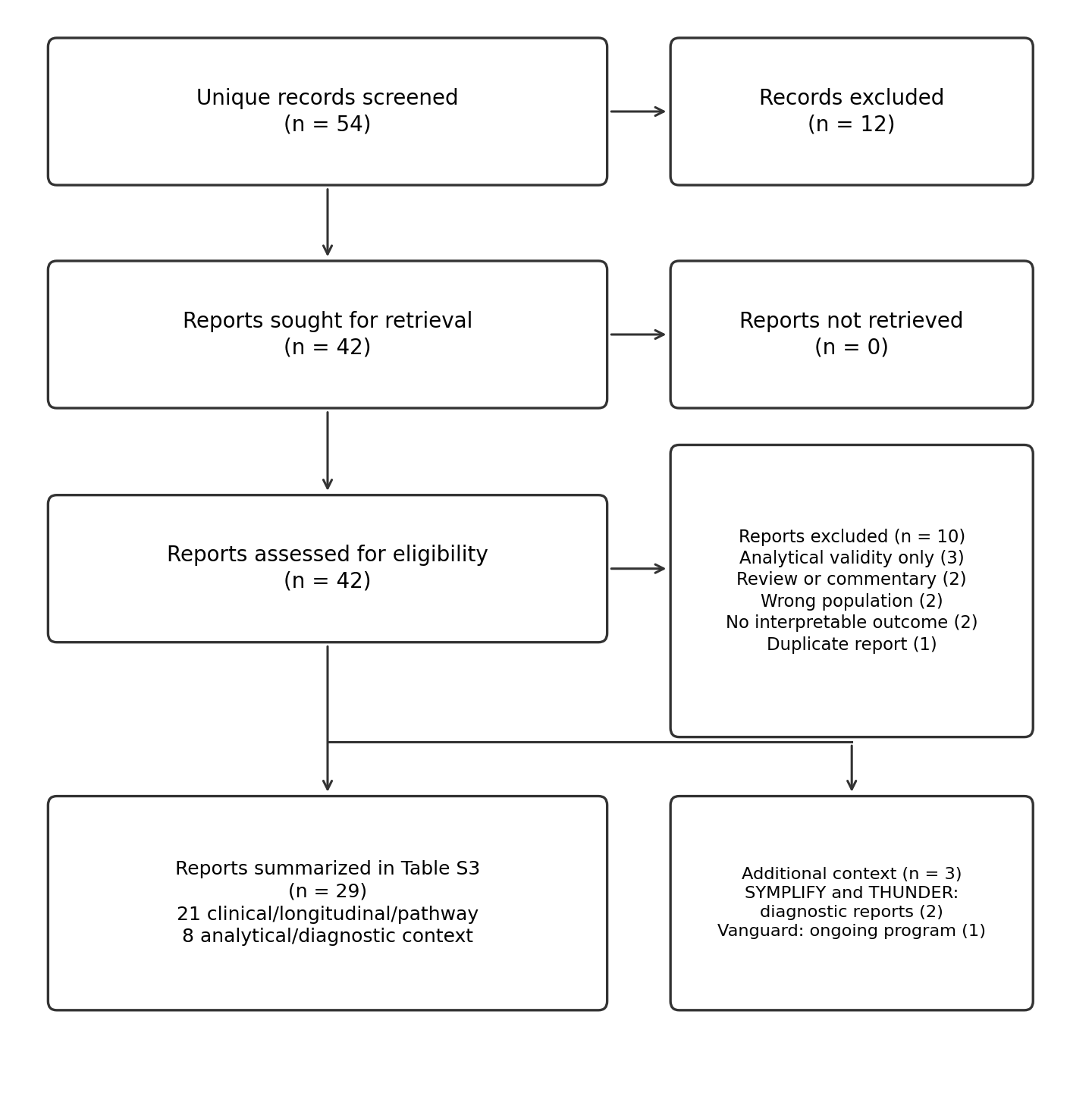
The selection flow comprised 54 unique records, 12 screening exclusions, 42 retrieved reports and 10 full-text exclusions, leaving 32 retained items. Table S3 summarizes 29 reports: 21 clinical, longitudinal or pathway reports and eight analytical or diagnostic context reports. Two further diagnostic reports, SYMPLIFY (30) and THUNDER (32), are discussed in the main text and appraisal tables, and Vanguard is an ongoing program (31). The 32 retained items therefore do not correspond to 32 independent completed studies, since several publications share cohorts.
Figure 1. Study selection flow: 29 tabulated reports, two additional diagnostic context reports
and one ongoing program.
The evidence comprises MRD intervention trials, longitudinal prognostic studies, MCED pathways, and a separate analytical/diagnostic context group. Table 1 summarizes selected reports; Table S3 lists study-level summaries. Linked follow-up reports are interpreted together, and participant counts must not be summed across overlapping cohorts.
The most clinically actionable evidence came from DYNAMIC in stage II colon cancer and IMvigor011 in ctDNA-positive muscle-invasive bladder cancer (14–15, 27). DYNAMIC demonstrated reduced chemotherapy exposure without an apparent loss of recurrence-free survival, whereas IMvigor011 demonstrated improved disease-free and overall survival with biomarker-selected adjuvant atezolizumab. DYNAMIC-III and the feasibility-stage OPTIMISE study illustrate why a ctDNA result does not automatically establish benefit from escalation or treatment at molecular recurrence (26, 28).
Table 1. Selected study characteristics and supporting diagnostic context
| Study | Population/sample | Design and assay | Endpoint | Interpretation |
|---|---|---|---|---|
| Garcia-Murillas 2015 (1) | Early breast cancer; n=55 | Prospective tumor-informed cohort | Molecular relapse | ctDNA anticipated clinical relapse and established prognostic validity. |
| TRACERx 2017/2023 (2, 13) | Early NSCLC; prospective cohort | Tumor-informed phylogenetic ctDNA | Relapse and dissemination | Strong biological and prognostic evidence; treatment actionability not tested. |
| Reinert 2019 (5) | Stage I-III CRC; n=130 | Prospective ultradeep sequencing | Postsurgical recurrence | Postoperative ctDNA strongly stratified recurrence risk. |
| Christensen 2019 (6) | Bladder cancer; n=68 | Longitudinal tumor-informed cfDNA | Metastatic relapse | Molecular relapse preceded clinical progression in many patients. |
| Coombes 2019 (7) | Early breast cancer; n=49 | Personalized serial ctDNA | Metastatic recurrence | ctDNA frequently preceded metastatic recurrence. |
| IMvigor010 biomarker analysis 2021 (18) | Resected MIBC; randomized-trial biospecimens | Exploratory ctDNA subgroup analysis | Adjuvant atezolizumab interaction | Hypothesis-generating predictive signal; prospective confirmation required. |
| Loupakis 2021 (19) | CRC after metastasectomy; n=112 | Personalized ctDNA cohort | MRD and recurrence | Post-resection ctDNA associated with high recurrence risk. |
| Magbanua 2021 (20) | Neoadjuvant-treated breast cancer; n=84 | Prospective serial ctDNA | Response and survival | ctDNA dynamics reflected response and prognosis. |
| DYNAMIC 2022/2025 (14–15) | Stage II colon cancer; n=455 | Randomized ctDNA-guided strategy | Chemotherapy use and RFS | Reduced chemotherapy exposure with comparable 2- and 5-year RFS. |
| GALAXY/CIRCULATE-Japan 2023/2024 (21, 29) | Resectable CRC; n=1,039 and 2,240 (overlapping cohorts) | Prospective observational platform | MRD, DFS, OS, ACT interaction | Strong prognostic evidence; treatment interaction remains observational. |
| c-TRAK TN 2023 (25) | Early TNBC; 208 registered, 161 under surveillance | Prospective ctDNA surveillance with intervention | ctDNA-triggered pembrolizumab | Illustrated limitations of late molecular detection and weak intervention uptake. |
| DYNAMIC-III 2025 (26) | Stage III colon cancer; n=968 evaluable | Randomized strategy trial | Risk-adjusted adjuvant therapy | De-escalation non-inferiority and escalation benefit were not established. |
| IMvigor011 2025 (27) | ctDNA-positive MIBC; n=250 randomized | Phase III double-blind RCT | DFS and OS | Atezolizumab improved DFS and OS versus placebo. |
| OPTIMISE 2023 (28) | Metastatic CRC after radical-intent treatment; n=32 | Open-label randomized feasibility study | Feasibility of ctDNA-guided adjuvant treatment | 32 enrolled; 14 standard-care and 16 ctDNA-guided participants reported; 19% ctDNA-positive in the guided arm |
| Martin-Arana 2025 (22) | Localized stage II-III colon cancer | Tumor-agnostic plasma WES | MRD sensitivity and relapse biology | Promising detection method; external clinical validation required. |
| DETECT-A 2020 (11) | Asymptomatic women; n=10,006 | Prospective blood test plus PET-CT pathway | Feasibility and diagnostic resolution | Feasible pathway without mortality endpoint. |
| PATHFINDER 2023/2025 (23–24) | Screening-eligible adults; n=6,662 | Prospective MCED return-of-results cohort | Diagnostic resolution and psychosocial outcomes | Feasible pathway; false-positive work-up and anxiety remain relevant. |
| CCGA validation 2020/2021 (9, 16) | Multiple cancers and controls | Targeted methylation classifier validation | Sensitivity, specificity, tissue of origin | Diagnostic validation, not population outcomes evidence. |
MCED evidence spans distinct settings. DETECT-A and PATHFINDER evaluated prospective diagnostic pathways in screening populations (11, 23), with additional psychosocial follow-up in PATHFINDER (24). CCGA and other classifier studies assessed diagnostic performance (9, 16, 17). SYMPLIFY enrolled symptomatic patients (30), while THUNDER provided development and validation data (32). These populations and designs should not be pooled as evidence of screening benefit.
Table 2. Key numerical results and clinical conclusions
| Study/program | Sample size | Primary endpoint | Main numerical result | Clinical conclusion |
|---|---|---|---|---|
| DYNAMIC (14–15) | 455 randomized | Chemotherapy use; RFS | Chemotherapy 15% vs 28%; 2-y RFS 93.5% vs 92.4%; 5-y RFS 88% vs 87% | Supports de-escalation in stage II colon cancer. |
| DYNAMIC-III (26) | 968 evaluable | 3-y RFS in ctDNA-negative; 2-y RFS in ctDNA-positive | De-escalation: 3-y RFS 85.3% vs 88.1%, non-inferiority not met; escalation: no benefit | Not a basis for universal escalation/de-escalation. |
| GALAXY (21, 29) | 1,039 initial; 2,240 updated | DFS/OS and ACT interaction | Postoperative ctDNA strongly associated with recurrence; treatment interaction observational | High prognostic value; causal treatment inference limited. |
| c-TRAK TN (25) | 208 registered; 161 monitored | ctDNA detection and pembrolizumab response | 44/161 (27.3%) positive by 12 mo; metastases in 23/32 assigned intervention; 0/5 treated achieved sustained clearance | Cautionary actionability evidence. |
| IMvigor011 (27) | 761 monitored; 250 randomized | DFS and OS | DFS 9.9 vs 4.8 mo, HR 0.64 (0.47-0.87); OS 32.8 vs 21.1 mo, HR 0.59 (0.39-0.90) | Direct evidence of MRD-guided treatment benefit. |
| OPTIMISE (28) | 32 enrolled | Feasibility of a ctDNA-guided workflow | 14 standard care; 16 ctDNA-guided; 19% positive in the guided arm | Feasibility evidence; not powered for efficacy |
| DETECT-A (11) | 10,006 | Cancer detection pathway | Prospective blood test plus PET-CT pathway; mortality not assessed | Feasibility only. |
| PATHFINDER (23) | 6,662 | Diagnostic resolution | Median resolution 79 d; true-positive 57 d; false-positive 162 d | Feasibility with substantial downstream testing. |
| THUNDER (32) | Prospective/validation cohorts | cfDNA methylation sequencing assay | Diagnostic performance and tissue-of-origin classification | Analytical/diagnostic context; not a mortality study. |
| SYMPLIFY (30) | Symptomatic adults; 5,461 evaluable | Prospective observational diagnostic cohort | Cancer-origin accuracy 85.2% among true-positive cases; diagnostic pathway outcomes | Supports diagnostic feasibility; not a population mortality trial. |
| Vanguard (31) | Active feasibility trial | Recruitment and diagnostic logistics | No effectiveness result available | Designed to inform a future definitive RCT. |
In DYNAMIC, 455 patients with stage II colon cancer were randomized. Chemotherapy was administered to 15% of the ctDNA-guided group and 28% of the standard-management group. Two-year recurrence-free survival was 93.5% versus 92.4%, and at a median follow-up of 59.7 months five-year recurrence-free survival was 88% versus 87% (14–15). The clinical contribution of the strategy was therefore reduced treatment exposure without an apparent survival penalty, rather than improved survival.
In IMvigor011, 761 patients entered serial ctDNA surveillance and 250 ctDNA-positive patients were randomized to atezolizumab or placebo. Median disease-free survival was 9.9 versus 4.8 months (hazard ratio 0.64, 95% confidence interval 0.47-0.87), and median overall survival was 32.8 versus 21.1 months (hazard ratio 0.59, 95% confidence interval 0.39-0.90) (27). This provides direct evidence that an MRD result can select a population in which a defined intervention improves outcomes.
DYNAMIC-III included 968 evaluable patients with stage III colon cancer. De-escalation did not establish non-inferiority (3-year RFS 85.3% versus 88.1%), and escalation did not improve outcomes in ctDNA-positive patients (26). In the feasibility-stage OPTIMISE study, 32 patients were enrolled; 14 were assigned to standard care and 16 to ctDNA-guided treatment, with ctDNA detected in 19% of baseline samples in the guided arm. OPTIMISE supports feasibility of a prespecified workflow but was not powered to establish clinical benefit (28).
Postoperative or serial ctDNA was associated with recurrence risk in colorectal cancer (5, 19, 21, 29), early-stage lung cancer (2, 13), and breast cancer (1, 7). Bladder-cancer studies also examined relapse and exploratory treatment interactions (6, 18). Neoadjuvant response monitoring (20) and tumor-agnostic MRD analysis (22) address related but distinct questions. Associations vary with assay, sampling, tumor shedding, treatment and endpoint.
Prognostic discrimination is not equivalent to clinical benefit. In c-TRAK TN, 208 patients registered and 161 entered ctDNA surveillance; 44/161 (27.3%) had ctDNA detected by 12 months. Of 32 assigned to intervention, 23 already had metastases on staging; none of the five starting pembrolizumab achieved sustained ctDNA clearance (25). A negative test cannot exclude all recurrences, particularly in low-shedding tumors.
DETECT-A enrolled 10,006 women and demonstrated that a multi-analyte blood test followed by PET-CT could be incorporated into a prospective diagnostic pathway (11). PATHFINDER enrolled 6,662 participants; among participants with a cancer signal detected result, median time to diagnostic resolution was 79 days, and false-positive participants underwent substantial laboratory and imaging evaluation (23). These studies established feasibility but were not designed to demonstrate mortality reduction.
SYMPLIFY enrolled symptomatic patients referred for cancer investigation, not an asymptomatic screening population. Among 5,461 evaluable participants, 368 were diagnosed with cancer; cancer-origin prediction was correct in 85.2% of true-positive cases (30). This supports diagnostic evaluation in the studied setting. Vanguard was described as a feasibility program intended to inform a future definitive screening trial (31).
Clinical applicability requires a complete chain from molecular detection to a valid decision, an effective intervention, and improved patient-important outcomes. DYNAMIC and IMvigor011 satisfy this chain in defined settings (14–15, 27). DYNAMIC-III, c-TRAK TN, and OPTIMISE show why the result cannot be generalized across tumors or interventions (25–26, 28).
For MCED, current evidence supports pathway feasibility and high specificity in selected cohorts but not mortality reduction. Implementation decisions must consider false-positive investigations, overdiagnosis, costs, diagnostic capacity, and equity of access.
Randomized comparisons require outcome-level appraisal of allocation, deviations, missing data, measurement and selective reporting (35). Exploratory subgroup and observational findings additionally require careful consideration of selection and confounding (36, 37). Tables 3 and S4 identify relevant considerations, but complete tool-specific records are needed before formal ratings can be assigned.
Non-randomized evidence raises concerns about confounding, selection, assay timing, spectrum effects, and incomplete verification of negative tests (36–38). Lack of a randomized comparator limits causal utility claims but is not itself a flaw in a descriptive feasibility study. Tables 3 and S4 retain descriptive considerations and applicability notes; tool-specific ratings are not established.
Table 3. Descriptive appraisal considerations by study
| Study/evidence group | Design / relevant framework | Assessment status | Descriptive consideration |
|---|---|---|---|
| DYNAMIC (14) | RCT; RoB 2 | Descriptive appraisal | Open-label strategy but objective outcomes and prespecified analysis. |
| DYNAMIC 5-y follow-up (15) | Extended RCT follow-up; RoB 2 | Descriptive appraisal | Primary follow-up and exploratory ctDNA-clearance analyses require separate appraisal. |
| DYNAMIC-III (26) | Randomized strategy trial; RoB 2 | Descriptive appraisal | Primary strategy estimates and subgroup findings require separate outcome-level appraisal. |
| OPTIMISE (28) | Open-label randomized feasibility study; RoB 2 | Descriptive appraisal | Small feasibility sample; not powered for a clinical outcome. |
| IMvigor011 (27) | Phase III RCT; RoB 2 | Descriptive appraisal | Double-blind design and objective primary endpoint. |
| GALAXY (21, 29) | Prospective observational; QUIPS/ROBINS-I | Descriptive appraisal | Confounding in estimates of ACT benefit. |
| IMvigor010 ctDNA analysis (18) | Exploratory biomarker analysis; ROBINS-I | Descriptive appraisal | Post hoc subgroup and treatment interaction. |
| c-TRAK TN (25) | Prospective intervention cohort; ROBINS-I | Descriptive appraisal | Small treated subgroup and overt disease at ctDNA detection. |
| TRACERx (2, 13) | Prospective prognostic cohort; QUIPS | Descriptive appraisal | Selection and assay-timing limitations; no intervention test. |
| Breast MRD cohorts (1, 7, 20) | Prognostic cohorts; QUIPS | Descriptive appraisal | Small samples and heterogeneous timing. |
| DETECT-A (11) | Diagnostic pathway; QUADAS-2 | Descriptive appraisal | Verification and pathway effects; no randomized outcome endpoint. |
| PATHFINDER (23–24) | Diagnostic pathway; QUADAS-2 | Descriptive appraisal | No randomized control and incomplete long-term verification of negatives. |
| THUNDER (32) | Validation cohort; QUADAS-2 | Descriptive appraisal | Analytical/diagnostic validation; no population-outcome endpoint. |
| SYMPLIFY (30) | Prospective observational diagnostic cohort; QUADAS-2 | Descriptive appraisal | Symptomatic diagnostic setting; applicability to asymptomatic screening is indirect. |
| CCGA/Klein (9, 16) | Classifier validation; QUADAS-2 | Descriptive appraisal | Spectrum and case-control applicability concerns. |
| Kim 2023 (17) | Classifier study; QUADAS-2 | Descriptive appraisal | External intended-use population validation required. |
DYNAMIC provides randomized evidence on chemotherapy exposure and recurrence-free survival; the single-trial setting and non-inferiority margin constrain interpretation (14–15). IMvigor011 provides randomized DFS and OS estimates for a biomarker-selected population (27). Its result applies to the studied disease, assay and treatment combination. Formal outcome-level certainty has not been established.
For other MRD settings, the evidence remains heterogeneous. Colorectal cohorts show strong prognostic associations (21, 29), but intervention studies have not consistently demonstrated benefit from acting on a positive result (25, 26). OPTIMISE primarily assessed feasibility (28). Prognostic discrimination should therefore not be equated with proven treatment utility.
DETECT-A and PATHFINDER support the feasibility of screening pathways (11, 23); the companion PATHFINDER report addresses psychosocial outcomes (24). SYMPLIFY provides symptomatic diagnostic evidence (30), and THUNDER provides classifier validation (32). None of these reports establishes a mortality benefit from population screening. Tables 4 and S5 separate observed findings from benefits that remain unproven.
Table 4. Descriptive evidence profile and clinical interpretation
| Finding | Evidence base | Certainty (narrative) | Interpretive limitations | Conclusion |
|---|---|---|---|---|
| ctDNA-guided de-escalation in stage II colon cancer (14–15) | RCT plus 5-y follow-up | Narrative | No serious inconsistency; some indirectness and imprecision from single strategy trial and non-inferiority margin | Reduced chemotherapy with non-inferior 2-y RFS and similar 5-y outcomes. |
| ctDNA-guided atezolizumab in ctDNA-positive MIBC (27) | Phase III RCT | Narrative | Randomized DFS and OS estimates; applicability limited to the studied disease, assay and treatment. | Improved DFS and OS. |
| ctDNA-guided strategy in stage III colon cancer (26) | Randomized strategy trial | Narrative | Complex intervention, phase 2 escalation component, imprecision | Prognostic value high; strategy benefit not established. |
| Treatment at molecular recurrence (25, 28) | Prospective intervention study plus randomized feasibility study | Narrative | Different interventions and small treated subgroups; assess each effect separately | Detection alone does not ensure benefit. |
| Post-treatment MRD prognosis across solid tumors (see Table S3) | Multiple prospective cohorts | Narrative | Consistent direction but heterogeneity and confounding | Strong prognostic value. |
| MCED diagnostic-pathway feasibility (11, 23, 30, 32) | Prospective pathway and diagnostic validation reports | Narrative | No mortality endpoint; indirectness for population screening benefit | Feasibility and high specificity supported. |
| MCED population mortality benefit (11, 23, 30, 32) | Prospective diagnostic cohorts and validation studies | Narrative | No randomized mortality outcome in the included evidence | Broad implementation remains premature. |
This review separates analytical validity, prognostic validity, and clinical utility. ctDNA is clinically actionable only when the test identifies a population for whom a defined management strategy produces net benefit. DYNAMIC and IMvigor011 are the clearest examples, but they support setting-specific decisions rather than universal ctDNA-guided oncology (14–15, 27).
MCED evidence has advanced from retrospective classifier validation to prospective diagnostic pathways, but the evidentiary standard for population screening is not satisfied by specificity, positive predictive value, or stage distribution alone. Mature outcome follow-up, transparent assessment of harms, and replication independent of test manufacturers remain necessary.
The practical implication is that ctDNA and cfDNA tests provide clinical information rather than treatment. Their value depends on timing, assay sensitivity, tumor biology, availability of effective interventions, and the capacity of the health system to resolve positive findings without disproportionate harm.
Limitations include reliance on aggregate data, heterogeneous assays and outcomes, and the absence of prospective registration. The search was harmonized to a final date of 31 January 2026; per-source export files and screening sheets are not published, so the search cannot be reproduced record by record. Exclusions are reported by category rather than by citation, and the selection of context studies reflects editorial judgement. Appraisal is descriptive, without completed tool-specific forms or GRADE ratings. Overlapping cohorts and the limited volume of interventional evidence further constrain generalization.
ctDNA has demonstrated clinical utility in selected solid-tumor MRD settings. The strongest evidence supports reduced chemotherapy exposure in stage II colon cancer without an apparent loss of recurrence-free survival and improved disease-free and overall survival with atezolizumab in ctDNA-positive muscle-invasive bladder cancer (14–15, 27). In most other settings, ctDNA remains a powerful prognostic biomarker whose optimal treatment response has not been established.
MCED should not be described as an established population screening method. DETECT-A, PATHFINDER, SYMPLIFY, and THUNDER support feasibility and selected diagnostic performance, but mortality benefit and net population benefit remain unknown. Future implementation requires randomized evidence of benefit, harms, and workable diagnostic pathways.
Author contributions: Anel Ibrayeva: Conceptualization, Methodology, Investigation, Literature search, Data curation, Formal analysis, and Writing – original draft. Batyrbek Assembekov: Methodology, Investigation, Screening, Data extraction, Validation, and Writing – review and editing. Yulia Reshetnyak: Investigation, Data curation, Validation, Visualization, and Writing – review and editing. All authors have read and approved the final manuscript and agree to be accountable for all aspects of the work.
Funding: The authors received no financial support for the research, authorship or publication of this article.
Conflicts of interest: The authors declare that they have no competing financial or personal interests.
Acknowledgments: The authors are grateful to the research teams whose primary reports are summarized here, and to the PRISMA 2020 working group, whose guidance informed the reporting of the search and selection process.
Data availability statement: All data supporting this review are contained in the manuscript and in Tables S1–S7, which provide the search terms, exclusion categories, study-level summaries, descriptive appraisals and the reporting checklist. Record-level search exports, the citation-level exclusion log and completed appraisal forms are not deposited. Table S7 is provided as a reusable extraction template.
AI use statement: ChatGPT (OpenAI) supported English-language editing, consistency review, citation distribution and document layout. It did not reconstruct missing study records, run a new systematic search or grade the evidence. Scientific content and final verification remain the responsibility of the authors.
Garcia-Murillas I, Schiavon G, Weigelt B, et al. Mutation tracking in circulating tumor DNA predicts relapse in early breast cancer. Sci Transl Med. 2015;7(302):302ra133. doi:10.1126/scitranslmed.aab0021.
Abbosh C, Birkbak NJ, Wilson GA, et al. Phylogenetic ctDNA analysis depicts early-stage lung cancer evolution. Nature. 2017;545:446–451. doi:10.1038/nature22364.
Phallen J, Sausen M, Adleff V, et al. Direct detection of early-stage cancers using circulating tumor DNA. Sci Transl Med. 2017;9(403):eaan2415. doi:10.1126/scitranslmed.aan2415.
Cohen JD, Li L, Wang Y, et al. Detection and localization of surgically resectable cancers with a multi-analyte blood test. Science. 2018;359(6378):926–930. doi:10.1126/science.aar3247.
Reinert T, Henriksen TV, Christensen E, et al. Analysis of plasma cell-free DNA by ultradeep sequencing in patients with stages I to III colorectal cancer. JAMA Oncol. 2019;5(8):1124–1131. doi:10.1001/jamaoncol.2019.0528.
Christensen E, Birkenkamp-Demtroder K, Sethi H, et al. Early detection of metastatic relapse and monitoring of therapeutic efficacy by ultra-deep sequencing of plasma cell-free DNA in bladder cancer. J Clin Oncol. 2019;37(18):1547–1557. doi:10.1200/JCO.18.02052.
Coombes RC, Page K, Salari R, et al. Personalized detection of circulating tumor DNA antedates breast cancer metastatic recurrence. Clin Cancer Res. 2019;25(14):4255–4263. doi:10.1158/1078-0432.CCR-18-3663.
Cristiano S, Leal A, Phallen J, et al. Genome-wide cell-free DNA fragmentation in patients with cancer. Nature. 2019;570(7761):385–389. doi:10.1038/s41586-019-1272-6.
Liu MC, Oxnard GR, Klein EA, Swanton C, Seiden MV, CCGA Consortium. Sensitive and specific multi-cancer detection and localization using methylation signatures in cell-free DNA. Ann Oncol. 2020;31(6):745–759. doi:10.1016/j.annonc.2020.02.011.
Zviran A, Schulman RC, Shah M, et al. Genome-wide cell-free DNA mutational integration enables ultra-sensitive cancer monitoring. Nat Med. 2020;26(7):1114–1124. doi:10.1038/s41591-020-0915-3.
Lennon AM, Buchanan AH, Kinde I, et al. Feasibility of blood testing combined with PET-CT to screen for cancer and guide intervention. Science. 2020;369(6499):eabb9601. doi:10.1126/science.abb9601.
Chen X, Gole J, Gore A, et al. Non-invasive early detection of cancer four years before conventional diagnosis using a blood test. Nat Commun. 2020;11:3475. doi:10.1038/s41467-020-17316-z.
Abbosh C, Frankell AM, Harrison T, et al. Tracking early lung cancer metastatic dissemination in TRACERx using ctDNA. Nature. 2023;616:553–562. doi:10.1038/s41586-023-05776-4.
Tie J, Cohen JD, Lahouel K, et al. Circulating tumor DNA analysis guiding adjuvant therapy in stage II colon cancer. N Engl J Med. 2022;386(24):2261–2272. doi:10.1056/NEJMoa2200075.
Tie J, Wang Y, Lo SN, et al. Circulating tumor DNA analysis guiding adjuvant therapy in stage II colon cancer. Five-year outcomes of the randomized DYNAMIC trial. Nat Med. 2025;31:1509–1518. doi:10.1038/s41591-025-03579-w.
Klein EA, Richards D, Cohn A, et al. Clinical validation of a targeted methylation-based multi-cancer early detection test using an independent validation set. Ann Oncol. 2021;32(9):1167–1177. doi:10.1016/j.annonc.2021.05.806.
Kim SY, Jeong S, Lee W, et al. Cancer signature ensemble integrating cfDNA methylation, copy number, and fragmentation facilitates multi-cancer early detection. Exp Mol Med. 2023;55:2445–2460. doi:10.1038/s12276-023-01119-5.
Powles T, Assaf ZJ, Davarpanah N, et al. ctDNA guiding adjuvant immunotherapy in urothelial carcinoma. Nature. 2021;595(7867):432–437. doi:10.1038/s41586-021-03642-9.
Loupakis F, Sharma S, Derouazi M, et al. Detection of molecular residual disease using a personalized circulating tumor DNA assay in colorectal cancer patients undergoing resection of metastases. JCO Precis Oncol. 2021;5:1166–1177. doi:10.1200/PO.21.00101.
Magbanua MJM, Swigart LB, Wu HT, et al. Circulating tumor DNA in neoadjuvant-treated breast cancer reflects response and survival. Ann Oncol. 2021;32(2):229–239. doi:10.1016/j.annonc.2020.11.007.
Kotani D, Oki E, Nakamura Y, et al. Molecular residual disease and efficacy of adjuvant chemotherapy in patients with colorectal cancer. Nat Med. 2023;29:127–134. doi:10.1038/s41591-022-02115-4.
Martin-Arana J, Gimeno-Valiente F, Henriksen TV, et al. Whole-exome tumor-agnostic ctDNA analysis enhances minimal residual disease detection and reveals relapse mechanisms in localized colon cancer. Nat Cancer. 2025;6:1000–1016. doi:10.1038/s43018-025-00960-z.
Schrag D, Beer TM, McDonnell CH, et al. Blood-based tests for multicancer early detection. PATHFINDER, a prospective cohort study. Lancet. 2023;402:1251–1260. doi:10.1016/S0140-6736(23)01700-2.
Nadauld L, McDonnell CH, et al. Psychosocial impact associated with a multicancer early detection test in PATHFINDER. A prospective multicentre cohort study. Lancet Oncol. 2025;26(2). doi:10.1016/S1470-2045(24)00645-4.
Turner NC, Swift C, Jenkins B, et al. Results of the c-TRAK TN trial. A clinical trial using ctDNA mutation tracking to detect molecular residual disease and trigger intervention in patients with moderate-risk and high-risk early-stage triple-negative breast cancer. Ann Oncol. 2023;34(2):200–211. doi:10.1016/j.annonc.2022.11.005.
Tie J, et al. Circulating tumor DNA-guided adjuvant therapy in locally advanced colon cancer. The randomized phase 2 and 3 DYNAMIC-III trial. Nat Med. 2025;31(12):4291–4300. doi:10.1038/s41591-025-04030-w.
Powles T, et al. ctDNA-guided adjuvant atezolizumab in muscle-invasive bladder cancer. N Engl J Med. 2025;393(24):2395–2408. doi:10.1056/NEJMoa2511885.
Callesen LB, Hansen TF, Andersen RF, et al. ctDNA-guided adjuvant treatment after radical-intent treatment of metastatic spread from colorectal cancer—the first interim results from the OPTIMISE study. Acta Oncol. 2023;62(12):1742-1748. doi:10.1080/0284186X.2023.2259083.
Nakamura Y, et al. ctDNA-based molecular residual disease and survival in resectable colorectal cancer. Nat Med. 2024;30:3272–3283. doi:10.1038/s41591-024-03254-6.
Nicholson BD, Oke J, Virdee PS, et al. Multi-cancer early detection test in symptomatic patients referred for cancer investigation in England and Wales (SYMPLIFY): a large-scale, observational cohort study. Lancet Oncol. 2023;24(7):733-743. doi:10.1016/S1470-2045(23)00277-2.
National Cancer Institute. The Vanguard Study: testing a new way to screen for cancer. Cancer Screening Research Network multi-cancer detection feasibility study. ClinicalTrials.gov identifier NCT06995898.
Gao Q, Lin YP, Li BS, et al. Unintrusive multi-cancer detection by circulating cell-free DNA methylation sequencing (THUNDER): development and independent validation studies. Ann Oncol. 2023;34(5):486-495. doi:10.1016/j.annonc.2023.02.010.
Page MJ, McKenzie JE, Bossuyt PM, et al. The PRISMA 2020 statement. An updated guideline for reporting systematic reviews. BMJ. 2021;372:n71. doi:10.1136/bmj.n71.
Rethlefsen ML, Kirtley S, Waffenschmidt S, et al. PRISMA-S. An extension to the PRISMA Statement for Reporting Literature Searches in Systematic Reviews. Syst Rev. 2021;10:39. doi:10.1186/s13643-020-01542-z.
Higgins JPT, Savovic J, Page MJ, Elbers RG, Sterne JAC. Revised Cochrane risk-of-bias tool for randomized trials, RoB 2. Version 2.0. Cochrane. 2019.
Hayden JA, van der Windt DA, Cartwright JL, Cote P, Bombardier C. Assessing bias in studies of prognostic factors. Ann Intern Med. 2013;158(4):280–286. doi:10.7326/0003-4819-158-4-201302190-00009.
Sterne JAC, Hernan MA, Reeves BC, Savovic J, Berkman ND, Viswanathan M, et al. ROBINS-I. A tool for assessing risk of bias in non-randomized studies of interventions. BMJ. 2016;355:i4919. doi:10.1136/bmj.i4919.
Whiting PF, Rutjes AWS, Westwood ME, Mallett S, Deeks JJ, Reitsma JB, et al. QUADAS-2. A revised tool for the quality assessment of diagnostic accuracy studies. Ann Intern Med. 2011;155(8):529–536. doi:10.7326/0003-4819-155-8-201110180-00009.
Guyatt GH, Oxman AD, Vist GE, Kunz R, Falck-Ytter Y, Alonso-Coello P, et al. GRADE. An emerging consensus on rating quality of evidence and strength of recommendations. BMJ. 2008;336(7650):924–926. doi:10.1136/bmj.39489.470347.AD.
Table S1. Search terms and sources
| Source/platform | Search-date status | Coverage and limits | Reported terms / syntax |
|---|---|---|---|
| MEDLINE via PubMed | 31 January 2026 | Inception to search date; humans; English at screening | (("circulating tumor DNA"[tiab] OR "circulating tumour DNA"[tiab] OR ctDNA[tiab] OR "cell-free DNA"[tiab] OR cfDNA[tiab] OR "liquid biopsy"[tiab]) AND ("molecular residual disease"[tiab] OR "minimal residual disease"[tiab] OR recurrence[tiab] OR relapse[tiab] OR surveillance[tiab] OR "multi-cancer early detection"[tiab] OR multicancer[tiab]) AND (cancer*[tiab] OR tumor*[tiab] OR tumour*[tiab] OR neoplasm*[tiab])) NOT (leukemia[tiab] OR lymphoma[tiab] OR myeloma[tiab]) |
| Embase via Elsevier | 31 January 2026 | Inception to search date; humans; English at screening | ('circulating tumor DNA'/exp OR 'cell free DNA'/exp OR 'liquid biopsy'/exp OR ctdna:ti,ab,kw OR cfdna:ti,ab,kw) AND ('molecular residual disease':ti,ab,kw OR 'minimal residual disease'/exp OR recurrence:ti,ab,kw OR relapse:ti,ab,kw OR surveillance:ti,ab,kw OR 'multi-cancer early detection':ti,ab,kw OR multicancer:ti,ab,kw) AND 'neoplasm'/exp NOT ('leukemia'/exp OR 'lymphoma'/exp OR 'multiple myeloma'/exp) |
| Scopus | 31 January 2026 | Inception to search date; article or conference paper; English | TITLE-ABS-KEY((ctdna OR "circulating tumor DNA" OR "circulating tumour DNA" OR cfdna OR "cell-free DNA" OR "liquid biopsy") AND ("molecular residual disease" OR "minimal residual disease" OR recurrence OR relapse OR surveillance OR "multi-cancer early detection" OR multicancer) AND (cancer OR tumor OR tumour OR neoplasm)) AND NOT TITLE-ABS-KEY(leukemia OR lymphoma OR myeloma) |
| Web of Science Core Collection | 31 January 2026 | Inception to search date; English | TS=((ctDNA OR "circulating tumor DNA" OR "circulating tumour DNA" OR cfDNA OR "cell-free DNA" OR "liquid biopsy") AND ("molecular residual disease" OR "minimal residual disease" OR recurrence OR relapse OR surveillance OR "multi-cancer early detection" OR multicancer) AND (cancer OR tumor OR tumour OR neoplasm)) NOT TS=(leukemia OR lymphoma OR myeloma) |
| Cochrane CENTRAL | 31 January 2026 | Inception to search date | (ctDNA OR "circulating tumor DNA" OR cfDNA OR "cell-free DNA" OR "liquid biopsy") AND ("molecular residual disease" OR "minimal residual disease" OR recurrence OR relapse OR "multi-cancer early detection" OR multicancer) AND (cancer OR tumor OR neoplasm) |
| ClinicalTrials.gov | 31 January 2026 | All study types and statuses | ("circulating tumor DNA" OR ctDNA OR "cell-free DNA" OR cfDNA OR "liquid biopsy") AND ("molecular residual disease" OR "minimal residual disease" OR recurrence OR relapse OR "multi-cancer early detection" OR multicancer) |
| WHO ICTRP, ISRCTN, jRCT | 31 January 2026 | All statuses | Equivalent combinations of ctDNA/cfDNA/liquid biopsy with MRD/recurrence/MCED terms, adapted to each interface |
Note: 31 January 2026 is the final search date applied across sources. The strings below present the search logic at concept level and are not verbatim platform exports.
Table S2. Full-text exclusion categories
| Reason for exclusion | Number of reports |
|---|---|
| Analytical validity or classifier development without longitudinal clinical outcome | 3 |
| Review, commentary, or editorial without original eligible data | 2 |
| Wrong population, including hematologic malignancy or non-screening population | 2 |
| No clinically interpretable outcome or no diagnostic resolution | 2 |
| Duplicate or secondary report without unique extractable data | 1 |
Table S3. Study-level evidence summaries
| Report | Cancer/domain | Design | Sample | Assay | Endpoint | Main result | Evidence role |
|---|---|---|---|---|---|---|---|
| Garcia-Murillas 2015 (1) | Breast | Prospective cohort | 55 | Tumor-informed mutation tracking | Relapse prediction | ctDNA anticipated relapse | Prognostic |
| Abbosh 2017 (2) | NSCLC | Prospective translational cohort | 100 | Tumor-informed phylogenetic assay | Relapse dynamics | ctDNA tracked tumor evolution | Prognostic |
| Phallen 2017 (3) | Pan-cancer | Validation cohort | 200+ | Targeted ctDNA sequencing | Early detection | Technical feasibility | Analytical context |
| Cohen 2018 (4) | Eight cancers | Case-control validation | 1,005 | CancerSEEK multi-analyte | Detection/localization | Feasibility; no outcomes | Diagnostic context |
| Reinert 2019 (5) | CRC | Prospective cohort | 130 | Ultradeep tumor-informed sequencing | Postsurgical recurrence | Strong prognostic association | Prognostic |
| Christensen 2019 (6) | Bladder | Prospective cohort | 68 | Tumor-informed cfDNA | Metastatic relapse | Molecular lead time | Prognostic |
| Coombes 2019 (7) | Breast | Prospective cohort | 49 | Personalized ctDNA | Metastatic recurrence | ctDNA antedated recurrence | Prognostic |
| Cristiano 2019 (8) | Pan-cancer | Classifier validation | 236 cancers plus controls | Fragmentomics | Cancer detection | Technical validation | Analytical context |
| Liu/CCGA 2020 (9) | Pan-cancer | Validation study | 6,689 | Targeted methylation | Sensitivity/specificity/CSO | High specificity; stage-dependent sensitivity | Diagnostic context |
| Zviran 2020 (10) | Pan-cancer | Method validation | multiple cohorts | Genome-wide cfDNA integration | Ultrasensitive monitoring | Technical performance | Analytical context |
| Lennon/DETECT-A 2020 (11) | MCED | Prospective interventional | 10,006 | Multi-analyte test plus PET-CT | Diagnostic pathway | Feasible; mortality not assessed | Pathway |
| Chen 2020 (12) | Pan-cancer | Nested case-control | 605 samples | Methylation blood test | Prediagnostic detection | Signal before diagnosis; design indirect | Analytical context |
| Powles/IMvigor010 2021 (18) | MIBC | Exploratory RCT biomarker analysis | 581 biomarker-evaluable | Tumor-informed ctDNA | Treatment interaction | Hypothesis-generating benefit in ctDNA-positive | Predictive exploratory |
| Loupakis 2021 (19) | Metastatic CRC resection | Prospective cohort | 112 | Personalized ctDNA | MRD and recurrence | Strong recurrence stratification | Prognostic |
| Magbanua 2021 (20) | Breast | Prospective cohort | 84 | Tumor-informed ctDNA | Response/survival | ctDNA dynamics prognostic | Prognostic |
| Tie/DYNAMIC 2022 (14) | Stage II colon | Randomized strategy trial | 455 | Tumor-informed ctDNA | Chemotherapy use; RFS | 15% vs 28% chemotherapy; noninferior 2-y RFS | Actionable |
| Tie/DYNAMIC follow-up 2025 (15) | Stage II colon | Extended RCT follow-up | 455 | Tumor-informed ctDNA | 5-y RFS/OS | RFS 88% vs 87%; OS 93.8% vs 93.3% | Actionable |
| Kotani/GALAXY 2023 (21) | Resectable CRC | Prospective observational | 1,039 | Tumor-informed ctDNA | MRD; ACT interaction | Strong prognostic association | Prognostic/predictive exploratory |
| Klein 2021 (16) | Pan-cancer | Independent validation | 4,077 | Targeted methylation | Sensitivity/specificity/CSO | High specificity; no outcome benefit | Diagnostic context |
| Schrag/PATHFINDER 2023 (23) | MCED | Prospective pathway cohort | 6,662 | Targeted methylation MCED | Diagnostic resolution | Median 79 d | Pathway |
| Abbosh/TRACERx 2023 (13) | NSCLC | Prospective translational cohort | 421 | Tumor-informed ctDNA | Dissemination/relapse | Strong prognostic evidence | Prognostic |
| Kim 2023 (17) | Pan-cancer | Classifier study | multiple cohorts | Methylation/CNV/fragmentation | Detection/CSO | Improved classifier performance | Analytical context |
| Nakamura/GALAXY 2024 (29) | Resectable CRC | Prospective observational | 2,240; expanded overlapping cohort | Tumor-informed ctDNA | DFS/OS | MRD strongly associated with survival | Prognostic |
| Turner/c-TRAK TN 2023 (25) | TNBC | Prospective surveillance with intervention | 208 registered; 161 monitored | Tumor-informed ctDNA | Detection and pembrolizumab | 44/161 (27.3%) positive by 12 mo; 0/5 treated achieved sustained clearance | Actionability caution |
| Tie/DYNAMIC-III 2025 (26) | Stage III colon | Randomized strategy trial | 968 evaluable | Tumor-informed ctDNA | Risk-adjusted ACT | De-escalation non-inferiority and escalation benefit not established | Actionability uncertain |
| Powles/IMvigor011 2025 (27) | MIBC | Phase III RCT | 250 randomized | Tumor-informed ctDNA | DFS/OS | HR 0.64 and 0.59 | Actionable |
| Callesen/OPTIMISE 2023 (28) | Metastatic CRC after radical-intent treatment | Open-label randomized feasibility study | 32 enrolled; 14 standard care and 16 ctDNA-guided | Baseline ctDNA positive in 19% of guided arm | Feasibility | Not powered for efficacy | Workflow evidence |
| Martin-Arana 2025 (22) | Colon | Prospective diagnostic/prognostic | localized cohort | Tumor-agnostic plasma WES | MRD sensitivity | Promising; external validation needed | Prognostic/technical |
| Nadauld/PATHFINDER psychosocial analysis 2025 (24) | MCED | Prospective cohort analysis | PATHFINDER cohort | Participant-reported outcomes | Psychosocial impact | Transient anxiety effects | Harms |
Table S4. Descriptive appraisal and applicability considerations
| Study or evidence group | Relevant framework | Descriptive appraisal consideration |
|---|---|---|
| DYNAMIC (14) | RoB 2 | Setting-specific ctDNA-guided strategy |
| DYNAMIC 5-year follow-up (15) | RoB 2 | Setting-specific; exploratory ctDNA-clearance analyses |
| DYNAMIC-III (26) | RoB 2 | Complex escalation and de-escalation strategy |
| OPTIMISE (28) | RoB 2 | Small feasibility sample; not powered for clinical outcome. |
| IMvigor011 (27) | RoB 2 | Limited to biomarker-selected muscle-invasive bladder cancer and the evaluated assay-treatment combination |
| GALAXY/CIRCULATE-Japan (21, 29) | QUIPS and ROBINS-I | Observational estimates of adjuvant-treatment benefit |
| IMvigor010 ctDNA analysis (18) | ROBINS-I | Exploratory biomarker subgroup analysis not prospectively designed to establish treatment effectiveness |
| c-TRAK TN (25) | ROBINS-I | Small treated subgroup and frequent radiologically detectable disease at ctDNA detection |
| TRACERx (2, 13) | QUIPS | Research cohort with assay-timing and treatment-actionability limitations |
| Breast cancer MRD cohorts (1, 7, 20) | QUIPS | Small cohorts, heterogeneous sampling schedules and no randomized intervention test |
| DETECT-A (11) | QUADAS-2 | Restricted population and non-randomized diagnostic pathway without mortality assessment |
| PATHFINDER (23–24) | QUADAS-2 | No randomized comparator and incomplete long-term verification of participants with negative results |
| THUNDER (32) | QUADAS-2 | Diagnostic validation context; no population-outcome endpoint. |
| SYMPLIFY (30) | QUADAS-2 | Symptomatic diagnostic setting; applicability to asymptomatic screening is indirect. |
| CCGA/Klein validation studies (9, 16) | QUADAS-2 | Case-control and spectrum effects limit applicability to an intended-use screening population |
| Kim 2023 (17) | QUADAS-2 | Classifier-development evidence without adequate external validation in an intended-use screening population |
Note: Entries are descriptive appraisals rather than formal, tool-specific ratings. The framework column identifies the instrument appropriate to each design, and applicability notes concern external validity rather than internal bias.
Table S5. Descriptive evidence profile
| Outcome | Studies | Risk of bias | Inconsistency | Indirectness | Imprecision | Publication bias | Certainty (narrative) |
|---|---|---|---|---|---|---|---|
| Reduced ACT without RFS loss in stage II colon (14–15) | 1 RCT + follow-up | Descriptive appraisal | Single trial; no cross-study comparison | Setting-specific strategy | Non-inferiority margin affects interpretation | Not reliably assessable | Narrative |
| DFS/OS benefit in ctDNA-positive MIBC (27) | 1 phase III RCT | Descriptive appraisal | Not applicable | Not serious for studied setting | Not graded | Not reliably assessable | Narrative |
| Stage III colon ctDNA-guided strategy (26) | 1 randomized strategy trial | Descriptive appraisal | Not applicable | Not graded | Not graded | Not reliably assessable | Narrative |
| Treatment at molecular recurrence (25, 28) | 2 intervention studies | Descriptive appraisal | Different interventions; no pooled estimate | Not graded | Not graded | Possible | Narrative |
| Post-treatment MRD prognosis (see Table S3) | Multiple cohorts | Descriptive appraisal | Not serious directionally | Not graded | Variable | Possible | Narrative |
| MCED diagnostic feasibility (11, 23–24, 32) | Prospective pathways | Descriptive appraisal | Not graded | Feasibility does not establish mortality benefit | Not serious for performance | Cannot exclude; sponsorship is not proof of bias | Narrative |
| MCED population benefit (see Tables 1–2) | Prospective pathways and diagnostic validation | Descriptive appraisal | Diagnostic performance does not establish mortality or net population benefit | Indirect for asymptomatic population screening | No pooled estimate | Not reliably assessable | Narrative |
Table S6. PRISMA 2020 reporting checklist
| Item | Topic | Requirement addressed | Location in manuscript |
|---|---|---|---|
| 1 | Title | Identifies the report as a systematic review | Title page |
| 2 | Abstract | Structured summary with objectives, methods, results, and conclusions | Abstract |
| 3 | Rationale | Rationale in context of existing knowledge | Introduction |
| 4 | Objectives | Explicit review objective and domains | Introduction |
| 5 | Eligibility criteria | Inclusion/exclusion criteria and grouping for synthesis | Methods – Protocol and eligibility criteria |
| 6 | Information sources | Databases, registries, and update search with dates | Methods and search supplement: databases and registers searched through 31 January 2026 |
| 7 | Search strategy | Search terms reported by source | Table S1: search terms by source |
| 8 | Selection process | Independent screening and conflict resolution | Methods — Study selection: two reviewers, independent screening with third-reviewer adjudication |
| 9 | Data collection process | Independent extraction process | Methods — Data extraction: two reviewers, independent extraction |
| 10a | Data items - outcomes | Outcome definitions | Methods – Data extraction |
| 10b | Data items - other variables | Study and assay variables | Methods – Data extraction; Table S3 |
| 11 | Risk of bias | Frameworks described; descriptive appraisal in place of completed tool-specific forms | Methods — Appraisal: descriptive appraisal (Table S4) |
| 12 | Effect measures | HR, RR, proportions, medians, and CIs | Tables 2 and S3 |
| 13a | Synthesis eligibility | Separate MRD, prognosis, MCED, and harms groups | Methods – Data synthesis |
| 13b | Data preparation | Narrative harmonization and no imputation | Methods – Data extraction and synthesis |
| 13c | Presentation methods | Structured tables and narrative synthesis | Results; Tables 1-4 |
| 13d | Synthesis methods | Meta-analysis not performed because of heterogeneity | Methods – Data synthesis |
| 13e | Heterogeneity exploration | Clinical sources discussed narratively | Results; Discussion |
| 13f | Sensitivity analyses | Not performed; absence of meta-analysis does not preclude sensitivity analysis | Methods – Data synthesis: not performed |
| 14 | Reporting bias assessment | Considered qualitatively; no formal testing | Methods – Data synthesis; Table S5 |
| 15 | Certainty assessment | Certainty described narratively, without GRADE ratings | Methods — Evidence confidence: certainty described narratively |
| 16a | Study selection results | Flow counts and diagram | Results – Study selection; Figure 1 (reported counts) |
| 16b | Excluded studies | Exclusions reported by category | Table S2: exclusion categories |
| 17 | Study characteristics | Characteristics and study summaries | Table 1; Table S3 (summaries, not full extraction forms) |
| 18 | Risk of bias results | Provisional shared-domain appraisal | Appraisal tables show descriptive considerations or documentation gaps; no verified formal risk-of-bias ratings. |
| 19 | Individual study results | Sample sizes and numerical estimates | Results; Tables 2 and S3 |
| 20a | Synthesis results - contributing studies | Studies grouped by clinical domain | Results – MRD interventions, prognosis and MCED |
| 20b | Synthesis results - statistical synthesis | Not applicable; no meta-analysis | Methods – Data synthesis: no meta-analysis |
| 20c | Synthesis results - heterogeneity | Narrative explanation | Results; Discussion |
| 20d | Synthesis results - sensitivity | Not performed | Methods – Data synthesis: not performed |
| 21 | Reporting biases | Considered qualitatively; cannot reliably exclude | Methods – Data synthesis; Limitations |
| 22 | Certainty of evidence | Provisional outcome-level confidence | Evidence profile and Discussion; certainty described narratively |
| 23a | Discussion - interpretation | Interpretation in relation to evidence | Discussion |
| 23b | Discussion - evidence limitations | Risk of bias, indirectness, heterogeneity | Appraisal, confidence and Limitations |
| 23c | Discussion - review limitations | Review-process limitations | Limitations; Methods – Information sources |
| 23d | Discussion - implications | Practice and research implications | Discussion; Conclusions |
| 24a | Registration | Not prospectively registered | Methods – Protocol and eligibility criteria |
| 24b | Protocol | Protocol not publicly deposited | Methods – Protocol and eligibility criteria |
| 24c | Amendments | No registered amendment history | Methods — Information sources: final search date 31 January 2026 |
| 25 | Support | Funding declaration provided | Declarations – Funding |
| 26 | Competing interests | Conflict-of-interest declaration provided | Declarations – Conflict of interest |
| 27 | Availability of data/materials | Available summaries and supplementary tables identified | Data availability; Tables S1–S7 |
Table S7. Data extraction template
| Domain | Variables | Instructions |
|---|---|---|
| Identification | Author, year, journal, DOI, PMID, registry identifier | Record exactly as reported |
| Population | Cancer type, stage, setting, age, inclusion/exclusion criteria, sample size | Separate screened, enrolled, randomized, and analyzed populations |
| Study design | RCT, intervention cohort, prognostic cohort, diagnostic pathway, classifier validation | Specify prospective/retrospective and single-/multicenter |
| Assay | ctDNA/cfDNA target, tumor-informed vs tumor-agnostic, platform, threshold, blinding | Record version and timing of assay |
| Sampling | Postoperative window, serial schedule, preanalytical handling | Record time from treatment to blood draw |
| Clinical algorithm | Action after positive/negative test, comparator, confirmatory work-up | Required for actionability assessment |
| Outcomes | RFS, DFS, OS, recurrence, treatment exposure, toxicity, PPV, specificity, sensitivity, resolution, harms | Use study definitions and time horizons |
| Effect estimates | Events, proportions, HR/RR/OR, 95% CI, P value | Extract adjusted and unadjusted estimates separately |
| Risk of bias | Tool, domain judgments, support for judgment | RoB 2, QUIPS, ROBINS-I, or QUADAS-2 |
| Certainty and applicability | GRADE domains, clinical applicability, funding, conflicts | Separate prognostic validity from clinical utility |
Abbreviations: ACT, adjuvant chemotherapy; CI, confidence interval; CNV, copy-number variation; CRC, colorectal cancer; CSO, cancer signal origin; DFS, disease-free survival; HR, hazard ratio; MIBC, muscle-invasive bladder cancer; NSCLC, non-small cell lung cancer; OS, overall survival; PPV, positive predictive value; RCT, randomized controlled trial; RFS, recurrence-free survival; TNBC, triple-negative breast cancer; WES, whole-exome sequencing.
GMR GLOBAL MEDICAL REVIEWS Volume 1 • Issue 1 • 2026 |
OPEN ACCESS CC BY 4.0 |
|---|