Clinical decision-making rarely depends on a single data source. Physicians combine symptoms, examination findings, laboratory values, images, waveforms, prior documentation, medication history, guidelines, patient context and health-system constraints. Multimodal artificial intelligence (AI) is attractive because it attempts to approximate this information environment rather than forcing clinical reasoning into a single image, text or numeric input. The World Health Organization has highlighted the potential clinical uses of large multi-modal models, but also stresses the risks of inaccurate outputs, bias, privacy breaches, automation bias and weak governance (1).
The recent generation of vision-language models, multimodal large language models and tool-using AI agents has changed the type of clinical tasks that can be evaluated. Instead of classifying one image or answering one text question, these systems can combine photographs, radiographs, pathology slides, ultrasound videos, echocardiography videos, clinical notes, structured electronic health record variables, guidelines and retrieval tools. Published examples now include eye emergency triage (2), intensive care unit (ICU) prognosis (3), pathology assistance (4), radiology report generation (5), echocardiography interpretation (6), oncology decision preparation (7), lymphadenopathy diagnosis (8), simulated multimodal telehealth consultations (9), hematology tumor-board support (10) and dental imaging support (11).
The central problem is that technical performance does not automatically translate into clinical effectiveness. A high area under the curve, a high expert-preference score or strong tumor-board concordance may be useful, but it does not prove fewer deaths, fewer treatment failures, fewer missed diagnoses, better referral appropriateness, lower cost or improved equity. The gap between model capability and patient-important benefit is especially important in AI, because impressive demonstrations can be rapidly interpreted by institutions and vendors as implementation evidence before safety, workflow and subgroup performance have been adequately tested (12,13,14).
There is also a conceptual problem in the literature. Some of the strongest real-world clinical AI studies evaluate text-based large language model (LLM) clinical decision support embedded in electronic medical record workflows (15,16,17), referral coordination (18) or referral justification (19). These studies may be more clinically mature than many strict multimodal evaluations, but they do not necessarily meet a strict definition of multimodal AI. If such trials are mixed silently with image-text or multi-input systems, the review question becomes blurred and conclusions become vulnerable to overstatement.
For that reason, this review separates two evidence layers. The strict core synthesis includes AI systems that integrate at least two distinct data modalities, directly or through modality-specific tools, in a clinical decision task. The expanded contextual synthesis includes generative AI or LLM-enabled clinical decision-support systems (CDSS) that use patient-specific clinical information and report clinical, process, safety or workflow endpoints. This separation is not merely semantic. It determines how the evidence should be interpreted, which risk-of-bias tools are most relevant and whether conclusions apply to multimodal reasoning, generative workflow support or both.
The aim of this evidence map is to provide a clinically conservative synthesis of what has been shown, what remains indirect and what conditions are needed before routine deployment. The emphasis is not only on whether models perform well, but on whether they are evaluated in contexts that resemble real clinical decisions, preserve clinician authority, report harms and address generalizability beyond academic development settings.
The primary objective was to identify and synthesize empirical clinical and near-clinical evidence on multimodal AI systems used for diagnosis, triage, prognosis, documentation, treatment decision preparation, referral support or clinical workflow support.
A secondary objective was to compare the maturity of strict multimodal AI evidence with an expanded set of generative AI clinical decision-support studies that are not always multimodal in the strict sense but provide important real-world evidence on workflow, safety or patient-level outcomes.
The review questions were: (1) which clinical functions have the strongest evidence; (2) whether reported gains are patient-important or mainly process/technical; (3) what role human-in-the-loop oversight plays; and (4) where safety, equity, local calibration and post-deployment monitoring remain insufficient.
This review was prepared as a structured, PRISMA 2020-informed evidence map and narrative synthesis. PRISMA 2020 and PRISMA-S principles were used to structure eligibility criteria, information-source reporting, study selection, synthesis and limitations (20,21,22). The evidence map reports a defined set of source-level records; per-source database yields are not reported for sources consulted without archived exports. The PubMed query and the replication strategies for other sources are given with their execution status in Supplementary Table S1, and reporting items with their manuscript locations are summarized in Supplementary Table S5.
The review was not prospectively registered, and no publicly accessible protocol was prepared. The eligibility framework and separation of strict multimodal AI from the expanded generative AI clinical decision-support layer were applied during final report-level classification and synthesis. In the absence of a protocol, these decisions should not be interpreted as prospectively specified.
Eligibility was defined by population/setting, index technology, comparator, outcome relevance and publication type. The key methodological choice was to separate strict multimodal AI from adjacent text-based generative AI clinical decision support. Table 1 shows the decision rules applied in the screening set.
Table 1. Eligibility criteria
| Domain | Definition used in this review |
|---|---|
| Population/setting | Human patients, clinicians, clinical services or simulated clinical consultations involving patient cases. Animal-only studies and synthetic tasks without patient-level clinical context were excluded. |
| Strict core intervention/index technology | Multimodal AI, vision-language models, multimodal large language models or AI agents integrating at least two distinct data modalities, directly or through modality-specific tools in a clinical decision task. |
| Expanded contextual intervention | Generative AI or LLM-enabled clinical decision support using patient-specific clinical information with a clinical, process, safety or workflow endpoint, even when not strictly multimodal. |
| Comparator | Standard care, unassisted clinicians, expert panels, tumor boards, single-modality AI, guideline CDSS, pre/post workflow comparison or reference diagnosis. |
| Outcomes | Patient-important outcomes; diagnostic or triage accuracy; treatment or referral decisions; documentation/process outcomes; usability; safety/harms; equity/fairness; economic or resource outcomes. |
| Eligible designs | Pragmatic trials, cluster trials, prospective or retrospective validation studies, external validation studies, diagnostic accuracy studies, prediction/prognostic studies, usability/implementation studies and carefully defined simulated clinical evaluations. |
| Exclusions | Narrative reviews, guidance documents, editorials, preprints for the main synthesis, pure engineering benchmarks without a clinical workflow/outcome, and patient-education tools without decision-making or routing endpoints. |
| Time window | Peer-reviewed studies or reports published from 1 January 2018 to 9 July 2026. |
Information sources comprised PubMed/MEDLINE, publisher pages for Nature Portfolio, The Lancet Digital Health, Cell Reports Medicine, BMJ Digital Health & AI, Frontiers, Springer Nature and other journals, registry checks where relevant, and backward and forward citation searching. Google Scholar was used as a discovery aid. Final source verification and citation updating were completed on 9 July 2026. A dated per-source retrieval log is not included in the supplementary material.
Search terms combined concepts for multimodal AI, multimodal large language models, vision-language models, medical foundation models, generative AI, AI agents, clinical decision support, diagnosis, triage, tumor boards, treatment decisions, referral and clinical workflow. Supplementary Table S1 distinguishes the PubMed query and the sources consulted in this review from the replication strategies prepared for Embase, Scopus and Web of Science. Those subscription databases were not counted as searched sources in Figure 1, because no archived export or source-specific yield was retained for them.
Records, source details and eligibility decisions were maintained in a structured review log. Duplicate reports were checked using DOI, title, author list, journal and publication year. Multiple reports arising from the same underlying study were linked to prevent double counting, while report-level records were retained when they contributed distinct methods or outcomes. Because archived database exports were not retained for some subscription sources, only records verified directly at source were included in the quantitative screening flow.
Eligibility was applied in two review-specific passes during final classification. Pass 1 applied strict multimodal AI criteria. Pass 2 applied the expanded generative AI clinical decision-support contextual criteria. The two-pass structure prevented text-only LLM clinical decision-support studies from being merged with strict multimodal AI evidence. Screening was conducted in a single review stream rather than by two independent reviewers, which is reported as a limitation. Potentially eligible and uncertain reports were retained for full-text assessment, and final classifications were based on the complete report and the available supplementary material. Reports were classified as core, expanded contextual, excluded or background-only according to Table 1. Excluded and background-only reports, with the primary reason for each decision, are listed in Supplementary Table S2.
Data were extracted in a single review stream using the structured template in Supplementary Table S4. Extraction relied on the main publication, online supplementary material and registry information when relevant. No unpublished outcome data were incorporated. When multiple reports described the same underlying study, records were linked at study level and the most complete report was used for each data item. Information not reported in a publication was coded as not reported, and no missing values were imputed.
All outcomes relevant to the review questions were eligible for extraction. Patient-important outcomes were prioritized for interpretation, followed by treatment or referral decisions, clinical process and workflow outcomes, diagnostic or triage performance, report quality or expert concordance, usability, safety, equity and resource outcomes. The study authors' prespecified primary endpoint was retained when explicitly identified; otherwise, the principal outcome aligned with the stated study objective was extracted. Other variables included publication year, country and setting, study design, sample size and unit of analysis, participant or clinician characteristics, AI system and version, input modalities or tools, comparator or reference standard, validation setting, prospective status, human-in-the-loop design, safety and harms reporting, equity or fairness analysis, implementation constraints, funding and conflicts of interest. Compatible results and time points relevant to the review questions were retained when available.
Effect estimates were extracted and presented in the metric reported by each study. These included area under the receiver operating characteristic curve, sensitivity, specificity, accuracy, F1 score, odds ratios, risk ratios, hazard ratios, mean or median differences, concordance or preference proportions, consultation or processing time and usability scores. Reported 95% confidence intervals and P values were retained when available. No common effect metric was imposed, estimates were not transformed, and no numerical imputation or recalculation was undertaken for synthesis.
Study-design and applicability limitations are described by domain. Revised Cochrane risk-of-bias tool (RoB 2) domains inform discussion of randomized and cluster-randomized trials; Quality Assessment of Diagnostic Accuracy Studies 2 (QUADAS-2) domains inform diagnostic studies; and Prediction model Risk Of Bias ASsessment Tool (PROBAST) domains and TRIPOD+AI reporting considerations inform prediction-model studies. DECIDE-AI and CONSORT-AI principles inform assessment of early-stage, simulated, safety and implementation reports (12,13,14,23,24). Reporting guidance is not treated as a risk-of-bias instrument. The tools were applied descriptively rather than through completed signaling-question forms, so Tables S3A–S3D present domain-relevant observations rather than formal domain or overall risk-of-bias categories. Appraisal was conducted in a single review stream.
Because meta-analysis was not performed and each clinical-function synthesis contained few heterogeneous studies, funnel plots and regression-based tests for small-study effects were not appropriate. Risk of missing results was considered qualitatively by examining whether protocols or registrations were available, whether prespecified outcomes could be identified, whether reporting emphasized favorable technical endpoints while omitting clinical or safety outcomes, and whether null or unfavorable findings were represented. These considerations informed the interpretation of evidence maturity but were not converted into a numerical score.
Formal Grading of Recommendations Assessment, Development and Evaluation (GRADE) ratings were not undertaken in this evidence map; a review-specific evidence-maturity framework was used instead, and these ratings are not equivalent to GRADE certainty. Evidence maturity was judged at the outcome-domain level using an explicit framework that considered directness to a clinical decision, prospective or live evaluation, independence of external validation, comparator quality, presence of patient-important outcomes, sample size and precision, safety and equity reporting, and consistency or replication across settings. Ratings were reported as very low to low, low, low to moderate or moderate. Ratings were lowered for simulated or benchmark-like evaluation, retrospective single-site design, unclear reference standards, limited calibration, absent external validation, sparse harm reporting or lack of subgroup analysis. A high rating required replicated prospective evidence with patient-important outcomes and acceptable safety reporting.
Meta-analysis was not performed because the evidence differed substantially by clinical domain, AI architecture, input modality, comparator, validation design and endpoint. Studies were assigned to the strict multimodal core or the expanded generative AI clinical decision-support set during final classification. Within each evidence layer, studies were grouped by clinical function: diagnostic or triage support, prognosis or risk stratification, documentation or report generation, tumor-board or treatment decision preparation, simulated telehealth or usability, and expanded generative AI clinical decision support. Heterogeneity was explored narratively by comparing study design, prospective versus retrospective evaluation, external validation, human-in-the-loop configuration and endpoint type. No missing data were imputed. The expanded evidence layer was interpreted contextually and was not pooled with strict multimodal studies. No formal sensitivity analysis was conducted. Conclusions gave greater weight to prospective, externally validated, real-world and patient-outcome studies than to benchmark-like or simulated evaluations.
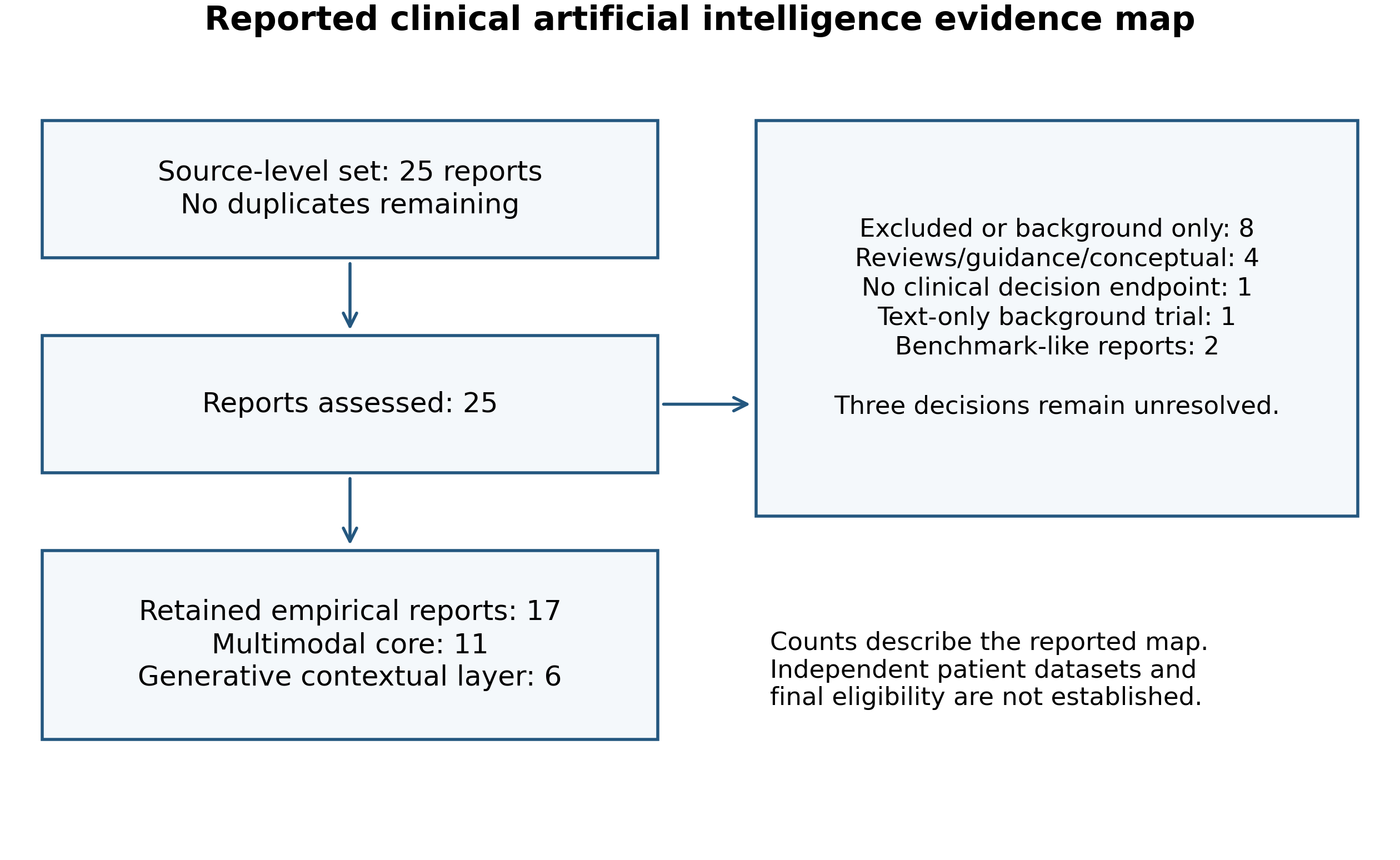
The screening set contained 25 unique reports, with no duplicates remaining before eligibility assessment. These reports were assessed at report level because they arose from targeted source verification rather than from a conventional set of archived database exports. Seventeen empirical reports were retained: 11 entered the strict multimodal AI core synthesis and 6 entered the expanded generative AI clinical decision-support contextual set. Eight reports were excluded from the empirical synthesis or retained only as background: four reviews, guidance documents or conceptual reports; one report without a clinical decision endpoint; one text-only background trial; and two benchmark-like reports without sufficient clinical workflow relevance. The study-selection process is summarized in Figure 1, and report-level decisions are listed in Supplementary Table S2.
Figure 1. Evidence-map selection flow.
The strict core set covered 11 reports across ophthalmology, intensive care, pathology, radiology, echocardiography, oncology, ultrasound diagnosis, emergency care, simulated telehealth and dentistry. The expanded contextual set added 6 clinical or near-clinical generative AI clinical decision-support studies that were clinically informative but not strict multimodal AI. Table 2 summarizes the included evidence. HemaGuide (10) was reassigned to the contextual layer because its reported inputs are clinical documents and structured case information with retrieval and decision tools; tool use alone does not establish multimodal input. Reports from the same primary-care program are retained for distinct endpoints and are not assumed to be independent patient datasets.
Table 2. Included studies and evidence classification
| Study | Clinical function/design | Sample and setting | AI input or tools | Layer | Main quantitative finding and interpretation |
|---|---|---|---|---|---|
| Chen et al. (2) | Ophthalmology emergency triage; diagnostic validation with external and pilot referral testing | 2,405 internal participants; 103 external participants; prospective pilot referral test | Ocular images + clinical metadata | Core | Internal triage AUC 0.982 (95% CI 0.966-0.998); external AUC 0.988; internal primary-diagnosis accuracy 80.8%. Routing relevance is high, but outcome impact remains indirect. |
| Lin et al. (3) | ICU prognosis; retrospective development, validation and external testing | 3,798 ICU patients from MIMIC-IV and an external hospital | Clinical parameters + chest X-rays | Core | External test AUC 0.82 and F1 score 0.61 versus APACHE II AUC 0.62 and F1 score 0.50. Local calibration and actionability remain decisive. |
| Lu et al. (4) | Pathology diagnostic assistance; proof-of-concept multimodal evaluation | 105 multiple-choice diagnostic cases; 260 open-ended cases assessed by 7 pathologists | Histopathology images + natural-language prompts/clinical context | Core | On 235 consensus open-ended cases, diagnostic accuracy was 78.7% versus 52.3% for GPT-4V. Strong near-clinical signal, but no prospective deployment. |
| Tanno et al. (5) | Radiology report generation; clinician-AI collaboration evaluation | 606 chest radiographs (306 MIMIC-CXR; 300 Indian dataset); 27 board-certified radiologists | Chest X-rays + report text | Core | Clinician-AI reports were equivalent or preferred in 53.6% and 71.2% of cases, versus 44.4% and 51.2% for AI alone in the two datasets. Clinician review remains essential. |
| Christensen et al. (6) | Echocardiography interpretation; foundation-model development and external validation | 1,032,975 videos from 224,685 studies in 99,870 patients; 5,000-video external test set | Echocardiography video + report text | Core | External LVEF mean absolute error was 7.1%; device-detection AUCs ranged from 0.84 to 0.97. Clinical utility still requires prospective workflow testing. |
| Ferber et al. (7) | Precision oncology decision preparation; realistic multimodal case evaluation | 20 realistic multimodal oncology cases | LLM + pathology tools + radiology segmentation + guideline/web tools | Core | Among 245 assessable statements, 223 (91.0%) were factually correct, 16 (6.5%) incorrect and 6 (2.4%) potentially harmful. Appropriate tool use was 87.5%, and decision accuracy increased from 30.3% for GPT-4 alone to 87.2% with the integrated agent. Simulated cases limit effectiveness inference. |
| Cao et al. (8) | Lymphadenopathy diagnosis; retrospective, prospective and multicenter validation with reader assistance | 7,371 patients; 147,420 BUS/CDFI key frames; multicenter retrospective and prospective cohorts | B-mode ultrasound videos + color Doppler videos + clinical information | Core | In the prospective external cohort, radiologists’ mean AUC increased from 0.767 (95% CI 0.705-0.829) to 0.899 (95% CI 0.853-0.944) with AI assistance; external false-positive rate decreased by 9.8%. |
| Russ et al. (25) | Emergency-care assessment; exploratory feasibility/usability pilot | 20 participants in an emergency-care feasibility study | Conversational interface + sensors/vital signs + report generation | Core | Mean System Usability Scale score was 90.6 ± 7.9; at least 80% gave the most positive ratings on key usability and safety items. Sample size was very small and no clinical-outcome comparator was used. |
| Mahajan et al. (26) | Multimodal diagnostic performance; visual-input contribution study | 160 Clinical Picture Quiz cases | Clinical visual data + text cases | Core | Across 160 cases, adding images did not produce a statistically significant aggregate improvement over text-only prompting. The evaluation remains benchmark-like and should not be overinterpreted. |
| Saab et al. (9) | Simulated multimodal telehealth; randomized blinded OSCE-style evaluation | 105 simulated consultations; 18 specialist physicians | Text chat + skin images + ECGs + clinical documents | Core | AMIE was superior on 29 of 32 overall evaluation axes and 7 of 9 multimodal axes. The signal is strong but simulated, with no real-world patient outcomes. |
| Zoller et al. (10) | Hematology tumor-board support; external validation and prospective silent validation | 45 high-complexity benchmark cases; 555 external cases; 64 prospective silent-validation cases | Case-grounded LLM agent + guidelines + case memory/tools | Context | Concordance with tumor-board decisions was 81.8% externally and 82.8% prospectively; hallucinations occurred in 2 of 664 outputs (0.3%). Survival and toxicity outcomes were not tested. |
| Liu et al. (11) | Dental imaging support; multimodal LLM development/evaluation | 450 internal test cases with 4,950 VQA pairs; external test of 19 cases with 3 junior dentists | Orthopantomography images + text/decision-support tasks | Core | ToothXpert achieved an F1 score of 73.73% and processed an external case in a mean 7.09 s; its F1 score exceeded two junior dentists by 1.96 and 2.99 percentage points. |
| Agweyu et al. (15) | Primary-care CDSS; pragmatic cluster-randomized trial | 9,691 patients; 103 clinical officers; 16 primary-care facilities | Text-based LLM/EMR-guideline CDSS | Context | Fourteen-day treatment failure was 2.2% with CDSS versus 2.0% with usual care (adjusted OR 0.77, 95% CI 0.55-1.08; P=0.13). Process gains did not translate into a significant patient-outcome benefit. |
| Agweyu et al. (16) | Primary-care CDSS safety evaluation | 1,469 clinical records from 16 primary-care facilities | LLM-based CDSS record review | Context | Hallucinations were identified in 50 encounters (3.4%, 95% CI 2.5-4.5), and clinical management guidance was aligned with local guidelines in 1,455 encounters (99.0%, 95% CI 98.4-99.5). Potentially harmful recommendations were generated in 115 encounters (7.8%, 95% CI 6.5-9.3), of which 67 were incorporated into the final clinical documentation. |
| Obong’o et al. (17) | Implementation/usability of EHR-integrated generative AI-CDSS | System logs from all consultations over 8 months; qualitative data from 42 staff members | Usage logs + clinician interviews | Context | Clinicians rated 31% of AI responses; 99.5% of rated responses received a positive rating. Uptake varied by clinician, case complexity and workflow, limiting transferability. |
| Tao et al. (18) | Primary-to-specialist care transition; randomized controlled trial | 2,069 patients and 111 specialists across three randomized groups | Text-based LLM chatbot for referral/coordination | Context | Specialist consultation time fell from 4.41 to 3.14 min (28.7% reduction; P<0.001), while physician-rated care coordination increased from 1.73 to 3.69 (P<0.001). |
| Saban et al. (19) | CT referral justification; retrospective real-world cohort | 6,356 patients in a large European cohort | Text-based LLMs compared with guideline CDSS/expert reference | Context | CT justification accuracy was 92.4% for experts, 88.8% for GPT-4 and 85.2% for Claude. The evidence is clinically relevant but retrospective and not strictly multimodal. |
| Abbreviations for Table 2: AI, artificial intelligence; AUC, area under the receiver operating characteristic curve; CI, confidence interval; CDSS, clinical decision support system; CT, computed tomography; ECG, electrocardiogram; EHR/EMR, electronic health/medical record; ICU, intensive care unit; LLM, large language model; LVEF, left ventricular ejection fraction; OR, odds ratio; OSCE, objective structured clinical examination; QA, question answering; VLM, vision-language model; BUS, B-mode ultrasound; CDFI, color Doppler flow imaging. Study-specific dataset and model names are retained as reported. | |||||
Diagnostic and triage studies produced the strongest strict multimodal performance signals. EE-Explorer combined ocular images and clinical metadata and reported high triage discrimination in internal and external evaluation, making it directly relevant to eye emergency routing (2). The lymphadenopathy study was especially important because it used B-mode and color Doppler ultrasound videos with clinical information, included retrospective and prospective multicenter validation, and assessed reader assistance; junior radiologists appeared to benefit from AI-supported interpretation (8). These studies support multimodal AI as a second-reader or triage layer, but they still do not prove downstream reductions in missed diagnosis, unnecessary referral or patient harm.
The ICU prediction model of Lin et al. and EchoCLIP illustrate a different evidence pattern. They show that imaging plus structured or textual clinical information can improve prognostic or interpretation tasks (3,6). The clinical question is not only whether discrimination improves, but whether predictions are calibrated locally and linked to an actionable management pathway. A model that identifies higher risk without changing treatment, monitoring intensity or resource allocation has limited clinical value.
The chest-radiograph vision-language model study is important because it evaluates clinician-AI collaboration rather than autonomous report generation alone (5). This is a realistic implementation pathway: AI-generated preliminary reports may reduce workload or improve completeness only if clinicians can review, correct and override them. The main risks are plausible but not fully quantified: false reassurance, subtle omission, anchoring bias and increased downstream work when outputs require extensive correction.
The multimodal oncology AI agent and the contextual HemaGuide system show how generative AI may support higher-level decision preparation when constrained by tools, guidelines, retrieval and case memory (7,10). This architecture is more defensible than unconstrained free-form generation because recommendations can be grounded, audited and compared with expert decision processes. The limitation is equally clear: expert concordance and prospective silent validation are not the same as improved survival, reduced toxicity, fewer inappropriate treatments or better quality of life.
Multimodal AMIE performed strongly in randomized blinded simulated telehealth consultations using skin photographs, electrocardiograms and clinical documents (9). This is a meaningful translational step beyond text-only chatbot evaluation, but it remains simulated and should not be interpreted as deployment evidence. The emergency-care platform had high usability in a small feasibility study, while the dental imaging multimodal large language model expands the field into oral health decision support (11,25). These studies justify further prospective evaluation, not autonomous clinical use.
The expanded generative AI-CDSS set provides the strongest real-world workflow evidence, even though several studies are not strict multimodal AI. The Kenyan cluster-randomized primary-care trial is the key example: it evaluated a generative AI-enabled CDSS embedded in clinical workflow across 16 primary-care facilities and found documentation/process gains without a statistically significant reduction in 14-day treatment failure (15). This distinction matters. A system can improve the apparent structure of care while failing to demonstrate a short-term patient-outcome benefit. The associated safety and implementation studies add useful information about adverse-event review, clinician experience and adoption patterns (16,17). The referral-transition and CT-referral studies show that text-based generative AI may influence routing and justification decisions, but they should remain separate from strict multimodal AI conclusions (18,19).
The appraisal tables describe retrospective or curated sampling, small external cohorts, simulated or preference-based endpoints, incomplete calibration reporting and limited patient-outcome evidence. QUADAS-2, PROBAST and RoB 2 use different domains and judgment rules; DECIDE-AI addresses reporting and clinical evaluation. Tables S3A–S3D therefore present descriptive limitations rather than pooled labels or formal categories. Table 3 reports a review-specific maturity framework rather than GRADE certainty.
Table 3. Maturity and strength of evidence by outcome domain
| Outcome domain | Evidence base | Overall evidence maturity | Main reason for judgement |
|---|---|---|---|
| Patient-important outcomes | Mainly expanded generative AI-CDSS trial evidence | Low to moderate | One pragmatic cluster RCT assessed treatment failure, but strict multimodal core evidence rarely tested hard outcomes (15). |
| Diagnostic/triage accuracy | EE-Explorer, lymphadenopathy model and related strict multimodal studies | Moderate | External/prospective validation exists for some studies, but calibration, workflow effect and downstream harm remain uncertain (2,8). |
| Prognosis/risk stratification | the ICU prediction model of Lin et al. and EchoCLIP-type evidence | Low to moderate | Performance gains are promising, but actionability and local calibration are insufficiently tested (3,6). |
| Documentation/report generation | Radiology VLM and CDSS documentation outcomes | Low to moderate | Clinician-AI collaboration is plausible, but error propagation and time burden need prospective testing (5,15). |
| Treatment decision preparation | Oncology AI agent and HemaGuide | Low to moderate | Concordance and auditability are strengths; patient benefit, toxicity and cost effects are not proven (7,10). |
| Usability and implementation | Emergency-care pilot and Kenya adoption study | Low | Useful implementation signals, but small samples and setting-specific workflows limit generalizability (17,25). |
| Safety and harms | Sparse adverse-event review and limited error reporting | Low | Rare harms, automation bias, delayed harm and subgroup harms are not adequately measured (16). |
| Equity/fairness | Mostly indirect or narrative reporting | Very low to low | Few studies report disaggregated performance by sex, age, language, ethnicity, geography, facility type or data completeness. |
| Economic/resource outcomes | Limited process-cost and referral/resource evidence | Very low to low | Cost-effectiveness, workload substitution and downstream resource use remain underdeveloped (15,19). |
Formal quantitative assessment of reporting bias was not possible. Across outcome domains, the available literature was dominated by positive technical, diagnostic or workflow findings, whereas null clinical-effect results, detailed harm analyses and negative implementation experiences were uncommon. Protocols, registrations and clearly prespecified clinical endpoints were inconsistently available, particularly for simulated and benchmark-like evaluations. Publication bias and selective outcome reporting therefore could not be excluded and were treated as reasons to avoid high evidence-maturity ratings.
This evidence map shows a field with strong technical progress but uneven clinical maturity. Strict multimodal AI systems increasingly perform well in diagnostic, triage, report-generation and expert-concordance tasks (2,3,4,5,6,7,8,9,10,11,25,26). The stronger clinical test, however, is whether an AI system changes a decision that matters to patients, clinicians or health systems. On that standard, the evidence remains limited. Most strict multimodal studies do not yet demonstrate fewer treatment failures, fewer missed diagnoses, reduced mortality, reduced complications or cost-effectiveness.
The most important interpretive point is that strict multimodal AI and text-based generative AI-CDSS should not be conflated. Text-based clinical decision-support studies may be more pragmatic and closer to patient outcomes than many multimodal evaluations (15,16,17,18,19). Yet they answer a different question. If they are used to support claims about multimodal AI without subgroup separation, the review becomes methodologically weak. A defensible synthesis should keep strict multimodal systems and expanded generative AI-CDSS evidence in separate layers.
The most plausible implementation model is assistive rather than autonomous. Across domains, the defensible functions are triage prioritization, second reading, structured documentation, preliminary report generation, referral preparation, guideline retrieval and tumor-board preparation. These uses are clinically relevant because they can reduce cognitive load or improve consistency while preserving clinician authority. They are also reversible and auditable. By contrast, autonomous high-stakes diagnosis or treatment selection remains insufficiently supported by current evidence.
Architecture matters. Systems that are retrieval-grounded, guideline-linked, tool-constrained and auditable appear more credible than unconstrained conversational models. HemaGuide and the oncology AI agent illustrate why this matters: they restrict unsupported generation and allow recommendations to be linked to case features, guidelines or tools (7,10). That does not remove risk, but it creates a clearer audit trail and makes error analysis more feasible.
Safety reporting is not yet mature. Absence of a reported harm signal in short studies should not be interpreted as proof of safety. AI-related harm can occur through missed diagnoses, over-referral, under-referral, unnecessary treatment, false reassurance, alert fatigue, clinician deskilling, automation bias or delayed downstream consequences. These outcomes require prospective monitoring and predefined adjudication rather than informal post hoc discussion (12,13,16).
Equity is a major unresolved issue. Multimodal AI could narrow gaps by giving non-specialist facilities access to structured decision support, triage logic and specialist-like preparation. It could also widen gaps if development datasets come mainly from tertiary academic centers, high-income settings, English-language documentation or clean electronic health records. Future studies should report performance by sex, age, geography, language, facility level, device type, data completeness and other clinically relevant subgroups whenever feasible.
The practical message for journals and health systems is modest but important. Multimodal and generative AI can already support clinical work, but the current evidence does not justify broad autonomous deployment. Implementation should require local validation, clinician training, human override, audit logs, predefined safety review, subgroup monitoring and a mechanism to pause or update the system after data drift. These conditions should be treated as minimum safeguards, not optional refinements.
The main strength of this review is the explicit separation of strict multimodal AI evidence from expanded generative AI-CDSS evidence. This avoids a common interpretive error in medical AI reviews. The synthesis also includes recent 2025-2026 studies, applies design-specific risk-of-bias logic and avoids claiming clinical effectiveness from benchmark-like or simulated studies.
Implement multimodal and generative AI first in assistive, auditable and reversible tasks: triage, second reading, documentation support, referral preparation and tumor-board preparation.
Avoid autonomous deployment in high-stakes diagnosis or treatment decisions without prospective local validation, predefined safety monitoring and clear clinician override.
Require local calibration, subgroup performance checks, audit logs, adverse-event review and a withdrawal or update mechanism after model drift.
Treat patient-facing and clinician-facing systems differently; workflow, liability, informed use and safety controls are not the same.
Conduct pragmatic and cluster-randomized trials with patient-important endpoints rather than only AUC, expert preference or simulation metrics.
Compare human-in-the-loop models directly: alert-only, second-reader, preliminary-report, recommendation-with-rationale and mandatory sign-off designs.
Report calibration, missingness, site-level data shift, language support and subgroup performance.
Measure harms prospectively, including missed diagnoses, over-referral, under-referral, unnecessary treatment, automation bias, clinician deskilling and delayed harm.
Include community clinics, rural facilities, low-resource settings and non-English workflows.
The available evidence supports assistive use of multimodal and generative AI-enabled clinical decision support in selected clinical functions, but remains insufficient for autonomous decision-making or broad claims of patient-important outcome benefit. The most consistent strict multimodal signals were observed for diagnostic discrimination, triage classification, report generation and expert-concordance outcomes. Real-world patient-outcome evidence is currently more mature in adjacent generative AI-CDSS studies, which are therefore analyzed separately from strict multimodal claims. A more defensible implementation pathway is assistive, human-in-the-loop, locally validated and auditable. The next phase of research should move from model demonstrations toward pragmatic trials, prospective safety surveillance, fairness audits and transparent post-deployment monitoring.
Author contributions: BS: Conceptualization, Methodology, Investigation, Data curation, Formal analysis, and Writing – original draft. TS: Conceptualization, Methodology, Supervision, and Writing – review and editing. DD: Investigation, Validation, Data curation, Visualization, and Writing – review and editing. All authors have read and approved the final manuscript and agree to be accountable for all aspects of the work.
Funding: This work was carried out without grant support from public, commercial or not-for-profit funding bodies.
Conflicts of interest: The authors declare no financial or non-financial relationships with the developers or vendors of the artificial intelligence systems discussed in this review.
Acknowledgments: The authors thank the study groups whose clinical evaluations of artificial intelligence systems are mapped in this review, and acknowledge the PRISMA 2020 statement, which informed the reporting structure adopted here.
Data availability statement: The report-level evidence map, search and replication strategies, descriptive appraisal tables, extraction template and PRISMA 2020 checklist are provided in Supplementary Tables S1–S5. Archived database exports, a dated retrieval log and the completed extraction records are not included in the supplementary material. No individual participant data were used.
AI use statement: Generative AI (ChatGPT, OpenAI) was used only for language editing, internal consistency checks, citation placement and formatting. It did not select, appraise or classify studies, run a new search or generate any of the reported results. The authors take full responsibility for the content of the manuscript and for these declarations.
World Health Organization. Ethics and governance of artificial intelligence for health: guidance on large multi-modal models. Geneva: World Health Organization; 2025.
Chen J, Wu X, Li M, et al. EE-Explorer: a multimodal artificial intelligence system for eye emergency triage and primary diagnosis. Am J Ophthalmol. 2023;252:253-264. doi:10.1016/j.ajo.2023.04.007.
Lin J, Yang J, Yin M, et al. Development and validation of multimodal models to predict the 30-day mortality of ICU patients based on clinical parameters and chest X-rays. J Imaging Inform Med. 2024;37(4):1312-1322. doi:10.1007/s10278-024-01066-1.
Lu MY, Chen B, Williamson DFK, et al. A multimodal generative AI copilot for human pathology. Nature. 2024;634(8033):466-473. doi:10.1038/s41586-024-07618-3.
Tanno R, Barrett DGT, Sellergren A, et al. Collaboration between clinicians and vision-language models in radiology report generation. Nat Med. 2025;31(2):599-608. doi:10.1038/s41591-024-03302-1.
Christensen M, Vukadinovic M, Yuan N, Ouyang D. Vision-language foundation model for echocardiogram interpretation. Nat Med. 2024;30(5):1481-1488. doi:10.1038/s41591-024-02959-y.
Ferber D, El Nahhas OSM, Wölflein G, et al. Development and validation of an autonomous artificial intelligence agent for clinical decision-making in oncology. Nat Cancer. 2025;6(8):1337-1349. doi:10.1038/s43018-025-00991-6.
Cao R, Zhu Y, Zhao H, et al. A multimodal feature disentanglement model for lymphadenopathy diagnosis based on BUS and CDFI ultrasound videos: a retrospective, prospective, multicenter study. Eur Radiol. 2026;36(7):6119-6132. doi:10.1007/s00330-026-12409-7.
Saab K, Park C, Strother T, et al. Advancing conversational diagnostic AI with multimodal reasoning. Nat Med. 2026;32(5):1726-1736. doi:10.1038/s41591-026-04371-0.
Zoller J, Kalz M, Wu X, et al. Clinical decision support in hematological malignancies using a case-grounded AI agent. Nat Med. 2026. doi:10.1038/s41591-026-04494-4.
Liu X, Hung KF, Yu W, et al. Developing and evaluating multimodal large language model for orthopantomography analysis to support clinical dentistry. Cell Rep Med. 2026;7(3):102652. doi:10.1016/j.xcrm.2026.102652.
Liu X, Cruz Rivera S, Moher D, Calvert MJ, Denniston AK, SPIRIT-AI and CONSORT-AI Working Group. Reporting guidelines for clinical trial reports for interventions involving artificial intelligence: the CONSORT-AI extension. Nat Med. 2020;26(9):1364-1374. doi:10.1038/s41591-020-1034-x.
Vasey B, Nagendran M, Campbell B, et al. Reporting guideline for the early stage clinical evaluation of decision support systems driven by artificial intelligence: DECIDE-AI. BMJ. 2022;377:e070904. doi:10.1136/bmj-2022-070904.
Collins GS, Moons KGM, Dhiman P, et al. TRIPOD+AI statement: updated guidance for reporting clinical prediction models that use regression or machine learning methods. BMJ. 2024;385:e078378. doi:10.1136/bmj-2023-078378.
Agweyu A, Mwaniki P, Menon V, et al. Generative AI-enabled clinical decision support system in primary care: a pragmatic, cluster-randomized trial. Nat Med. 2026;32(8):3032-3039. doi:10.1038/s41591-026-04503-6.
Agweyu A, Mwaniki P, Musau W, et al. Safety of a large language model-based clinical decision support system in African primary healthcare. Nat Health. 2026;1(6):607-618. doi:10.1038/s44360-026-00082-5.
Obong'o C, Njenga G, Otiangala D, et al. Mixed-methods evaluation of clinician experiences and adoption patterns of an EHR-integrated generative AI-based clinical decision support uptake by clinicians in Kenya. BMJ Digit Health Ai. 2026;2(1):e000207. doi:10.1136/bmjdhai-2025-000207.
Tao X, Zhou S, Ding K, et al. An LLM chatbot to facilitate primary-to-specialist care transitions: a randomized controlled trial. Nat Med. 2026;32(3):934-942. doi:10.1038/s41591-025-04176-7.
Saban M, Alon Y, Luxenburg O, et al. Comparison of CT referral justification using clinical decision support and large language models in a large European cohort. Eur Radiol. 2025;35(10):6150-6159. doi:10.1007/s00330-025-11608-y.
Page MJ, McKenzie JE, Bossuyt PM, et al. The PRISMA 2020 statement: an updated guideline for reporting systematic reviews. BMJ. 2021;372:n71. doi:10.1136/bmj.n71.
Page MJ, Moher D, Bossuyt PM, et al. PRISMA 2020 explanation and elaboration: updated guidance and exemplars for reporting systematic reviews. BMJ. 2021;372:n160. doi:10.1136/bmj.n160.
Rethlefsen ML, Kirtley S, Waffenschmidt S, et al. PRISMA-S: an extension to the PRISMA Statement for Reporting Literature Searches in Systematic Reviews. Syst Rev. 2021;10(1):39. doi:10.1186/s13643-020-01542-z.
Whiting PF, Rutjes AW, Westwood ME, et al. QUADAS-2: a revised tool for the quality assessment of diagnostic accuracy studies. Ann Intern Med. 2011;155(8):529-536. doi:10.7326/0003-4819-155-8-201110180-00009.
Wolff RF, Moons KGM, Riley RD, et al. PROBAST: a tool to assess the risk of bias and applicability of prediction model studies. Ann Intern Med. 2019;170(1):51-58. doi:10.7326/m18-1376.
Russ P, Mross PM, Kräling G, et al. Feasibility of a multimodal AI-based clinical assessment platform in emergency care: an exploratory pilot study. Front Digit Health. 2025;7:1657583. doi:10.3389/fdgth.2025.1657583.
Mahajan A, Fry C, Zhou L, Bates DW. Evaluating the effect of visual data on multimodal artificial intelligence diagnostic performance. Lancet Digit Health. 2025;7(12):100938. doi:10.1016/j.landig.2025.100938.
Goh E, Gallo R, Hom J, et al. Large language model influence on diagnostic reasoning: a randomized clinical trial. JAMA Netw Open. 2024;7(10):e2440969. doi:10.1001/jamanetworkopen.2024.40969.
Moor M, Banerjee O, Abad ZSH, et al. Foundation models for generalist medical artificial intelligence. Nature. 2023;616(7956):259-265. doi:10.1038/s41586-023-05881-4.
Schouten D, Nicoletti G, Dille B, et al. Navigating the landscape of multimodal AI in medicine: a scoping review on technical challenges and clinical applications. Med Image Anal. 2025;105:103621. doi:10.1016/j.media.2025.103621.
Thirunavukarasu AJ, Li S, Qin P, et al. Clinical artificial intelligence applications of vision-language foundation models. PLOS Digit Health. 2026;5(6):e0001453. doi:10.1371/journal.pdig.0001453.
Table S1. Search documentation status and reproducibility strategies
| Source | Status in the current review | Query or documentation note |
|---|---|---|
| PubMed/MEDLINE | Consulted for source-level retrieval and verification; final update 9 July 2026. Records contributed to the combined accessible set (n = 25); a source-specific yield was not archived separately. | (("multimodal artificial intelligence"[tiab] OR "multimodal AI"[tiab] OR "multimodal large language model*"[tiab] OR "large multimodal model*"[tiab] OR "vision-language model*"[tiab] OR "vision language model*"[tiab] OR "medical foundation model*"[tiab] OR "generative AI"[tiab] OR "large language model*"[tiab] OR "AI agent*"[tiab]) AND ("clinical decision support"[tiab] OR "Decision Support Systems, Clinical"[MeSH] OR diagnosis[tiab] OR triage[tiab] OR "tumor board"[tiab] OR "treatment decision"[tiab] OR referral[tiab] OR "clinical workflow"[tiab]) AND (clinical[tiab] OR patient*[tiab] OR clinician*[tiab] OR physician*[tiab] OR human*[tiab])) AND ("2018/01/01"[dp] : "2026/07/09"[dp]) |
| Publisher pages, registry checks and citation chasing | Consulted for direct record and full-text verification; final update 9 July 2026. No database-style export was available; records contributed to the combined accessible set (n = 25). | Nature Portfolio, The Lancet Digital Health, Cell Reports Medicine, BMJ Digital Health & AI, Frontiers, Springer Nature and other journal pages; registry checks when relevant; backward and forward citation chasing from highly relevant reports. |
| Embase | Replication strategy only; not counted as a searched database in the quantitative flow. | ('multimodal artificial intelligence':ti,ab OR 'multimodal ai':ti,ab OR 'multimodal large language model*':ti,ab OR 'large multimodal model*':ti,ab OR 'vision-language model*':ti,ab OR 'vision language model*':ti,ab OR 'medical foundation model*':ti,ab OR 'generative ai':ti,ab OR 'large language model*':ti,ab OR 'ai agent*':ti,ab) AND ('clinical decision support':ti,ab OR 'decision support system'/exp OR diagnosis:ti,ab OR triage:ti,ab OR 'tumor board':ti,ab OR 'treatment decision':ti,ab OR referral:ti,ab OR 'clinical workflow':ti,ab) AND [humans]/lim AND (2018-2026)/py |
| Scopus | Replication strategy only; not counted as a searched database in the quantitative flow. | TITLE-ABS-KEY(("multimodal artificial intelligence" OR "multimodal AI" OR "multimodal large language model*" OR "large multimodal model*" OR "vision-language model*" OR "medical foundation model*" OR "generative AI" OR "large language model*" OR "AI agent*") AND ("clinical decision support" OR diagnosis OR triage OR "tumor board" OR "treatment decision" OR referral OR "clinical workflow") AND (clinical OR patient* OR clinician* OR physician* OR human*)) AND PUBYEAR > 2017 |
| Web of Science Core Collection | Replication strategy only; not counted as a searched database in the quantitative flow. | TS=(("multimodal artificial intelligence" OR "multimodal AI" OR "multimodal large language model*" OR "large multimodal model*" OR "vision-language model*" OR "medical foundation model*" OR "generative AI" OR "large language model*" OR "AI agent*") AND ("clinical decision support" OR diagnosis OR triage OR "tumor board" OR "treatment decision" OR referral OR "clinical workflow") AND (clinical OR patient* OR clinician* OR physician* OR human*)) Timespan: 2018-2026 |
| Google Scholar/citation searching | Used as a citation-discovery aid; the queries below are replication aids rather than completed database searches. | Run as separate narrow searches and record the first 100 results per query: "multimodal AI" "clinical decision support" medicine; "vision-language model" "clinical" "decision support"; "large multimodal model" diagnosis clinical; "generative AI" "clinical decision support" randomized trial. Conduct forward/backward citation chasing from Chen 2023, Lu 2024, Tanno 2025, Agweyu 2026, Saab 2026 and Zoller 2026. |
Table S2. Excluded and background-only reports
| Report | Topic | Decision | Primary reason |
|---|---|---|---|
| Li et al. | A community-codesigned LLM-powered chatbot for primary care: a randomized controlled trial. doi:10.1038/s44360-025-00021-w. | Excluded | Patient education/e-learning outcome; no clinician decision-making or routing endpoint. |
| Goh et al. 2024 (27) | Large language model influence on diagnostic reasoning | Background only | Retained as contextual background. Text-only input alone is not a sufficient exclusion under the expanded contextual criteria. |
| Kim et al. 2025 | Utility of Multimodal Large Language Models in Analyzing Chest X-Rays with Incomplete Contextual Information. Healthcare Informatics Research. 2025;31(4):416. doi:10.4258/hir.2025.31.4.416. | Background only | Benchmark-style evaluation of model output without a clinical workflow or patient-relevant endpoint; retained for context. |
| Ekingen and Ucdal 2026 | Comparative Performance of Multimodal and Unimodal Large Language Models Versus Multicenter Human Clinical Experts in Aortic Dissection Management. Diagnostics. 2026;16(2):323. https://www.mdpi.com/2075-4418/16/2/323. | Background only | Benchmark-style comparison of model output with expert performance, without a clinical workflow or patient-relevant endpoint; retained for context. |
| Moor et al. 2023 (28) | Foundation models for generalist medical artificial intelligence | Background only | Conceptual/perspective article, not primary clinical evaluation. |
| Schouten et al. 2025 (29) | Navigating the landscape of multimodal AI in medicine | Background only | Review/scoping article, useful for context and citation chasing. |
| Thirunavukarasu et al. 2026 (30) | Clinical AI applications of vision-language foundation models | Background only | Review/overview, not primary empirical evaluation. |
| WHO 2025 (1) | Ethics and governance of AI for health: guidance on large multi-modal models | Background only | Guidance document, used for governance context, not empirical evidence. |
Table S3A. Descriptive assessment using QUADAS-2 domains
| Study | Patient selection | Index test | Reference standard | Flow/timing | Applicability limitations |
|---|---|---|---|---|---|
| Chen et al. (2) | Cohort assembly and spectrum selection were incompletely reported. | Threshold handling and model lock status were not fully transparent. | Adjudication and blinding details were incomplete. | External and pilot testing were reported, but exclusions and missing data were incompletely described. | Small external cohort and no downstream outcome evaluation. |
| Cao et al. (8) | Multicenter retrospective and prospective cohorts were used, but consecutive enrollment was not fully documented. | Independent internal, retrospective external and prospective external evaluations were reported. | Reference-standard blinding and adjudication across centers require fuller reporting. | Large cohorts were retained, but exclusions and missing video/frame handling were not fully transparent. | Strong diagnostic applicability but no downstream biopsy or harm outcome. |
| Liu et al. (11) | Curated test material and only 19 external cases. | Model/version locking and threshold procedures were incompletely reported for clinical use. | Reference-standard construction and blinding were not fully described. | Very small external evaluation and limited reporting of case-level exclusions. | Routine dental workflow and patient outcomes were not tested. |
| Saban et al. (19) | Real-world, consecutive CT referrals across centers, but short sampling windows may affect representativeness. | Identical prompts/settings were used, but model versions are time-sensitive. | ESR iGuide with radiologist input was used as the reference, not an outcome-based standard. | The retrospective cohort was evaluated consistently across comparison systems. | Clinically relevant but text-only, retrospective and without prospective ordering outcomes. |
Note: These tables summarize methodological observations and applicability limitations. They do not provide formal tool-specific risk-of-bias ratings; no combined overall category is calculated.
Table S3B. Descriptive assessment using PROBAST domains
| Study | Participants | Predictors | Outcome | Analysis | Applicability limitations |
|---|---|---|---|---|---|
| Lin et al. (3) | Retrospective ICU cohorts and selection procedures were incompletely described. | Clinical parameters and chest radiographs were available at prediction, but preprocessing transparency was limited. | 30-day mortality is objective. | Potential overfitting, incomplete missing-data reporting and limited calibration assessment. | Transportability and actionability across ICUs remain uncertain. |
| Christensen et al. (6) | Very large retrospective single-system cohort with patient-level splitting and an external dataset. | Echocardiography video and paired report text were clearly defined. | Quantitative labels and device outcomes were clinically interpretable, but some were report-derived. | Large-scale validation is a strength; calibration and multiple-video clustering remain relevant. | Technical benchmark without prospective workflow or outcome impact. |
Table S3C. Descriptive assessment using RoB 2 domains
| Study | Randomization | Deviations from intervention | Missing outcome data | Outcome measurement | Reporting observations |
|---|---|---|---|---|---|
| Agweyu et al. (15) | Clinical officers were randomized as clusters and allocation was reported. | Shared facilities, variable uptake and protocol deviations could reduce between-group contrast. | Withdrawals, loss to follow-up and exposure misclassification affected the primary analysis set. | An expert-adjudicated 14-day composite was used; rare safety outcomes remained imprecise. | Registration and a prespecified primary outcome were reported. |
| Tao et al. (18) | A three-arm randomized design with balanced baseline groups was reported. | Participants and staff were not blinded to chatbot use. | The final analysis included 2,069 participants; attrition details require the trial flow. | Consultation time was objective, but coordination and communication outcomes were perception-based. | A frozen model and defined trial endpoints were reported. |
Table S3D. DECIDE-AI-oriented appraisal of early-stage, simulated, safety and implementation studies
| Study | Appraisal approach | Sampling and setting | Comparator/outcome and applicability | Interpretation limits |
|---|---|---|---|---|
| Lu et al. (4) | DECIDE-AI | Curated diagnostic questions and expert ratings; no prospective workflow or patient-level comparator. | Benchmark-like pathology tasks and no prospectively specified clinical endpoint. | Limited directness to routine clinical care. |
| Tanno et al. (5) | DECIDE-AI / CONSORT-AI principles | Retrospective datasets; blinded clinician comparison is a strength. | Preference-based endpoints may reflect style; no live clinical deployment. | Clinical impact and transportability remain uncertain. |
| Ferber et al. (7) | DECIDE-AI | Twenty simulated oncology cases; no randomized clinical decisions. | Statement accuracy, tool use and simulated decision accuracy do not establish patient benefit. | Design does not establish a causal clinical effect. |
| Russ et al. (25) | DECIDE-AI | Uncontrolled feasibility study with n=20 and subjective usability outcomes. | Single exploratory setting; no diagnostic accuracy or clinical-outcome comparator. | Design does not establish a causal clinical effect. |
| Mahajan et al. (26) | DECIDE-AI | Public quiz cases and repeated prompt-based benchmarking. | No real-time workflow, clinician interaction or patient outcome. | Limited directness to routine clinical care. |
| Saab et al. (9) | DECIDE-AI | Randomized, blinded exploratory simulation with specialist ratings; not a preregistered clinical trial. | OSCE-style telehealth scenarios are not equivalent to routine patient care. | Clinical impact and transportability remain uncertain. |
| Zoller et al. (10) | DECIDE-AI | External and prospective silent validation are strengths; concordance was the main endpoint. | No treatment implementation, survival, toxicity or quality-of-life outcomes. | Clinical impact and transportability remain uncertain. |
| Agweyu et al. (16) | Observational safety appraisal / DECIDE-AI | Retrospective record review; subtle or delayed harms may be missed. | Direct primary-care relevance, but rare downstream harms and causal attribution remain uncertain. | Clinical impact and transportability remain uncertain. |
| Obong'o et al. (17) | Mixed-methods / DECIDE-AI | Self-selection, self-report and descriptive usage analysis; no counterfactual comparison. | One provider network and implementation context. | Design does not establish effectiveness. |
Table S4. Data extraction template
| Domain | Variable | Coding or format | Notes |
|---|---|---|---|
| Identification | Study ID and full citation | Author-year; reference number | Use one record per report and link multiple reports from the same study. |
| Bibliographic | Publication year and status | Year; peer reviewed/preprint | Preprints excluded from the main synthesis. |
| Context | Country, health system and clinical setting | Free text; single/multicenter | Record facility type and resource setting when available. |
| Clinical scope | Clinical domain and decision function | Diagnosis, triage, prognosis, documentation, treatment preparation, referral or workflow | Allow more than one function when explicitly defined in the report. |
| Design | Study design | RCT, cluster RCT, prospective/retrospective validation, diagnostic accuracy, implementation, feasibility or simulation | Record prospective status separately. |
| Population | Sample size and unit of analysis | Patients, encounters, images, cases, clinicians or facilities | Record development, validation and external cohorts separately. |
| Population | Participant characteristics | Age, sex, disease spectrum, clinician experience | Code not reported rather than assume absence. |
| Technology | AI system and version | Model name, version/date, vendor or open-source status | Record model updates and retrieval/tool components. |
| Technology | Input modalities and tools | Images, video, text, structured EHR, waveforms, sensors, guidelines, web or case memory | Classify strict multimodal versus expanded generative AI-CDSS. |
| Comparator | Comparator or reference standard | Standard care, unassisted clinicians, expert panel, tumor board, single-modality model or guideline CDSS | Describe blinding and adjudication where reported. |
| Task | Clinical task and intended user | Free text | Specify patient-facing, clinician-facing or silent evaluation. |
| Outcomes | Primary endpoint | Definition, time point and measurement method | Retain the authors’ prespecified primary endpoint. |
| Outcomes | Secondary endpoints | Clinical, diagnostic, process, usability, safety, equity or resource outcomes | Record all outcome time points. |
| Results | Effect estimates | AUC, sensitivity, specificity, accuracy, OR/RR/HR, mean difference, concordance, time or usability score | Include 95% CI and P value when available. |
| Validation | Validation setting | Internal, temporal, geographic, external, prospective silent or live deployment | Record number of centers and independence from development data. |
| Implementation | Human-in-the-loop design | No/yes; second reader, preliminary report, recommendation with rationale or mandatory sign-off | Record override and escalation mechanisms. |
| Safety | Safety and harms reporting | Prespecified, post hoc or not reported | Include hallucination, missed diagnosis, over/under-referral and delayed harm. |
| Equity | Equity/fairness assessment | Subgroups and performance metrics | Record sex, age, language, ethnicity, geography, facility type, device and missingness. |
| Implementation | Workflow and implementation constraints | Training, latency, interoperability, usability, workload and local calibration | Record model-drift and audit-log provisions. |
| Other | Funding and conflicts of interest | Source, role and author/vendor relationships | Record not reported where applicable. |
| Review process | Reviewer notes and verification status | Free text; verified/not verified | Document unclear items, correspondence and reasons for classification. |
Table S5. PRISMA 2020 checklist
| Section | Topic | Item | PRISMA 2020 requirement | Location/status in this review |
|---|---|---|---|---|
| TITLE | Title | 1 | Identify the report as a systematic review. | Title identifies an evidence map. Methods describe a PRISMA 2020-informed structure; complete systematic-review compliance is not claimed. |
| ABSTRACT | Abstract | 2 | Provide a structured summary of the review, including background, objectives, methods, results, limitations, conclusions, registration and funding. | Four-part Abstract reports the objective within Background, methods, results, conclusions, limitations and absence of prospective registration/public protocol. Funding is reported in the closing declaration. |
| INTRODUCTION | Rationale | 3 | Describe the rationale for the review in the context of existing knowledge. | Introduction. |
| INTRODUCTION | Objectives | 4 | Provide an explicit statement of the objective(s) or question(s) addressed by the review. | Introduction: aim, primary and secondary objectives, and review questions. |
| METHODS | Eligibility criteria | 5 | Specify inclusion and exclusion criteria and how studies were grouped for synthesis. | Methods - Eligibility criteria; Table 1. |
| METHODS | Information sources | 6 | Specify all databases, registers, websites, organizations, reference lists and other sources searched or consulted, and the date each source was last searched. | Methods and Supplementary Table S1: sources consulted and the final verification date are reported; per-source yields are not reported for sources consulted without archived exports. |
| METHODS | Search strategy | 7 | Present the full search strategies for all databases, registers and websites, including filters and limits. | Supplementary Table S1: the PubMed query and the replication strategies for the other sources, with execution status. |
| METHODS | Selection process | 8 | Specify methods used to decide whether a study met inclusion criteria, including number of reviewers, independence and any automation tools. | Methods – Data management and Selection process: single review stream. |
| METHODS | Data collection process | 9 | Specify methods used to collect data, including number of reviewers, independence, author contact and automation tools. | Methods - Data collection process; Supplementary Table S4. |
| METHODS | Data items - outcomes | 10a | List and define all outcomes for which data were sought and specify whether all compatible results were collected. | Methods - Data items and outcome prioritization; Supplementary Table S4. |
| METHODS | Data items - other variables | 10b | List and define all other variables for which data were sought and describe assumptions about missing or unclear information. | Methods - Data items and outcome prioritization; Supplementary Table S4. |
| METHODS | Risk of bias assessment | 11 | Specify methods used to assess risk of bias, including tools, reviewers, independence and automation tools. | Methods; Tables S3A–S3D: descriptive appraisal; no formal tool-specific ratings assigned. |
| METHODS | Effect measures | 12 | Specify the effect measure(s) used for each outcome. | Methods - Effect measures; Table 2. |
| METHODS | Synthesis methods | 13a | Describe how studies were judged eligible for each synthesis. | Methods - Synthesis methods; strict core and expanded contextual evidence layers. |
| METHODS | Synthesis methods | 13b | Describe methods required to prepare data for presentation or synthesis, including handling of missing data and conversions. | Methods - Data collection process, Data items and Effect measures. |
| METHODS | Synthesis methods | 13c | Describe methods used to tabulate or visually display results. | Table 2; Figure 1; Supplementary Tables S2-S4. |
| METHODS | Synthesis methods | 13d | Describe methods used to synthesize results and justify the choice of methods. | Methods - Synthesis methods; narrative synthesis and rationale for no meta-analysis. |
| METHODS | Synthesis methods | 13e | Describe methods used to explore possible causes of heterogeneity. | Methods - Synthesis methods; stratification by evidence layer, clinical function, design and validation context. |
| METHODS | Synthesis methods | 13f | Describe sensitivity analyses conducted to assess robustness. | Not applicable: no meta-analysis was performed. The expanded generative AI-CDSS layer is a separate contextual synthesis. |
| METHODS | Reporting bias assessment | 14 | Describe methods used to assess risk of bias due to missing results in a synthesis. | Methods - Assessment of reporting bias. |
| METHODS | Certainty assessment | 15 | Describe methods used to assess certainty or confidence in the body of evidence. | Methods - Assessment of certainty and evidence maturity; Table 3; formal GRADE not used. |
| RESULTS | Study selection | 16a | Describe search and selection results from records identified to studies included, ideally using a flow diagram. | Results - Study selection; Figure 1; Supplementary Table S2. The figure represents the combined accessible verification set, not a complete database-export flow. |
| RESULTS | Study selection | 16b | Cite studies that might appear eligible but were excluded and explain why. | Supplementary Table S2: report-level decisions with the primary reason for each. |
| RESULTS | Study characteristics | 17 | Cite each included study and present its characteristics. | Table 2. |
| RESULTS | Risk of bias in studies | 18 | Present risk-of-bias assessments for each included study. | Tables S3A–S3D: descriptive methodological observations. |
| RESULTS | Results of individual studies | 19 | For all outcomes, present summary statistics and effect estimates with precision for each study. | Table 2; narrative synthesis. |
| RESULTS | Results of syntheses | 20a | For each synthesis, briefly summarize characteristics and risk of bias among contributing studies. | Results - Synthesis by clinical function; Supplementary Tables S3A-S3D. |
| RESULTS | Results of syntheses | 20b | Present results of all statistical syntheses, including precision and heterogeneity. | Not applicable: meta-analysis was not performed; reason reported in Methods. |
| RESULTS | Results of syntheses | 20c | Present results of investigations of possible causes of heterogeneity. | Narrative comparison by evidence layer, clinical function, prospective/external validation and endpoint type. |
| RESULTS | Results of syntheses | 20d | Present results of sensitivity analyses. | Not applicable: no meta-analysis was performed; the expanded contextual evidence layer is reported separately. |
| RESULTS | Reporting biases | 21 | Present assessments of risk of bias due to missing results for each synthesis assessed. | Results - Reporting biases and missing evidence. |
| RESULTS | Certainty of evidence | 22 | Present assessments of certainty or confidence in the body of evidence. | Table 3 and Results - Risk of bias, applicability and evidence maturity; categories are evidence-maturity ratings, not GRADE ratings. |
| DISCUSSION | Interpretation | 23a | Provide a general interpretation of results in the context of other evidence. | Discussion. |
| DISCUSSION | Limitations of evidence | 23b | Discuss limitations of the evidence included in the review. | Discussion - Strengths and limitations. |
| DISCUSSION | Limitations of review processes | 23c | Discuss limitations of review methods and processes. | Discussion - Strengths and limitations. |
| DISCUSSION | Implications | 23d | Discuss implications for practice, policy and future research. | Implications for practice; Implications for research. |
| OTHER INFORMATION | Registration | 24a | Provide registration information, including register name and registration number, or state that the review was not registered. | Methods – Protocol and registration; closing Registration and protocol declaration: not prospectively registered. |
| OTHER INFORMATION | Protocol | 24b | Indicate where the review protocol can be accessed, or state that no protocol was prepared. | Methods - Protocol and registration; Other information: no public protocol. |
| OTHER INFORMATION | Amendments | 24c | Describe and explain amendments to information provided at registration or in the protocol. | Not applicable because the review was not registered and no public protocol was published. |
| OTHER INFORMATION | Support | 25 | Describe sources of financial or non-financial support and the role of funders or sponsors. | Closing Funding declaration. |
| OTHER INFORMATION | Competing interests | 26 | Declare competing interests of review authors. | Closing Competing interests declaration. |
| OTHER INFORMATION | Availability of data, code and materials | 27 | Report which review materials are publicly available and where they can be found. | Closing Data availability declaration; Tables S1–S5. |
GMR GLOBAL MEDICAL REVIEWS Volume 1 • Issue 1 • 2026 • Article e0005 |
OPEN ACCESS CC BY 4.0 |
|---|