Antimicrobial resistance (AMR) reduces the reliability of routine and high-complexity medical care. A global analysis estimated that bacterial AMR was directly responsible for 1.27 million deaths and associated with 4.95 million deaths in 2019 (1). The World Health Organization identifies AMR as a major public health threat because resistance increases the probability of treatment failure in surgery, transplantation, cancer therapy, intensive care, and other settings that depend on effective antibacterial treatment (2). In the European Union and European Economic Area, antimicrobial-resistant bacterial infections have been estimated to cause more than 35,000 deaths annually (3).
Bacteriophages provide an antibacterial mechanism that differs fundamentally from conventional antibiotics. They infect susceptible bacteria, replicate within the host cell, and may remain active against organisms resistant to multiple antibiotic classes. Therapeutic phages are not interchangeable agents, however. Host range is usually narrow; susceptibility can differ between closely related isolates; and activity can be modified by receptor expression, biofilm structure, phage pharmacokinetics, concomitant antibiotics, bacterial resistance, and host immune neutralization.
Personalized or strain-matched phage therapy therefore represents the most biologically coherent form of clinical phage treatment. In this model, a phage or defined cocktail is selected, adapted, or engineered against the patient’s isolate and incorporated into a broader treatment plan. The approach is particularly relevant to chronic airway infection, prosthetic or biofilm-associated infection, bloodstream infection, osteoarticular infection, and rescue therapy when conventional options are limited.
Recent human evidence demonstrates both promise and uncertainty. A multinational analysis of 100 consecutive patients reported clinical and microbiological improvement across heterogeneous difficult-to-treat infections (4). A focused cohort of adults with cystic fibrosis suggested that personalized inhaled phages may reduce Pseudomonas aeruginosa burden and improve short-term lung function (5). Expanded-access series have also shown that individualized production pathways can be implemented across multiple pathogens and infection sites (6,7). Conversely, mechanistic failure analysis has implicated pre-existing antiphage antibodies and bacterial heteroresistance in loss of treatment activity (8). These findings indicate that outcome depends not only on in vitro lysis, but on the full patient-pathogen-phage-antibiotic system.
This review was therefore designed to evaluate human clinical evidence supporting personalized phage therapy, distinguish it from fixed-product randomized trials, and identify the minimum methodological elements required for reproducible assessment. Reporting was structured according to the PRISMA 2020 statement (9).
The objective was to evaluate human clinical evidence on personalized or strain-matched bacteriophage therapy for drug-resistant or otherwise difficult-to-treat bacterial infections and to determine how study design, phage matching, concomitant therapy, resistance, and host immunity influence interpretation.
Reporting follows PRISMA 2020 guidance and its explanation and elaboration document (9, 10). The review was not prospectively registered, and eligibility and synthesis decisions are therefore reported as applied rather than as pre-specified in a public protocol. Reporting completeness is mapped in Table S2.
Eligibility criteria were structured to separate direct personalized evidence from indirect randomized evidence. Reviews, consensus documents, and methodological proposals were used only as contextual sources and were not counted as included clinical studies.
Table 1. Eligibility criteria
| Element | Definition |
|---|---|
| Population | Patients of any age with MDR, XDR, PDR, or otherwise difficult-to-treat bacterial infections, including airway, bloodstream, wound, urinary, device-associated, osteoarticular, intra-abdominal, and disseminated infection. |
| Direct intervention | Bacteriophage therapy selected, adapted, or engineered against the patient’s clinical isolate, administered alone or with antibiotics by intravenous, inhaled, oral, topical, intracavitary, intravesical, or other clinically relevant routes. |
| Indirect intervention | Fixed phage cocktails or standardized products evaluated in randomized or controlled trials without mandatory individual isolate matching. These studies were retained only for indirect evidence on safety, feasibility, formulation, dosing, and trial design. |
| Comparators | Placebo, standard antibacterial therapy, an active control, historical control, before-after comparison, or no comparator in compassionate-use cohorts and case reports. |
| Primary outcomes | Clinical improvement or cure; all-cause mortality; microbiological eradication or clearance; bacterial-load reduction; organ-specific functional outcomes; and serious or treatment-related adverse events. |
| Secondary outcomes | Phage resistance or heteroresistance; phage-antibiotic interactions; antiphage neutralization; feasibility; turnaround time; and treatment modification. |
| Study designs | Randomized trials, non-randomized comparative studies, prospective or retrospective cohorts, case series, and clinically informative case reports. |
| Exclusions | In vitro-only and animal-only studies; reviews without original patient data; editorials; protocols without results; environmental or agricultural applications; non-therapeutic phage studies; and reports without relevant clinical outcomes. |
Table 1 operationalizes the scope of the review by distinguishing direct isolate-matched treatment from fixed-product interventions. The framework deliberately permits broad clinical populations and administration routes, but it requires patient-specific phage selection, adaptation, or engineering for classification as direct personalized evidence. It also separates patient-centered effectiveness and safety outcomes from mechanistic and treatment-process outcomes used to explain response or failure.
A clinical report was classified as personalized when the therapeutic preparation was chosen on the basis of testing against the patient’s clinical isolate, or when phages were adapted or engineered for that isolate. Reports using a fixed product without mandatory isolate matching were classified as indirect evidence, even when the target pathogen was specified. Multidrug-resistant (MDR), extensively drug-resistant (XDR), and pandrug-resistant (PDR) classifications were accepted as reported by the primary authors. When a report used the broader term difficult-to-treat without a formal resistance category, eligibility required documented failure, intolerance, or absence of reasonable conventional antibacterial options.
Searches of PubMed/MEDLINE, Embase, Scopus, Web of Science Core Collection, Cochrane CENTRAL, ClinicalTrials.gov and citation sources were run through 5 February 2026. Table S1 presents the search strategy for each source; per-source export files and a dated supplementary-search log are not included in the supplementary material.
Two reviewers screened records independently, and disagreements were resolved by consensus and, when required, by consultation with a third reviewer. One primary reason for exclusion was assigned to each excluded full-text report using the following hierarchy: wrong population or intervention; in vitro or animal evidence only; review, editorial, protocol, consensus, or methodological publication without eligible primary clinical data; no extractable relevant outcome; and duplicate or overlapping report without additional data. Multiple publications describing the same cohort were linked and treated as reports of one study. The most complete peer-reviewed publication was designated as the primary report. Earlier or more detailed case reports were retained only when they contributed clinically or mechanistically relevant information, and their participants and outcomes were not counted independently. Probable but unconfirmed overlap was flagged, and numerical outcomes were not summed across the potentially overlapping reports.
A structured form was used to extract study design, country, clinical setting, infection site, pathogen, resistance profile, sample size, phage-selection procedure, phage susceptibility method, formulation, dose, route, concomitant antibiotics, source-control procedures, comparator, follow-up, clinical and microbiological outcomes, adverse events, emergence of resistance or heteroresistance, neutralizing antiphage activity, funding, and conflicts of interest. Extraction was performed in duplicate and reconciled by consensus; the completed extraction forms are not included in the supplementary material.
Methodological limitations were described using domains relevant to the revised Cochrane risk-of-bias tool (RoB 2) for randomized trials (12), JBI case-series assessment for uncontrolled cohorts (13), and JBI case-report assessment for individual cases (14). No non-randomized comparative studies were identified, so ROBINS-I was not applicable (15). The tools were applied descriptively rather than through completed signaling-question forms, so Table 5 presents domain-relevant considerations rather than formal tool-specific judgments, and distinguishes limitations of internal validity from applicability, phage exposure and host matching.
Confidence in the findings was discussed in relation to risk of bias, inconsistency, indirectness, imprecision and publication bias, following the domains of the Grading of Recommendations Assessment, Development and Evaluation (GRADE) framework (16). Certainty is described narratively rather than as formal GRADE ratings, and outcome-level evidence profiles were not constructed. Fixed-product trials are indirect for isolate-matched therapy; mechanistic findings are summarized separately.
Meta-analysis was not performed because of substantial heterogeneity in population, infection site, pathogen, phage product, matching procedure, route, dose, antibiotic co-therapy, source control, follow-up, and outcome definition. A structured narrative synthesis was undertaken across four evidence layers: personalized cohorts or case series, independent case-level or mechanistic studies, linked secondary case reports retained for additional detail, and indirect randomized evidence from fixed products. The unit of analysis was the study dataset rather than the publication. When a study reported infection episodes rather than patients, the original denominator was retained and explicitly identified. Synthesis without meta-analysis (SWiM) guidance informed the transparent grouping and presentation of the heterogeneous findings (17).
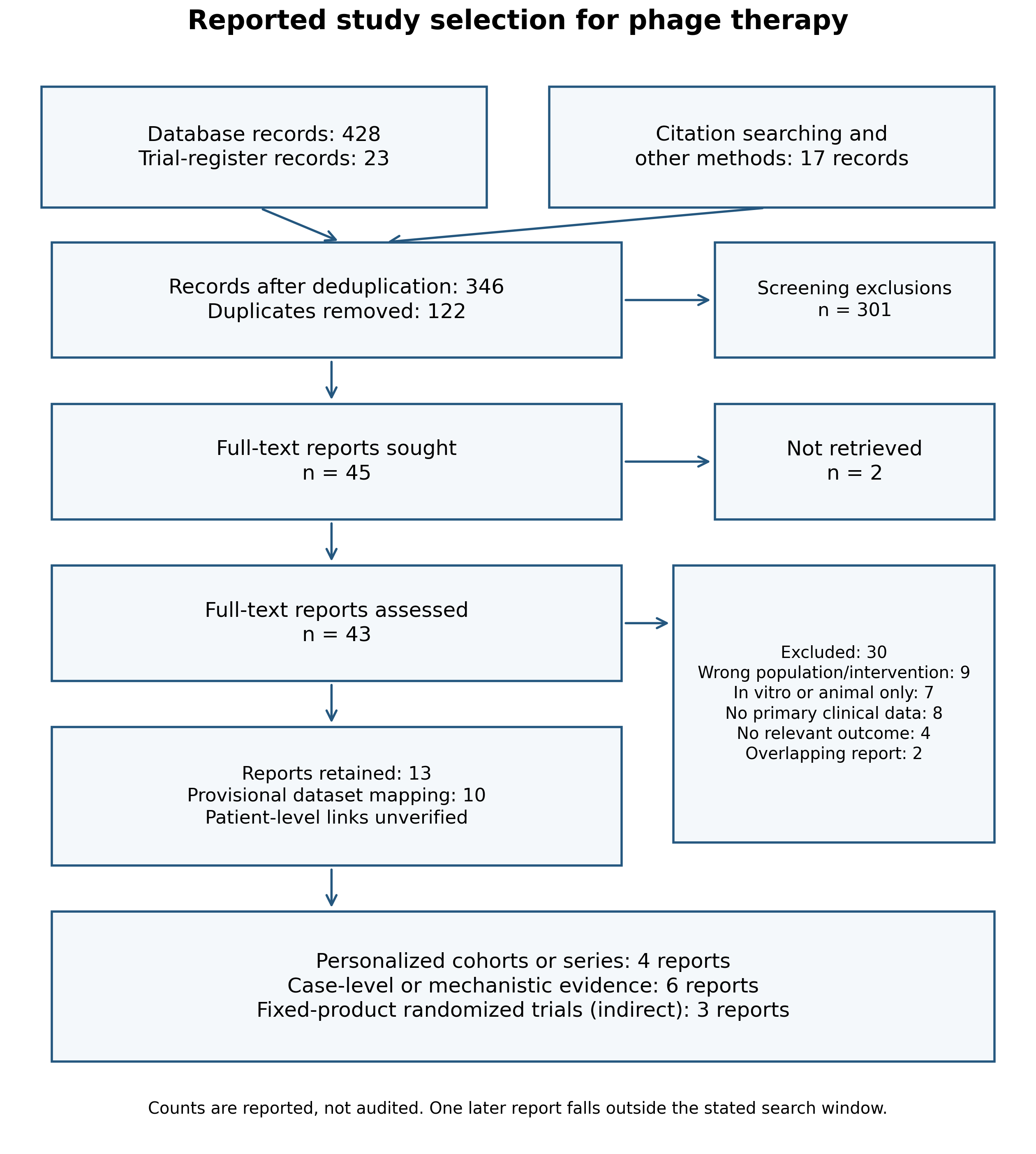
The search flow comprised 468 records: 428 from bibliographic databases, 23 from trial registers, and 17 through citation searching or other methods. After 122 duplicate records were removed, 346 titles and abstracts were screened, of which 301 were excluded. Forty-five full-text reports were sought for retrieval; two reports could not be obtained, leaving 43 reports for full-text assessment. Thirty reports were excluded: nine evaluated the wrong population or intervention, seven contained only in vitro or animal evidence, eight were reviews, editorials, protocols, consensus documents, or methodological publications without eligible primary clinical data, four did not report an extractable relevant clinical outcome, and two were duplicate or overlapping reports without additional data. Thirteen reports were retained and mapped to ten study datasets. The selection pathway is shown in Figure 1.
Figure 1. PRISMA 2020 study-selection flow.
The evidence set contains 13 clinical reports mapped to 10 study datasets; patient-level linkage between potentially overlapping reports cannot be established from the published information. Four reports are primary personalized cohorts or case series, three are separately described case-level reports, three are potentially linked secondary case reports, and three are randomized trials of fixed phage preparations used as indirect evidence. The Gordillo Altamirano report (8) was published after the 5 February 2026 search date, was added during post-search updating, and is reported separately from the main search yield. Table 2 summarizes each report and its contribution.
Table 2. Characteristics and contribution of included clinical reports
| Report | Design and population | Intervention | Main findings | Principal limitations | Role/overlap |
|---|---|---|---|---|---|
| Pirnay et al., 2024 (4) | Retrospective multinational series; 100 patients, 114 infection episodes | Individual isolate-matched phages or cocktails; antibiotics in most episodes | Clinical improvement 88/114; eradication 65/106; PAS 9/10 tested; resistance 7/16 evaluated | Largest consecutive personalized dataset; uncontrolled, heterogeneous, variable follow-up | Primary multinational cohort; probable case links to Ferry et al. and Van Nieuwenhuyse et al.; patient-level matching is not reported in the source publications |
| Chan et al., 2025 (5) | Compassionate-use cohort; 9 adults with cystic fibrosis and MDR or PDR P. aeruginosa | Personalized nebulized phage or cocktail selected to exploit receptor-associated trade-offs | Approximate median sputum reduction 10⁴ CFU/mL; median ppFEV1 increase 6 percentage points; no treatment-related adverse events reported | Small, uncontrolled, short follow-up, concurrent or recent antibiotics | Primary focused cohort; final peer-reviewed report used as the study source. |
| Green et al., 2023 (6) | Retrospective expanded-access series; 12 customized-treatment cases | Patient-specific phage production and treatment across multiple infection types | Bacterial eradication 5/12; clinical improvement 7/12; favorable clinical or microbiological outcome in two-thirds; no significant treatment-related toxicity reported | No comparator, heterogeneous indications, selective referral | Primary expanded-access series; possible partial overlap with Aslam et al. for one case. |
| Aslam et al., 2020 (7) | Single-center retrospective series; first 10 consecutive intravenous cases | Individualized intravenous phage therapy for MDR infections | Successful outcome in 7/10 cases; practical data on timing, regulation, and administration | Small uncontrolled series, major co-interventions | Primary single-center series; has a proposed patient-level link to Schooley et al. |
| Gordillo Altamirano et al., 2026 (8) | Mechanistic failure report; patient with cystic fibrosis and severe Bordetella infection | Compassionate-use personalized therapy | Pre-existing cross-reactive antiphage antibodies and bacterial heteroresistance implicated in failure | Single selected failure; not an effect estimate | Independent mechanistic failure study. |
| Schooley et al., 2017 (18) | Case report; disseminated MDR A. baumannii infection | Personalized phage cocktails plus antibiotics | Clinical rescue signal; resistance and phage-antibiotic interactions were clinically relevant | Single rescue case, multiple co-interventions | Potentially linked secondary case report associated with Aslam et al.; not counted independently in numerical summaries. |
| Dedrick et al., 2019 (19) | Case report; disseminated drug-resistant M. abscessus infection | Engineered phage combination | Clinical and microbiological improvement reported | Single highly selected case; engineered intervention | Independent case-level feasibility study in the current evidence set. |
| Ferry et al., 2022 (20) | Case report; PDR P. aeruginosa spinal abscess | Personalized local and intravenous phages plus surgery and antibiotics | Clinical healing despite bacterial persistence during part of the course | Single case, extensive source control and antibiotics | Potentially linked secondary case report associated with Pirnay et al.; retained for detailed clinical and microbiological information. |
| Köhler et al., 2023 (21) | Case report; chronic MDR P. aeruginosa lung infection | Repeated personalized aerosolized phage treatment | Favorable clinical course with isolate-directed iterative treatment | Single case and repeated co-interventions | Independent case-level airway study. |
| Van Nieuwenhuyse et al., 2022 (22) | Case report; toddler with XDR P. aeruginosa sepsis after liver transplantation | Intravenous phage-antibiotic combination for 86 days | Clinical and microbiological improvement permitting retransplantation; no antibody-mediated neutralization reported | Single pediatric rescue case | Potentially linked secondary case report associated with Pirnay et al.; retained for pediatric and immunological detail. |
| Jault et al., 2019 (23) | Randomized double-blind phase I/II trial in P. aeruginosa burn-wound infection | Fixed low-concentration cocktail, not individually matched | Expected efficacy not demonstrated; delivered titer and formulation were important | Serious indirectness for personalized therapy | Independent indirect randomized study. |
| Leitner et al., 2021 (24) | Randomized placebo-controlled double-blind trial in UTI after transurethral prostate resection | Fixed intravesical preparation | Controlled safety and feasibility data; no direct personalized-treatment estimate | Intervention did not require individual matching | Independent indirect randomized study. |
| Sarker et al., 2016 (25) | Randomized trial in children with acute E. coli diarrhea | Two fixed oral coliphage preparations | No clear clinical benefit established | Target abundance, ecological niche, and host matching limited interpretation | Independent indirect randomized study. |
| Abbreviations for Table 2: AMR, antimicrobial resistance; CFU, colony-forming units; MDR, multidrug-resistant; PDR, pandrug-resistant; XDR, extensively drug-resistant; PAS, phage–antibiotic synergy; ppFEV1, percent-predicted forced expiratory volume in one second; UTI, urinary tract infection. | |||||
Table 2 shows that the numerical evidence is concentrated in four uncontrolled personalized cohorts or case series, whereas the remaining personalized reports primarily contribute detailed information on feasibility, resistance, immune neutralization, and clinical decision-making. The three randomized trials provide more controlled safety and implementation data, but their fixed preparations do not directly test whether isolate-specific matching improves patient outcomes.
Thirteen reports were grouped into ten study datasets. The identified links connect Schooley et al. (18) with Aslam et al. (7), and Ferry et al. (20) and Van Nieuwenhuyse et al. (22) with Pirnay et al. (4). These links are treated as probable rather than confirmed patient-level matches, because the published reports do not provide patient-level identifiers. Probable partial overlap also concerns Green et al. (6) and Aslam et al. (7) for a liver-transplant recipient with recurrent MDR Escherichia coli urinary infection. Secondary reports contribute clinical or mechanistic detail only. Patient counts and outcomes are not added across potentially overlapping reports, and no total number of unique patients is claimed.
Table 3. Report-to-study overlap assessment
| Primary report | Linked report | Classification | Treatment in synthesis |
|---|---|---|---|
| Aslam et al., 2020 (7) | Schooley et al., 2017 (18) | Probable linkage; patient-level identifiers not reported | Aslam used for series-level outcomes; Schooley retained only for detailed mechanism and clinical course. |
| Pirnay et al., 2024 (4) | Ferry et al., 2022 (20) | Probable linkage; patient-level identifiers not reported | Pirnay used for cohort outcomes; Ferry retained for detailed management of PDR spinal infection. |
| Pirnay et al., 2024 (4) | Van Nieuwenhuyse et al., 2022 (22) | Probable linkage; patient-level identifiers not reported | Pirnay used for cohort outcomes; Van Nieuwenhuyse retained for pediatric, transplant, and neutralization detail. |
| Green et al., 2023 (6) | Aslam et al., 2020 (7) | Possible partial overlap | No cross-series pooling or combined patient total, because the case linkage cannot be confirmed from the published reports. |
Table 3 separates report-level inclusion from patient-level independence. Cohort outcomes are presented using the denominator in each primary publication; potentially linked case reports provide additional detail only. No aggregate patient denominator is calculated across reports with unresolved overlap.
A preliminary report on anti-phage antibodies described neutralizing activity after treatment and raised concern that antibody-mediated reduction of phage exposure may limit response in chronic infection (8). The observation supports longitudinal immune monitoring, but its clinical significance remains uncertain and should not be interpreted as proof of treatment failure in all patients.
The strongest direct numerical evidence was the multinational series reported by Pirnay et al. (4). The unit of analysis was the treated infection episode. Clinical improvement occurred in 88 of 114 episodes (77.2%), and eradication of the target organism was documented in 65 of 106 episodes with microbiological follow-up (61.3%). These results provide a clinically relevant signal across severe and heterogeneous infections, but they do not establish a counterfactual outcome because the study had no concurrent control group and most patients received antibiotics, source control, or other interventions.
Green et al. reported 12 expanded-access cases managed through a customized production pipeline (6). Bacterial eradication was reported in 5 of 12 cases and clinical improvement in 7 of 12; overall, two-thirds had a favorable clinical or microbiological outcome. The series demonstrates feasibility across pathogens and clinical settings, but outcome definitions and follow-up differed between patients.
Aslam et al. described the first 10 consecutive intravenous phage-therapy cases at a single United States center (7). Successful outcomes were reported in 7 of 10 cases. The report is particularly informative regarding referral, regulatory procedures, product acquisition, timing, and administration, but its small size and extensive co-interventions preclude causal estimation.
The cystic fibrosis cohort reported by Chan et al. (5) provides a more clinically focused estimate. Nine adults received personalized inhaled phage therapy directed against MDR or PDR P. aeruginosa. The median sputum bacterial-load reduction was approximately 10⁴ colony-forming units per milliliter during short-term follow-up, and the median increase in percent-predicted forced expiratory volume in one second (ppFEV1) was 6 percentage points. The temporal pattern is biologically coherent, but the sample was small and uncontrolled, and concurrent or recent antibiotic exposure limits attribution.
Independent case-level studies demonstrate operational feasibility in drug-resistant M. abscessus infection treated with engineered phages (19) and chronic MDR P. aeruginosa airway infection treated with repeated isolate-directed aerosolized phages (21). Linked secondary reports provide additional detail on disseminated A. baumannii infection (18), PDR P. aeruginosa spinal infection (20), and XDR P. aeruginosa sepsis after liver transplantation (22), but these patients were not added to series totals because overlap remains possible.
The failure report by the anti-phage antibody report (8) is methodologically valuable because it describes an unsuccessful course rather than a selected clinical success. Pre-existing cross-reactive antiphage antibodies and bacterial heteroresistance were implicated in treatment failure, illustrating that in vitro susceptibility at a single time point may not predict adequate in vivo exposure or durable population-level bacterial susceptibility.
Three randomized trials were retained as indirect evidence because they evaluated fixed products rather than treatment selected against the patient’s isolate (23,24,25). PhagoBurn demonstrated that inadequate delivered titer, product instability, and non-personalized formulation can obscure a clinical effect even in a biologically plausible indication (23). The intravesical urinary-tract trial showed that controlled administration is feasible, but it did not test whether isolate-specific matching improves outcome (24). The pediatric diarrhea trial did not establish a clear clinical benefit and highlighted the importance of target abundance, ecological niche, and effective host coverage (25). These trials were therefore interpreted primarily as evidence about formulation, exposure, safety, and trial design rather than direct tests of personalized therapy.
Phage susceptibility testing: a spot test alone may overestimate activity because clearing can result from lysis from without or from high local phage concentrations. Plaque-based testing, efficiency of plating, and liquid growth kinetics provide complementary information (26,27).
Phage-antibiotic interactions: Phage–antibiotic synergy (PAS) was observed in 9 of 10 tested cases in the Pirnay series (4). This small and selected denominator should be interpreted as a process signal rather than proof of universal synergy.
Phage resistance: resistance emerged in 7 of 16 evaluated cases in the Pirnay series (4). Resistance can sometimes impose a fitness cost or restore antibiotic susceptibility, but this requires isolate-specific validation (28).
Antiphage immunity: pre-existing or treatment-induced neutralizing antibodies may be relevant in chronic infection, repeated courses, and systemic administration (8).
Source control and concomitant therapy: drainage, debridement, device removal, and active antibiotics remain integral components of care and major confounders of observed outcome.
Short-term tolerability was generally acceptable. In the 100-patient series, seven suspected non-serious adverse reactions were reported and resolved (4). No treatment-related adverse events were reported in the nine-patient inhaled cystic fibrosis cohort (5), and the 12-case expanded-access series did not identify significant treatment-related toxicity (6). A previous systematic review similarly found that serious toxicity attributable to phages was uncommon, although adverse-event ascertainment was inconsistent and follow-up was usually short (29).
Safety interpretation must remain route-specific. For systemic administration, sterility, endotoxin burden, residual host-cell material, infusion reactions, cytokine responses, and immune neutralization require explicit monitoring. Absence of reported toxicity in compassionate-use reports should not be equated with definitive safety because outcome ascertainment was rarely standardized.
Confidence in effectiveness is limited by uncontrolled observational designs, small samples, heterogeneous definitions, co-interventions, probable publication overlap and selective reporting. No randomized trial directly evaluated the isolate-matched strategy addressed here. The outcome summaries in Table 4 are descriptive and are not formal GRADE ratings.
Table 4. Outcome summary and limitations of confidence
| Outcome | Observed evidence | Certainty statement | Rationale |
|---|---|---|---|
| Clinical improvement | 88/114 episodes in the largest series; 7/10 successful outcomes in one intravenous series; 7/12 improved in an expanded-access series | Narrative | Uncontrolled designs, co-interventions, heterogeneous definitions, potential overlap, and probable publication bias. |
| Microbiological eradication | 65/106 episodes in the largest series; 5/12 cases in an expanded-access series | Narrative | Variable sampling, timing, infection sites, and definitions; no randomized personalized comparison. |
| Bacterial-load reduction in cystic fibrosis | Approximate median reduction of 10⁴ CFU/mL in 9 adults | Narrative | Small uncontrolled cohort, short follow-up, concurrent or recent antibiotics. |
| Lung function in cystic fibrosis | Median ppFEV1 increase of 6 percentage points | Narrative | No comparator, imprecision, regression to the mean, and uncertain attribution. |
| Short-term safety | Mostly non-serious reactions in personalized series; randomized fixed-product trials provide additional indirect safety data | Narrative | Inconsistent ascertainment, short follow-up, route heterogeneity, and indirectness of fixed-product trials. |
Table 4 shows that effectiveness estimates are vulnerable to confounding, imprecision and reporting bias. The generally favorable direction of findings does not establish causality. Short-term safety data are also limited by inconsistent ascertainment, route heterogeneity and indirect randomized evidence; uncommon reported serious toxicity is not, by itself, a basis for a higher certainty rating.
Table 5 summarizes descriptive limitations by design. Uncontrolled cohorts and case reports do not provide comparative effect estimates. For randomized fixed-product trials, internal validity is considered separately from applicability: inadequate delivered titer or host coverage may affect intervention interpretation, but does not alone establish a RoB 2 category. No formal outcome-level RoB 2 categories are assigned.
Table 5. Study-level methodological assessment and principal limitations
| Study | Tool | Interpretation | Main basis |
|---|---|---|---|
| Pirnay et al., 2024 (4) | JBI case-series domains | Major methodological limitations | Uncontrolled compassionate-use treatment, confounding by antibiotics and source control, heterogeneous outcomes, and variable follow-up. |
| Chan et al., 2025 (5) | JBI case-series domains | Major methodological limitations | Small sample, no comparator, short follow-up, and concurrent or recent antibiotics. |
| Green et al., 2023 (6) | JBI case-series domains | Major methodological limitations | Selective referral, heterogeneous indications and outcomes, no comparator. |
| Aslam et al., 2020 (7) | JBI case-series domains | Major methodological limitations | Small single-center series, extensive co-interventions, and non-standardized outcomes. |
| Gordillo Altamirano et al., 2026 (8) | JBI case-report domains | Not suitable for effect estimation | Single selected failure case; high mechanistic value but no average effect estimate. |
| Schooley et al., 2017 (18) | JBI case-report domains | Not independently counted for effect estimation | Single rescue case and multiple co-interventions. |
| Dedrick et al., 2019 (19) | JBI case-report domains | Not suitable for effect estimation | Single highly selected case and engineered intervention. |
| Ferry et al., 2022 (20) | JBI case-report domains | Not independently counted for effect estimation | Single case with surgery and multiple antibacterial interventions. |
| Köhler et al., 2023 (21) | JBI case-report domains | Not suitable for effect estimation | Single case, repeated treatments, and time-varying co-interventions. |
| Van Nieuwenhuyse et al., 2022 (22) | JBI case-report domains | Not independently counted for effect estimation | Single pediatric rescue case with intensive multidisciplinary care. |
| Jault et al., 2019 (23) | RoB 2 | Appraised descriptively | Appraisal is descriptive; signaling questions were not completed. Intervention applicability and delivered exposure require separate interpretation. |
| Leitner et al., 2021 (24) | RoB 2 | Appraised descriptively | Appraisal is descriptive; signaling questions were not completed. Intervention applicability and delivered exposure require separate interpretation. |
| Sarker et al., 2016 (25) | RoB 2 | Appraised descriptively | Appraisal is descriptive; signaling questions were not completed. Intervention applicability and delivered exposure require separate interpretation. |
No direct personalized study supplied a low-risk comparative estimate of treatment effect. Recurring limitations include lack of a concurrent comparator, confounding by antibiotics and source control, selective access, variable follow-up and non-standardized outcomes. Potentially linked case reports were not added to cohort totals. Fixed-product trials are appraised descriptively rather than through completed RoB 2 judgments.
This review identifies a coherent pattern with substantial uncertainty. Personalized phage therapy is technically feasible and has produced repeated clinical and microbiological signals in selected patients with severe drug-resistant infections. The strongest numerical evidence comes from uncontrolled multinational and expanded-access series rather than randomized personalized comparisons. Confidence in an efficacy estimate therefore remains very limited, even when the observed proportions of clinical improvement or microbiological response appear substantial.
The distinction between personalized therapy and fixed-product randomized trials is central. Randomization supports causal comparisons within a trial; applicability to personalized therapy depends on how closely the tested intervention represents that strategy. A fixed preparation with incomplete host coverage, inadequate delivered titer, or unstable formulation cannot directly answer whether a correctly matched phage is effective against a susceptible patient isolate. Conversely, an uncontrolled personalized case cannot determine how much improvement was caused by the phage rather than antibiotics, surgery, drainage, device removal, natural recovery, or selective reporting. The evidence layers are complementary, but they answer different questions.
The review also shows that personalization is not equivalent to observing a clear zone on agar. A reproducible clinical pathway requires strain-level identification of the bacterial pathogen, complementary susceptibility methods, explicit assessment of the antibiotics retained in the regimen, predefined microbiological sampling, and repeat testing when cultures remain positive. In chronic or repeatedly treated patients, neutralizing activity may alter systemic or local exposure even when the phage remains active in vitro.
Phage-antibiotic interaction is promising but should be described cautiously. The high proportion of PAS among tested cases in the multinational series is notable (4), but the denominator was small and testing was selective. PAS should therefore be prospectively incorporated when feasible, particularly when phages are intended as adjuncts to a predefined antibiotic regimen, rather than presented as a proven universal modifier of response.
Resistance should be incorporated into protocol design rather than treated as an unexpected event. Because phages and bacteria co-evolve, resistant or heteroresistant subpopulations may emerge rapidly. The clinical consequence depends on the receptor involved, the fitness cost of resistance, and whether resistance changes antibiotic susceptibility or virulence (8,28). Serial isolate collection is therefore essential to determine whether resistance represents loss of therapeutic activity, an exploitable evolutionary shift, or both.
The evidence favors development through centralized or networked phage libraries rather than ad hoc product acquisition. A clinically useful library should include whole-genome sequencing, exclusion of lysogeny and undesirable genes, host-range annotation, production history, titer and stability data, endotoxin and sterility results, PAS profiles, and prior clinical-use information (27,30). For acute intensive-care indications, turnaround time from isolate receipt to qualified product delivery may be as important as nominal in vitro activity.
Future evaluation should not be restricted to conventional fixed-product parallel-group trials. Adaptive platform trials, registry-embedded randomized components, N-of-1 sequences in stable chronic disease, and prospective registries with target-trial emulation may preserve isolate matching while improving comparability. Common laboratory rules, product-quality standards, predefined outcome definitions, independent endpoint assessment, and transparent reporting of unsuccessful cases are necessary regardless of design.
The following framework is a review-derived proposal rather than an established universal clinical standard:
A fresh clinical isolate with strain-level identification, antimicrobial susceptibility testing, and confirmation that the recovered organism is clinically relevant.
Phage susceptibility testing using complementary methods, preferably a plaque-based assay or efficiency of plating together with liquid growth kinetics; a spot test alone should not determine eligibility.
Prospective assessment of phage-antibiotic interactions when phages are used with a defined antibiotic regimen, with explicit reporting of concentrations, sequence, timing, and interpretation criteria.
Whole-genome characterization of therapeutic phages, including exclusion of lysogeny, toxin, antimicrobial-resistance, and other undesirable genes.
Route-specific quality control, including identity, titer, sterility or bioburden, endotoxin, stability, storage conditions, and manufacturing traceability.
A predefined treatment plan describing route, dose, frequency, duration, concomitant antibiotics, source control, and criteria for modification or discontinuation.
Baseline and longitudinal cultures with repeat susceptibility testing when the target organism persists or recurs.
Assessment of neutralizing antiphage activity when technically feasible in chronic infection, repeated exposure, or systemic administration.
Prospectively defined clinical, microbiological, functional, and safety endpoints with a fixed follow-up schedule.
For cystic fibrosis airway infection, preferred endpoints include sputum bacterial burden, ppFEV1, pulmonary exacerbations, systemic antibiotic exposure, respiratory symptoms, hospitalization, and microbiome disruption. For bloodstream or intensive-care infections, relevant endpoints include time to clearance of bacteremia, 14- or 28-day mortality, organ dysfunction, vasopressor-free or ventilator-free days, adequacy of source control, and serious adverse events.
The evidence base is dominated by compassionate-use cohorts and case reports, with substantial risks of selection, confounding, outcome-assessment bias, and selective publication. Successful or unusual cases are more likely to be reported than routine failures.
Intervention heterogeneity was substantial. Studies differed in pathogen, infection site, phage source, matching procedure, formulation, titer, route, antibiotic co-therapy, source control, treatment duration, and outcome definition. Pooling would therefore produce a summary estimate with limited biological meaning.
The protocol was not prospectively registered. Eligibility criteria and synthesis rules were standardized for this revision, but the absence of prospective registration limits confidence regarding the chronology of decisions.
Publication and participant overlap was assessed at report level. Three case reports were treated as potentially nested within larger series and were not added to cohort totals. A probable partial overlap between two expanded-access series could not be resolved from the published information. The ten-dataset mapping therefore rests on the published descriptions, since patient-level identifiers are not reported in the source publications.
Outcome definitions and adverse-event ascertainment were inconsistent. Long-term safety, immune neutralization, microbiome effects, and durability of microbiological response remain incompletely characterized.
Personalized phage therapy for drug-resistant and otherwise difficult-to-treat bacterial infections has progressed beyond isolated biological speculation. Human studies demonstrate operational feasibility, generally acceptable short-term tolerability, and repeated clinical and microbiological signals, particularly when phages are matched to the patient’s isolate and integrated with antibiotics and source control. Nevertheless, confidence in effectiveness remains very limited because direct evidence is dominated by uncontrolled compassionate-use experience, heterogeneous co-interventions, potential report overlap, and selective publication.
The most scientifically defensible development model is adjunctive precision infectious-disease care rather than replacement of antibiotics. This model requires a matched and quality-controlled phage preparation, optimized antibacterial therapy, appropriate source control, dynamic microbiological monitoring, planned assessment of resistance and heteroresistance, and attention to antiphage immunity. Evidence-based implementation will depend on standardized susceptibility procedures, transparent reporting of both successes and failures, route-specific manufacturing standards, centralized phage libraries, and adaptive or registry-embedded trials that preserve individual matching while improving causal inference.
Author contributions: AS: Conceptualization, Methodology, Investigation, Data curation, Formal analysis, and Writing – original draft. DM: Methodology, Investigation, Data curation, and Writing – review and editing. PE: Investigation, Formal analysis, Validation, and Writing – review and editing. All authors have read and approved the final manuscript and agree to be accountable for all aspects of the work.
Funding: No specific funding was received for the preparation of this review.
Conflicts of interest: The authors have no competing interests to disclose.
Acknowledgments: The authors thank the clinical teams whose treated cases and cohorts made this synthesis possible, and acknowledge the PRISMA 2020 statement, which guided the reporting of study selection and data handling.
Data availability statement: Outcome data are available in the cited publications. Search strategies, selection counts, grouped exclusion reasons and the overlap assessment are reported in the manuscript and in Supplementary Table S1. Per-source export files, reviewer-level screening records, the citation-level exclusion log, the identities of the two unretrieved reports and the completed extraction forms are not included in the supplementary material.
AI use statement: ChatGPT (OpenAI) was used to edit language, check internal consistency, position citations and format the manuscript. No new systematic search and no formal risk-of-bias assessment were delegated to the tool. Responsibility for the final content and for these declarations rests with the authors.
1. Antimicrobial Resistance Collaborators. Global burden of bacterial antimicrobial resistance in 2019: a systematic analysis. Lancet. 2022;399(10325):629-655. doi:10.1016/S0140-6736(21)02724-0.
2. World Health Organization. Global action plan on antimicrobial resistance. Geneva: World Health Organization; 2015. Available from: https://www.who.int/publications/i/item/9789241509763
3. European Centre for Disease Prevention and Control. 35 000 annual deaths from antimicrobial resistance in the EU/EEA. Stockholm: ECDC; 2022 Nov 17. Available from: https://www.ecdc.europa.eu/en/news-events/eaad-2022-launch
4. Pirnay JP, Djebara S, Steurs G, et al. Personalized bacteriophage therapy outcomes for 100 consecutive cases: a multicentre, multinational, retrospective observational study. Nat Microbiol. 2024;9(6):1434-1453. doi:10.1038/s41564-024-01705-x.
5. Chan BK, Stanley GL, Kortright KE, et al. Personalized inhaled bacteriophage therapy for treatment of multidrug-resistant Pseudomonas aeruginosa in cystic fibrosis. Nat Med. 2025;31(5):1494-1501. doi:10.1038/s41591-025-03678-8.
6. Green SI, Clark JR, Santos HH, et al. A retrospective, observational study of 12 cases of expanded-access customized phage therapy: production, characteristics, and clinical outcomes. Clin Infect Dis. 2023;77(8):1079-1091. doi:10.1093/cid/ciad335.
7. Aslam S, Lampley E, Wooten D, et al. Lessons learned from the first 10 consecutive cases of intravenous bacteriophage therapy to treat multidrug-resistant bacterial infections at a single center in the United States. Open Forum Infect Dis. 2020;7(9):ofaa389. doi:10.1093/ofid/ofaa389.
8. Łusiak-Szelachowska M, Międzybrodzki R, Rogóż P, Weber-Dąbrowska B, Żaczek M, Górski A. Do anti-phage antibodies persist after phage therapy? A preliminary report. Antibiotics (Basel). 2022;11(10):1358. doi:10.3390/antibiotics11101358.
9. Page MJ, McKenzie JE, Bossuyt PM, et al. The PRISMA 2020 statement: an updated guideline for reporting systematic reviews. BMJ. 2021;372:n71. doi:10.1136/bmj.n71.
10. Page MJ, Moher D, Bossuyt PM, et al. PRISMA 2020 explanation and elaboration: updated guidance and exemplars for reporting systematic reviews. BMJ. 2021;372:n160. doi:10.1136/bmj.n160.
11. Rethlefsen ML, Kirtley S, Waffenschmidt S, et al. PRISMA-S: an extension to the PRISMA Statement for Reporting Literature Searches in Systematic Reviews. Syst Rev. 2021;10(1):39. doi:10.1186/s13643-020-01542-z.
12. Sterne JAC, Savović J, Page MJ, et al. RoB 2: a revised tool for assessing risk of bias in randomised trials. BMJ. 2019;366:l4898. doi:10.1136/bmj.l4898.
13. Munn Z, Barker TH, Moola S, et al. Methodological quality of case series studies: an introduction to the JBI critical appraisal tool. JBI Evid Synth. 2020;18(10):2127-2133. doi:10.11124/jbisrir-d-19-00099.
14. JBI. Checklist for case reports [Internet]. Adelaide: JBI; 2017. Available from: https://jbi.global/sites/default/files/2019-05/JBI_Critical_Appraisal-Checklist_for_Case_Reports2017_0.pdf
15. Sterne JA, Hernán MA, Reeves BC, et al. ROBINS-I: a tool for assessing risk of bias in non-randomised studies of interventions. BMJ. 2016;355:i4919. doi:10.1136/bmj.i4919.
16. Guyatt G, Oxman AD, Akl EA, et al. GRADE guidelines: 1. Introduction - GRADE evidence profiles and summary of findings tables. J Clin Epidemiol. 2011;64(4):383-394. doi:10.1016/j.jclinepi.2010.04.026.
17. Campbell M, McKenzie JE, Sowden A, et al. Synthesis without meta-analysis (SWiM) in systematic reviews: reporting guideline. BMJ. 2020;368:l6890. doi:10.1136/bmj.l6890.
18. Schooley RT, Biswas B, Gill JJ, et al. Development and use of personalized bacteriophage-based therapeutic cocktails to treat a patient with a disseminated resistant Acinetobacter baumannii infection. Antimicrob Agents Chemother. 2017;61(10):e00954-17. doi:10.1128/aac.00954-17.
19. Dedrick RM, Guerrero-Bustamante CA, Garlena RA, et al. Engineered bacteriophages for treatment of a patient with a disseminated drug-resistant Mycobacterium abscessus. Nat Med. 2019;25(5):730-733. doi:10.1038/s41591-019-0437-z.
20. Ferry T, Kolenda C, Laurent F, et al. Personalized bacteriophage therapy to treat pandrug-resistant spinal Pseudomonas aeruginosa infection. Nat Commun. 2022;13(1):4239. doi:10.1038/s41467-022-31837-9.
21. Köhler T, Luscher A, Falconnet L, et al. Personalized aerosolised bacteriophage treatment of a chronic lung infection due to multidrug-resistant Pseudomonas aeruginosa. Nat Commun. 2023;14(1):3629. doi:10.1038/s41467-023-39370-z.
22. Van Nieuwenhuyse B, Van der Linden D, Chatzis O, et al. Bacteriophage-antibiotic combination therapy against extensively drug-resistant Pseudomonas aeruginosa infection to allow liver transplantation in a toddler. Nat Commun. 2022;13(1):5725. doi:10.1038/s41467-022-33294-w.
23. Jault P, Leclerc T, Jennes S, et al. Efficacy and tolerability of a cocktail of bacteriophages to treat burn wounds infected by Pseudomonas aeruginosa (PhagoBurn): a randomised, controlled, double-blind phase 1/2 trial. Lancet Infect Dis. 2019;19(1):35-45. doi:10.1016/s1473-3099(18)30482-1.
24. Leitner L, Ujmajuridze A, Chanishvili N, et al. Intravesical bacteriophages for treating urinary tract infections in patients undergoing transurethral resection of the prostate: a randomised, placebo-controlled, double-blind clinical trial. Lancet Infect Dis. 2021;21(3):427-436. doi:10.1016/s1473-3099(20)30330-3.
25. Sarker SA, Sultana S, Reuteler G, et al. Oral phage therapy of acute bacterial diarrhea with two coliphage preparations: a randomized trial in children from Bangladesh. EBioMedicine. 2016;4:124-137. doi:10.1016/j.ebiom.2015.12.023.
26. Daubie V, Chalhoub H, Blasdel B, et al. Determination of phage susceptibility as a clinical diagnostic tool: a routine perspective. Front Cell Infect Microbiol. 2022;12:1000721. doi:10.3389/fcimb.2022.1000721.
27. Yerushalmy O, Braunstein R, Alkalay-Oren S, et al. Towards Standardization of Phage Susceptibility Testing: The Israeli Phage Therapy Center "Clinical Phage Microbiology"-A Pipeline Proposal. Clin Infect Dis. 2023;77(Suppl 5):S337-S351. doi:10.1093/cid/ciad514.
28. Chan BK, Sistrom M, Wertz JE, Kortright KE, Narayan D, Turner PE. Phage selection restores antibiotic sensitivity in MDR Pseudomonas aeruginosa. Sci Rep. 2016;6:26717. doi:10.1038/srep26717.
29. Uyttebroek S, Chen B, Onsea J, et al. Safety and efficacy of phage therapy in difficult-to-treat infections: a systematic review. Lancet Infect Dis. 2022;22(8):e208-e220. doi:10.1016/s1473-3099(21)00612-5.
30. Pires DP, Costa AR, Pinto G, Meneses L, Azeredo J. Current challenges and future opportunities of phage therapy. FEMS Microbiol Rev. 2020;44(6):684-700. doi:10.1093/femsre/fuaa017.
Table S1. Database-specific search strategies
| Source | Full strategy or reproducible procedure |
|---|---|
| PubMed/MEDLINE | ("Bacteriophage Therapy"[MeSH Terms] OR "phage therapy"[tiab] OR bacteriophage*[tiab] OR phagotherapy[tiab] OR "therapeutic phage"[tiab] OR "therapeutic phages"[tiab]) AND (personalized[tiab] OR personalised[tiab] OR individualized[tiab] OR individualised[tiab] OR tailored[tiab] OR customized[tiab] OR customised[tiab] OR "compassionate use"[tiab] OR "expanded access"[tiab] OR susceptibility[tiab] OR "host range"[tiab] OR "phage-antibiotic"[tiab]) AND (infection*[tiab] OR bacteremia[tiab] OR sepsis[tiab] OR MDR[tiab] OR XDR[tiab] OR PDR[tiab] OR "multidrug-resistant"[tiab] OR "drug-resistant"[tiab] OR "difficult-to-treat"[tiab]) |
| Embase (Elsevier) | ('phage therapy'/exp OR 'bacteriophage'/exp OR 'phage therapy':ti,ab OR bacteriophage*:ti,ab OR phagotherapy:ti,ab) AND (personalized:ti,ab OR personalised:ti,ab OR individualized:ti,ab OR tailored:ti,ab OR customized:ti,ab OR 'compassionate use':ti,ab OR 'expanded access':ti,ab OR susceptibility:ti,ab OR 'host range':ti,ab OR 'phage antibiotic':ti,ab) AND (infection*:ti,ab OR sepsis:ti,ab OR bacteremia:ti,ab OR MDR:ti,ab OR XDR:ti,ab OR PDR:ti,ab OR 'multidrug resistant':ti,ab OR 'drug resistant':ti,ab OR 'difficult to treat':ti,ab) |
| Scopus | TITLE-ABS-KEY(("phage therapy" OR bacteriophage* OR phagotherapy OR "therapeutic phage*") AND (personalized OR personalised OR individualized OR individualised OR tailored OR customized OR customised OR "compassionate use" OR "expanded access" OR susceptibility OR "host range" OR "phage-antibiotic") AND (infection* OR sepsis OR bacteremia OR MDR OR XDR OR PDR OR "multidrug-resistant" OR "drug-resistant" OR "difficult-to-treat")) |
| Web of Science Core Collection | TS=(("phage therapy" OR bacteriophage* OR phagotherapy OR "therapeutic phage*") AND (personalized OR personalised OR individualized OR individualised OR tailored OR customized OR customised OR "compassionate use" OR "expanded access" OR susceptibility OR "host range" OR "phage-antibiotic") AND (infection* OR sepsis OR bacteremia OR MDR OR XDR OR PDR OR "multidrug-resistant" OR "drug-resistant" OR "difficult-to-treat")) |
| Cochrane CENTRAL | ("phage therapy" OR bacteriophage* OR phagotherapy):ti,ab,kw AND (personalized OR personalised OR individualized OR tailored OR customized OR "compassionate use" OR susceptibility OR "host range"):ti,ab,kw AND (infection* OR MDR OR XDR OR PDR OR "drug resistant" OR "difficult to treat"):ti,ab,kw |
| ClinicalTrials.gov | Condition/disease: bacterial infection OR antimicrobial-resistant infection. Other terms: (phage therapy OR bacteriophage) AND (personalized OR susceptibility OR MDR OR XDR OR PDR). Study type: interventional and observational. Recruitment status: all. Search date: 5 February 2026; 23 records identified. Export all records and archive the file. |
| Citation searching | Screen reference lists of all included reports and relevant systematic reviews. Perform forward citation searching for the principal personalized cohorts and randomized trials. Search date: 5 February 2026. Record platform, seed article, and the number of unique reports identified. |
| PubMed complementary fixed-product trial search (replication query) | ("phage therapy"[tiab] OR bacteriophage*[tiab] OR phagotherapy[tiab]) AND (randomized controlled trial[pt] OR controlled clinical trial[pt] OR random*[tiab] OR placebo[tiab] OR trial[tiab]) |
| Complementary routes for other sources (replication queries) | Embase, Scopus, Web of Science and CENTRAL: combine the phage-therapy block with trial/randomization/placebo terms, without requiring personalization. ClinicalTrials.gov: phage therapy OR bacteriophage; include interventional trials without a strain-matching restriction. Record actual execution dates, yields, exports and the route for every retained report. |
Note: Table S1 lists the search strategies used, together with complementary replication queries for fixed-product trials. The complementary queries omit the mandatory personalization block and are provided for replication rather than as executed searches. Per-source exports and citation seeds are not included in the supplementary material; the retrieval route of the fixed-product trials and of the later report (8) is described in the Methods.
Table S2. PRISMA 2020 reporting checklist
| Item | Topic | Location and reporting status |
|---|---|---|
| 1 | Title | Title identifies a systematic review. |
| 2 | Abstract | Four-part Abstract; registration reported; funding in closing declaration. |
| 3 | Rationale | Introduction. |
| 4 | Objectives | Introduction, final paragraph. |
| 5 | Eligibility criteria | Methods—Eligibility criteria; Table 1. |
| 6 | Information sources | Methods—Information sources; Table S1. Later report retrieval date/route missing. |
| 7 | Search strategy | Table S1; strategies reported by source. |
| 8 | Selection process | Methods – Study selection: duplicate screening with third-reviewer adjudication. |
| 9 | Data collection process | Methods – Data extraction: duplicate extraction and consensus reconciliation. |
| 10a | Data items - outcomes | Methods—Data extraction; Table 4. |
| 10b | Data items - other variables | Methods—Data extraction; Tables 1–3. |
| 11 | Risk of bias assessment | Methods – Risk of bias; Table 5: descriptive appraisal by domain. |
| 12 | Effect measures | Methods—Synthesis; Results. Original denominators retained; no pooled effect. |
| 13a | Synthesis methods | Methods—Synthesis and unit of analysis; evidence layers. |
| 13b | Synthesis methods | Methods—Selection and synthesis. Overlapping participants not summed. |
| 13c | Synthesis methods | Tables 2–5; Figure 1. |
| 13d | Synthesis methods | Methods—Synthesis. Narrative synthesis; heterogeneity explains no meta-analysis. |
| 13e | Synthesis methods | Results—Treatment-process determinants; Discussion. Narrative comparisons only. |
| 13f | Synthesis methods | Not applicable: no meta-analysis was performed. |
| 14 | Reporting bias assessment | Limitations: selective publication discussed narratively. |
| 15 | Certainty assessment | Methods – Certainty: GRADE domains discussed narratively. |
| 16a | Study selection | Results – Study selection; Figure 1. |
| 16b | Study selection | Grouped reasons only; individual exclusion and unretrieved-report lists missing. |
| 17 | Study characteristics | Table 2. |
| 18 | Risk of bias in studies | Table 5: descriptive limitations by domain. |
| 19 | Results of individual studies | Results; Tables 2 and 4. |
| 20a | Results of syntheses | Results—Evidence layers and risk of bias. |
| 20b | Results of syntheses | Not applicable: no statistical synthesis. |
| 20c | Results of syntheses | Narrative comparison of designs, matching and co-interventions. |
| 20d | Results of syntheses | Not applicable: no meta-analysis was performed. |
| 21 | Reporting biases | Limitations: reporting bias discussed narratively. |
| 22 | Certainty of evidence | Table 4: narrative certainty statement. |
| 23a | Interpretation | Discussion. |
| 23b | Limitations of evidence | Discussion—Limitations. |
| 23c | Limitations of review processes | Discussion—Limitations; Methods documentation caveats. |
| 23d | Implications | Discussion—Future study requirements; Conclusions. |
| 24a | Registration | Methods – Protocol status: not prospectively registered. |
| 24b | Protocol | Methods – Protocol status: no public protocol deposited. |
| 24c | Amendments | No prospective registered protocol; revision-time decisions disclosed. |
| 25 | Support | Funding declaration. |
| 26 | Competing interests | Conflicts of interest declaration. |
| 27 | Availability of data, code and materials | Data availability declaration; Table S1. |
GMR GLOBAL MEDICAL REVIEWS Volume 1 • Issue 1 • 2026 • Article e0004 |
OPEN ACCESS CC BY 4.0 |
|---|