Obesity is a chronic, relapsing, and biologically heterogeneous disease that requires long-term management. The 2025 World Health Organization guideline placed GLP-1-based medicines within comprehensive chronic obesity care (1), while the U.S. Food and Drug Administration expanded the indication for semaglutide 2.4 mg to reduction of major cardiovascular events in adults with established cardiovascular disease and overweight or obesity (2). These developments make drug selection a clinical outcome question rather than a choice based solely on the percentage of weight lost.
Semaglutide produced substantial weight reduction in STEP 1 (3), but withdrawal was followed by marked regain and partial reversal of cardiometabolic improvement (4). Tirzepatide produced substantial reductions in SURMOUNT-1 (5), supported maintenance when continued in SURMOUNT-4 (6), and was superior to semaglutide in the head-to-head SURMOUNT-5 trial (7). Oral semaglutide (8), oral orforglipron in phase 2 and phase 3 trials (9, 10), and the triple agonist retatrutide (11) have expanded the range of administration routes and expected efficacy.
Comorbidity changes the hierarchy of evidence. Semaglutide has cardiovascular outcome data from SELECT and its long-term weight analysis (12, 13). In obesity-related heart failure with preserved ejection fraction (HFpEF), semaglutide improved symptoms, physical limitations, and exercise function in patients without and with type 2 diabetes (14, 15), whereas tirzepatide reduced a composite of cardiovascular death or worsening heart failure in SUMMIT (16). Tirzepatide also has direct randomized evidence in obstructive sleep apnea (OSA) (17). Hepatic evidence includes phase 2 and phase 3 semaglutide trials (18, 19) and the phase 2 SYNERGY-NASH trial of tirzepatide (20). Long-term follow-up from SURMOUNT-1 further supports tirzepatide in people with prediabetes (21).
The clinical value observed in trials is modified by access, dose escalation, tolerability, and persistence. Real-world comparisons and discontinuation studies show that many patients do not remain on treatment long enough to reproduce trial efficacy (22, 23). Substantial weight reduction also includes loss of lean mass, although available body-composition studies indicate that most lost tissue is fat mass and do not establish that lean-mass reduction necessarily causes functional decline (24, 25).
This review examines how selected contemporary incretin trials inform treatment choice by dominant comorbidity, sustained access, route compatibility, and functional vulnerability. Its objective is to distinguish direct clinical-outcome evidence from cross-trial comparisons and interpretive monitoring recommendations.
This focused systematic review uses a structured narrative synthesis. Reporting follows PRISMA 2020 and PRISMA-S (26–28). A protocol defining eligibility, extraction fields and the synthesis plan was prepared before extraction; it was not prospectively registered or publicly deposited.
The primary population was adults with obesity or overweight and a clinically relevant comorbidity or treatment-pathway concern. Adolescent studies were excluded from the main synthesis. The PICO framework is shown in Table 1.
Table 1. PICO framework of the review
| Component | Definition |
|---|---|
| Population | Adults with obesity or overweight. Prespecified phenotypes included prediabetes, established atherosclerotic cardiovascular disease (ASCVD), HFpEF, OSA, metabolic dysfunction-associated steatohepatitis (MASH), risk of sarcopenia or functional vulnerability, reproductive age or preconception, and barriers to injectable therapy. |
| Intervention | Semaglutide, tirzepatide, oral semaglutide, orforglipron, retatrutide, and related contemporary GLP-1, GIP/GLP-1, or triple GIP/GLP-1/glucagon strategies. Liraglutide was not part of the primary comparative synthesis because the review focused on contemporary higher-efficacy therapies. |
| Comparator | Placebo, lifestyle intervention, active comparator, continuation versus withdrawal, injectable versus oral strategy, or real-world treatment trajectories. |
| Outcomes | Weight reduction and maintenance; incident type 2 diabetes; major adverse cardiovascular events; HFpEF outcomes; OSA metrics; MASH histology; body composition and physical function; adverse events; discontinuation and reinitiation; quality of life. |
Eligible primary sources were randomized controlled trials, randomized withdrawal trials, head-to-head trials, extension and maintenance analyses, body-composition substudies, outcome trials, and large observational cohorts. Minimum follow-up for primary clinical studies was 12 weeks, except where a shorter report provided unique safety or treatment-pathway information. Systematic reviews, network meta-analyses, guidelines, regulatory documents, and professional statements were used for context and citation searching but were not used as primary evidence of comparative effect.
Studies were excluded when they involved a non-target population, an intervention outside the contemporary scope, follow-up too short for a clinically relevant outcome, a duplicate or secondary report without new data, or outcomes that could not inform phenotype, maintenance, persistence, route, body composition, or comorbidity-related selection.
Sources comprised MEDLINE/PubMed, Embase, Scopus, Web of Science Core Collection, CENTRAL, ClinicalTrials.gov, WHO ICTRP and citation searching. Bibliographic coverage began on 1 January 2024; supplementary searching had no lower date limit and retained earlier studies. The final search date was 8 January 2026.
The core strategy combined obesity or overweight terms with drug-class and individual-drug terms. Outcome terms were reserved for supplementary searches and screening. Supplementary Section S1 reproduces the search strings for each platform; per-source yields are reported in aggregate within the selection flow.
The search design and source coverage are summarized in Table 2.
Table 2. Search design and source coverage
| Search component | Sources | Coverage | Purpose |
|---|---|---|---|
| Contemporary bibliographic search | PubMed, Embase, Scopus, Web of Science Core Collection, CENTRAL | From 1 January 2024; final search date 8 January 2026 | Recent phase 3, outcome, extension, comparative, body-composition, and observational evidence. |
| Trial-register search | ClinicalTrials.gov, WHO ICTRP | Registry status searched through 8 January 2026; no publication-date restriction | Completed and ongoing adult obesity studies; verification of trial programs and outcomes. |
| Supplementary evidence search | PubMed, citation indexes, reference lists, and journal websites | Citation and topic searches through 8 January 2026; earlier studies retained | Earlier and phenotype-specific randomized, outcome, withdrawal, body-composition, and persistence evidence. |
| Targeted website and citation search | WHO, FDA, EASO, journal websites, backward and forward citation searching | Web and citation checks through 8 January 2026 | Regulatory, policy, reproductive-context, online-first, and citation-linked evidence. |
Two reviewers independently screened titles, abstracts and full texts, resolving disagreements by consensus or by a third reviewer. Extraction fields included design, sample size, population, intervention, comparator, dose, duration, weight, glycemia, cardiovascular and HFpEF outcomes, sleep apnea, MASH histology, body composition, adverse events, discontinuation and reinitiation. Supplementary Tables S4A and S4B present the extraction template and the principal study-level summaries.
RoB 2 (29) and ROBINS-I (30) provided the frameworks for randomized and non-randomized evidence, applied descriptively rather than through completed signaling-question forms. Tables S3A and S3B accordingly present domain-relevant considerations rather than formal domain and overall ratings. Bias is distinguished throughout from imprecision, surrogate endpoints and restricted applicability. Table 8 gives a narrative interpretation of certainty rather than formal GRADE ratings.
Risk of bias due to missing results was considered qualitatively; outcome-to-protocol comparisons were not carried out for every study, so selective reporting cannot be excluded. Funnel plots and tests for small-study effects were not applied, because too few comparable studies were available within any single outcome domain. No sensitivity analyses were conducted.
Meta-analysis was not performed because drugs, doses, follow-up, populations, estimands, and outcomes differed substantially. Narrative synthesis grouped weight reduction, prediabetes, ASCVD, HFpEF, OSA, MASH, oral routes, body composition, functional vulnerability, and persistence. Reported numerical results are not interchangeable across trials or estimands. Linked analyses from the same trial were interpreted together without summing overlapping participants. Treatment-selection and monitoring suggestions are interpretive; a phenotype-based prescribing algorithm was not tested.
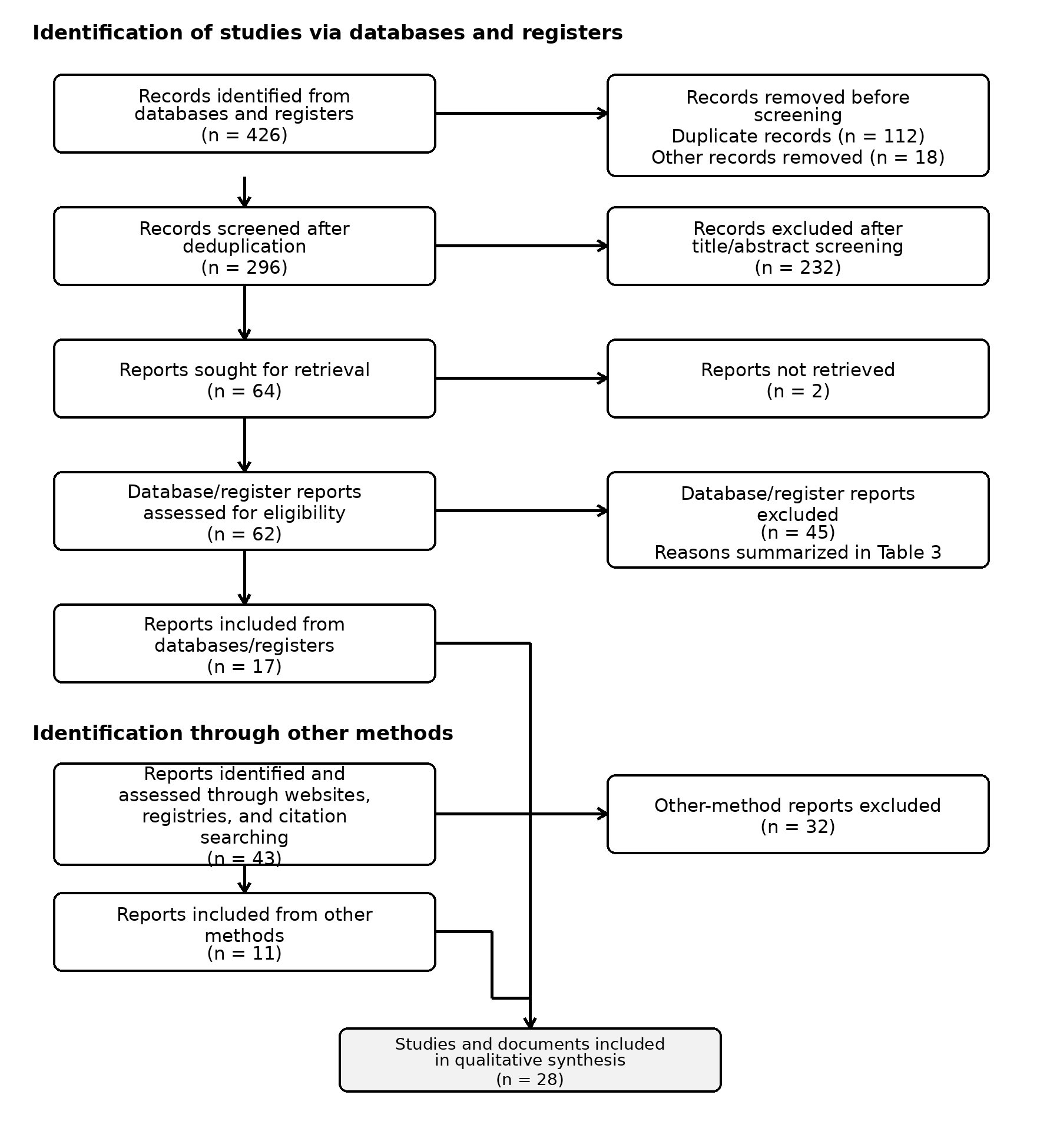
The selection flow identified 426 database/register records: 112 duplicates and 18 further records were removed before screening, leaving 296 records, of which 232 were excluded. Of the 64 reports sought, 2 were not retrieved, 62 were assessed and 45 were excluded, leaving 17. Other methods yielded 43 assessed reports, of which 32 were excluded and 11 retained. The resulting 28 sources comprise 22 primary reports or analyses listed in Table 5 and six contextual sources identified in Table 4; they do not represent 28 independent trials. The 18 pre-screening removals comprise protocols, insufficient abstracts, corrections and non-primary publications, reported here by category rather than by citation. Figure 1 presents the flow, and Table 3 gives database/register exclusion categories.
Figure 1. Study selection flow. Contextual sources are distinguished from primary reports.
Table 3. Reasons for exclusion of database or register full-text reports
| Reason for exclusion | n | Explanation |
|---|---|---|
| Short follow-up or no clinically relevant outcome | 16 | Reports limited to early surrogate changes without maintenance, comorbidity, safety-trajectory, or clinically interpretable outcome data. |
| Wrong population or intervention | 10 | Predominantly diabetes-only studies without obesity-oriented outcomes or interventions outside the contemporary prespecified scope. |
| Duplicate or secondary report without new data | 11 | Comments, letters, conference-only summaries, or secondary publications without an independent dataset or new eligible analysis. |
| No data relevant to personalization or treatment trajectory | 8 | Treatment effects could not be linked to phenotype, body composition, persistence, route, or a clinically relevant pathway. |
The 22 primary reports in Table 5 informed clinical effects. WHO guidance (1), FDA material (2), body-composition and comparative reviews (25, 31), and reproductive-context sources (32, 33) informed interpretation. Methodological references (26–30) are not part of the 28-source evidence set. Related analyses may share participants and must not be counted as independent trials.
Table 4. Structure of the evidence base
| Evidence group | Included sources | Role in synthesis |
|---|---|---|
| Randomized efficacy, comparative, outcome, and withdrawal studies | STEP 1, SURMOUNT-1, SURMOUNT-4, SURMOUNT-5, OASIS 1, orforglipron phase 2 and ATTAIN-1, retatrutide phase 2, SELECT, STEP-HFpEF, STEP-HFpEF DM, SUMMIT, SURMOUNT-OSA, semaglutide NASH, ESSENCE, and SYNERGY-NASH (3, 5–12, 14–20). | Primary estimates of efficacy, comparative effects, clinical outcomes, maintenance, and safety. |
| Extensions and secondary randomized analyses | STEP 1 extension, SELECT long-term weight analysis, SURMOUNT-1 diabetes-prevention analysis (4, 13, 21). | Withdrawal, long-term weight maintenance, and transition to type 2 diabetes. |
| Body-composition evidence | SURMOUNT-1 DXA substudy and systematic review/network meta-analysis (24, 25). | DXA primary data (24); secondary synthesis (25) provides context and is not an independent participant cohort. |
| Real-world cohorts | Semaglutide versus tirzepatide and discontinuation/reinitiation cohorts (22, 23). | Applicability under routine dosing, access, discontinuation, and reinitiation. |
| Contextual sources | WHO, FDA, body-composition and comparative meta-analyses, and reproductive-context sources (1, 2, 25, 31–33). | Guideline, regulatory, comparative, and reproductive interpretation; not primary comparative evidence. |
| Note: Categories overlap. Reference 25 contributes to body-composition context and the contextual-source group; it is counted once in the total of 28 sources. | ||
In STEP 1, mean weight change at 68 weeks was -14.9% with semaglutide 2.4 mg and -2.4% with placebo, for an estimated treatment difference of -12.4 percentage points (95% CI -13.4 to -11.5) (3). One year after withdrawal, participants previously assigned semaglutide regained 11.6 percentage points, leaving a net change of -5.6% from baseline at week 120 (4). In SURMOUNT-1, mean weight change at 72 weeks was -15.0%, -19.5%, and -20.9% with tirzepatide 5, 10, and 15 mg, respectively, versus -3.1% with placebo (5).
SURMOUNT-4 showed that after an open-label lead-in, continued tirzepatide produced a further mean change of approximately -5.5% from randomization to week 88, whereas switching to placebo produced 14.0% regain; 89.5% versus 16.6% maintained at least 80% of the initial weight loss (6). In SURMOUNT-5, mean weight change at 72 weeks was -20.2% with tirzepatide and -13.7% with semaglutide, a between-group difference of -6.5 percentage points; waist circumference changed by -18.4 and -13.0 cm, respectively (7). These results support tirzepatide when maximal weight reduction is the dominant goal, while the withdrawal studies support planning for chronic therapy or a structured maintenance strategy.
In SELECT, major adverse cardiovascular events occurred in 6.5% of participants receiving semaglutide and 8.0% receiving placebo (hazard ratio 0.80, 95% CI 0.72-0.90) (12). At 208 weeks, mean weight change was -10.2% with semaglutide and -1.5% with placebo, and waist circumference changed by -7.7 versus -1.3 cm (13). This provides the strongest direct basis for semaglutide in patients with established ASCVD without diabetes.
HFpEF evidence is not confined to one molecule. In STEP-HFpEF, semaglutide improved the Kansas City Cardiomyopathy Questionnaire clinical summary score (KCCQ-CSS) by 16.6 points versus 8.7 with placebo and reduced weight by 13.3% versus 2.6%; the between-group improvement in six-minute walk distance (6MWD) was 20.3 m (14). In STEP-HFpEF DM, the KCCQ-CSS treatment difference was 7.3 points (95% CI 4.1-10.4), the weight difference was -6.4 percentage points (95% CI -7.6 to -5.2), and the 6MWD difference was 14.3 m (15). In SUMMIT, cardiovascular death or worsening heart failure occurred in 9.9% with tirzepatide and 15.3% with placebo (hazard ratio 0.62, 95% CI 0.41-0.95), with a KCCQ-CSS treatment difference of 6.9 points (95% CI 3.3-10.6) (16). The SUMMIT composite was driven mainly by fewer worsening-HF events; a reduction in cardiovascular mortality alone was not demonstrated (16). No direct semaglutide-tirzepatide HFpEF comparison was included; selection should therefore reflect the outcome priority, diabetes status, tolerability, and access rather than an unsupported class hierarchy.
SURMOUNT-OSA included two 52-week randomized trials with 469 participants. Tirzepatide reduced apnea-hypopnea index by approximately 20.0 events per hour more than placebo in participants not using positive airway pressure and by 23.8 events per hour more than placebo in participants using positive airway pressure; corresponding between-group weight differences were approximately -16.1 and -17.3 percentage points (17). These direct data support tirzepatide in moderate-to-severe OSA with obesity, while positive airway pressure adherence and sleep symptoms remain clinically relevant monitoring targets.
In the phase 2 semaglutide NASH trial, resolution of steatohepatitis without worsening fibrosis occurred in 59% with semaglutide 0.4 mg daily and 17% with placebo, while improvement in fibrosis stage without worsening steatohepatitis did not differ significantly (43% vs 33%) (18). In the phase 3 ESSENCE trial, 1,197 participants were randomized; the 72-week interim analysis covered the first 800. In this analysis, MASH resolution without worsening fibrosis occurred in 62.9% with semaglutide 2.4 mg and 34.3% with placebo; fibrosis improvement without worsening MASH occurred in 36.8% and 22.4%, respectively (19). In SYNERGY-NASH, MASH resolution without worsening fibrosis occurred in 44%, 56%, and 62% with tirzepatide 5, 10, and 15 mg versus 10% with placebo; at least one-stage fibrosis improvement without worsening MASH occurred in 55%, 51%, and 51% versus 30% (20). Semaglutide has the more mature phase 3 hepatic evidence, while tirzepatide has promising phase 2 histological data. These findings apply to biopsy-confirmed MASH populations and should not be automatically extrapolated to all patients with MASLD.
Among 1,032 participants with prediabetes in the long-term SURMOUNT-1 analysis, mean weight change at 176 weeks was -12.3%, -18.7%, and -19.7% with tirzepatide 5, 10, and 15 mg versus -1.3% with placebo. Type 2 diabetes developed in 1.3% versus 13.3%, corresponding to a hazard ratio of 0.07 (21). This supports tirzepatide when diabetes prevention is a dominant clinical priority, while recognizing that risk may change after treatment withdrawal.
In OASIS 1, oral semaglutide 50 mg produced a mean 68-week weight change of -15.1% versus -2.4% with placebo, and 170/317 (54%) versus 17/295 (6%) achieved at least 15% weight loss (8). In the phase 2 orforglipron trial, mean weight change at 36 weeks reached -14.7% at the most effective dose versus -2.3% with placebo (9). In the phase 3 ATTAIN-1 trial, treatment-regimen estimates at 72 weeks were -7.5%, -8.4%, and -11.2% with orforglipron 6, 12, and 36 mg versus -2.1% with placebo (10). Oral delivery can address injection aversion or logistical barriers, but no direct evidence establishes superior long-term persistence compared with injectables. Oral agents should therefore be selected for route compatibility rather than assumed adherence advantage.
In the phase 2 retatrutide trial, mean weight reduction reached 24.2% at 48 weeks at the highest dose, but long-term safety, maintenance, and clinical outcome data remain limited (11). In the SURMOUNT-1 DXA substudy, tirzepatide reduced body weight by 21.3%, fat mass by 33.9%, and lean mass by 10.9%, compared with 5.3%, 8.2%, and 2.6% with placebo; approximately three quarters of lost weight was fat mass (24). Across GLP-1-based therapies, body-composition evidence indicates a consistent reduction in lean mass but sparse evidence for falls, disability, strength, or independence (25).
In a large real-world comparison, tirzepatide was associated with greater probabilities of achieving at least 5%, 10%, and 15% weight loss than semaglutide, but discontinuation was common in both groups (22). In a US cohort of 125,474 adults initiating liraglutide, semaglutide, or tirzepatide, one-year discontinuation reached 46.5% among patients with type 2 diabetes and 64.8% among those without diabetes; among 41,792 discontinuers eligible for the reinitiation analysis, estimated restart rates within one year of stopping were 47.3% and 36.3%, respectively (23). These findings support explicit discussion of cost, access, adverse effects, and a maintenance plan before treatment begins.
Across the included randomized trials, gastrointestinal adverse events - primarily nausea, diarrhea, vomiting, and constipation - were the most common treatment-related events. They were usually mild to moderate, occurred mainly during dose escalation, and were a principal reason for treatment discontinuation in obesity trials (5, 7, 9, 10). Gastrointestinal events were also reported in MASH trials (18–20). In SURMOUNT-1, discontinuation due to adverse events occurred in 4.3%, 7.1%, and 6.2% of participants receiving tirzepatide 5, 10, and 15 mg, respectively, compared with 2.6% receiving placebo (5). In SURMOUNT-5, treatment was discontinued because of adverse events in 6.1% of participants receiving tirzepatide and 8.0% receiving semaglutide (7). In ATTAIN-1, adverse events led to discontinuation in 5.3%-10.3% across the orforglipron groups versus 2.7% with placebo; serious adverse events occurred in 3.8%-5.5% and 4.9%, respectively (10).
Serious adverse events were not consistently more frequent with incretin-based therapy than with comparators. In SELECT, permanent discontinuation due to adverse events occurred in 16.6% with semaglutide and 8.2% with placebo, mainly because of gastrointestinal disorders; gallbladder-related disorders occurred in 2.8% and 2.3%, respectively (12). Gallbladder-related events were uncommon but were also reported in obesity and MASH trials (18–20). Acute pancreatitis was rare across the included studies and was generally reported as isolated adjudicated cases, which precluded reliable between-drug comparisons (11, 17–20). Overall, tolerability was influenced more by gastrointestinal symptoms and dose escalation than by serious or rare events, although individual risk assessment remains necessary. The characteristics and principal numerical findings of the key included primary studies are summarized in Table 5.
Table 5. Key included primary studies and numerical findings
| Study | Design and population | Intervention/comparator | Follow-up | Key numerical finding | Personalization implication |
|---|---|---|---|---|---|
| STEP 1 (3) | RCT; n=1,961; adults without diabetes | Semaglutide 2.4 mg vs placebo | 68 weeks | Weight -14.9% vs -2.4%; difference -12.4 pp (95% CI -13.4 to -11.5). | High-efficacy semaglutide; maintenance planning required. |
| STEP 1 extension (4) | Off-treatment extension of trial subset | Prior semaglutide vs prior placebo | 1 year off treatment | Regain 11.6 pp after semaglutide; net change -5.6% from baseline at week 120. | Withdrawal commonly reverses part of benefit. |
| SURMOUNT-1 (5) | RCT; n=2,539; obesity without diabetes | Tirzepatide 5/10/15 mg vs placebo | 72 weeks | Weight -15.0%, -19.5%, -20.9% vs -3.1%. | Strong option when magnitude of weight loss dominates. |
| SURMOUNT-4 (6) | Randomized withdrawal; 670 randomized after lead-in | Continue tirzepatide vs switch to placebo | 88 weeks total | Post-randomization -5.5% vs +14.0%; ≥80% maintenance 89.5% vs 16.6%. | Supports chronic continuation or structured maintenance. |
| SURMOUNT-5 (7) | Open-label head-to-head RCT; n=751 | Tirzepatide vs semaglutide | 72 weeks | Weight -20.2% vs -13.7%; difference -6.5 pp; waist -18.4 vs -13.0 cm. | Best direct comparative signal for weight-loss-dominant phenotype. |
| OASIS 1 (8) | Phase 3 RCT; n=667 | Oral semaglutide 50 mg vs placebo | 68 weeks | Weight -15.1% vs -2.4%; ≥15% loss: 170/317 (54%) vs 17/295 (6%). | Oral option when administration requirements are acceptable. |
| Orforglipron phase 2 (9) | Phase 2 RCT; n=272 | Orforglipron doses vs placebo | 36 weeks | Weight reduction up to -14.7% vs -2.3%. | Oral small-molecule proof of efficacy. |
| ATTAIN-1 (10) | Phase 3 RCT; n=3,127 | Orforglipron 6/12/36 mg vs placebo | 72 weeks | Treatment-regimen weight -7.5%, -8.4%, -11.2% vs -2.1%. | Oral route; long-term outcome evidence remains immature. |
| Retatrutide phase 2 (11) | Phase 2 RCT; n=338 | Retatrutide doses vs placebo | 48 weeks | Weight reduction up to -24.2%. | Promising but not ready for outcome-based personalization. |
| SELECT (12) | Event-driven RCT; n=17,604; ASCVD without diabetes | Semaglutide 2.4 mg vs placebo | Mean 39.8 months | MACE 6.5% vs 8.0%; HR 0.80 (95% CI 0.72-0.90). | Strongest evidence for established ASCVD phenotype. |
| SELECT weight analysis (13) | Randomized longitudinal secondary analysis | Semaglutide 2.4 mg vs placebo | 208 weeks | Weight -10.2% vs -1.5%; waist -7.7 vs -1.3 cm. | Durable weight reduction in high cardiovascular-risk population. |
| STEP-HFpEF (14) | RCT; n=529; HFpEF and obesity | Semaglutide 2.4 mg vs placebo | 52 weeks | KCCQ-CSS +16.6 vs +8.7; weight -13.3% vs -2.6%; 6MWD difference +20.3 m. | Direct HFpEF evidence without diabetes. |
| STEP-HFpEF DM (15) | RCT; n=616; HFpEF, obesity, T2D | Semaglutide 2.4 mg vs placebo | 52 weeks | KCCQ difference +7.3; weight difference -6.4 pp; 6MWD difference +14.3 m. | Direct HFpEF evidence with type 2 diabetes. |
| SUMMIT (16) | RCT; n=731; HFpEF and obesity | Tirzepatide vs placebo | Median 104 weeks | CV death/worsening HF 9.9% vs 15.3%; HR 0.62; KCCQ difference +6.9. | Supports tirzepatide for HFpEF event and symptom outcomes. |
| SURMOUNT-OSA (17) | Two phase 3 RCTs; n=469 | Tirzepatide vs placebo | 52 weeks | AHI differences about -20.0 and -23.8 events/h; weight differences -16.1 and -17.3 pp. | Direct OSA phenotype evidence. |
| Semaglutide NASH (18) | Phase 2 RCT; n=320 | Semaglutide 0.4 mg daily vs placebo | 72 weeks | NASH resolution 59% vs 17%; fibrosis improvement 43% vs 33% (not significant). | Hepatic efficacy signal; fibrosis uncertainty. |
| ESSENCE interim (19) | Phase 3 RCT; 1,197 randomized; interim cohort n=800 | Semaglutide 2.4 mg vs placebo | 72 weeks interim histology | MASH resolution 62.9% vs 34.3%; fibrosis improvement 36.8% vs 22.4%. | Most mature phase 3 hepatic evidence. |
| SYNERGY-NASH (20) | Phase 2 RCT; n=190; MASH F2-F3 | Tirzepatide 5/10/15 mg vs placebo | 52 weeks | MASH resolution 44%, 56%, 62% vs 10%; fibrosis improvement 55%, 51%, 51% vs 30%. | Promising hepatic data; phase 3 confirmation needed. |
| SURMOUNT-1 diabetes prevention (21) | Long-term analysis; prediabetes n=1,032 | Tirzepatide vs placebo | 176 weeks | T2D 1.3% vs 13.3%; HR 0.07; weight -12.3% to -19.7% vs -1.3%. | Strong option for prediabetes/high diabetes risk. |
| Real-world semaglutide vs tirzepatide (22) | Retrospective cohort; 18,386 matched | Tirzepatide vs semaglutide | 12 months | Greater likelihood of ≥5/10/15% loss; on-treatment difference at 12 months about -6.9 pp. | Routine-care advantage, tempered by confounding and discontinuation. |
| Discontinuation/reinitiation cohort (23) | US cohort; n=125,474; restart analysis n=41,792 | Liraglutide, semaglutide, or tirzepatide | 1 year | 1-year discontinuation: 46.5% with T2D vs 64.8% without; restart after stopping: 47.3% vs 36.3%. | Persistence and access are core treatment-selection variables. |
| SURMOUNT-1 DXA (24) | DXA substudy; n=160 | Tirzepatide vs placebo | 72 weeks | Weight -21.3%; fat mass -33.9%; lean mass -10.9% (placebo -5.3%,
-8.2%, -2.6%). |
Monitor function in vulnerable patients; most lost mass was fat. |
| Abbreviations: 6MWD, six-minute walk distance; AHI, apnea-hypopnea index; ASCVD, atherosclerotic cardiovascular disease; CI, confidence interval; CV, cardiovascular; DXA, dual-energy X-ray absorptiometry; HF, heart failure; HR, hazard ratio; KCCQ-CSS, Kansas City Cardiomyopathy Questionnaire clinical summary score; MACE, major adverse cardiovascular events; MASH, metabolic dysfunction-associated steatohepatitis; NASH, nonalcoholic steatohepatitis; pp, percentage points; RCT, randomized controlled trial; T2D, type 2 diabetes. | |||||
The evidence does not support a single drug hierarchy for every patient. Table 6 summarizes the best-supported use cases and the maturity of evidence, while Table 7 translates those findings into a clinical monitoring matrix.
Table 6. Phenotype-oriented synthesis by drug or strategy
| Drug or strategy | Best-supported phenotype or use | Evidence basis | Principal limitation |
|---|---|---|---|
| Tirzepatide | Weight-loss-dominant treatment; prediabetes; OSA; HFpEF with obesity. | Weight-loss and maintenance trials (5–7); OSA and HFpEF trials (16, 17); long-term prediabetes analysis (21). | Injectable route, gastrointestinal tolerability, cost, chronic-treatment requirement, and no direct HFpEF comparison with semaglutide. |
| Semaglutide 2.4 mg | Established ASCVD without diabetes; obesity-related HFpEF; biopsy-confirmed MASH when phase 3 histological evidence is relevant. | SELECT cardiovascular and weight outcomes (12, 13); STEP-HFpEF program (14, 15); ESSENCE histology (19). | Lower mean weight loss than tirzepatide in one open-label head-to-head trial; regain after withdrawal. |
| Oral semaglutide or orforglipron | Injection aversion or logistical barriers to injectable treatment. | Clinically meaningful randomized weight reduction with oral regimens (8–10). | Regimen- and jurisdiction-specific availability; studied doses are not interchangeable. No proven persistence advantage over injections. |
| Retatrutide | Investigational strategy for severe obesity and high metabolic burden. | Very large phase 2 weight-loss signal (11). | Long-term safety, maintenance, and hard clinical outcomes require confirmation. |
| Muscle-preserving support | Older, sedentary, frail, or functionally vulnerable patients receiving any high-efficacy therapy. | Predominant fat-mass loss but concurrent lean-mass reduction (24, 25). | Few trials report strength, falls, disability, or independence. |
| Abbreviations: ASCVD, atherosclerotic cardiovascular disease; HFpEF, heart failure with preserved ejection fraction; MASH, metabolic dysfunction-associated steatohepatitis; OSA, obstructive sleep apnea. | |||
Table 7. Clinical matrix for personalization of incretin therapy
| Clinical phenotype | Selection logic | Monitoring focus |
|---|---|---|
| Prediabetes or high risk of type 2 diabetes | Tirzepatide is strongly supported when accessible and tolerated (21). | HbA1c, fasting glucose, weight, gastrointestinal events, and intended treatment duration. |
| Established ASCVD without diabetes | Semaglutide 2.4 mg has direct MACE outcome evidence (12). | Cardiovascular risk, blood pressure, lipids, weight, and tolerability. |
| HFpEF with obesity | Both semaglutide and tirzepatide have direct randomized evidence. Tirzepatide has a clinical-event composite; semaglutide has consistent symptom, function, and weight data with and without diabetes (14–16). | KCCQ, 6MWD, congestion, functional status, weight, blood pressure, and HF therapy. |
| OSA with obesity | Tirzepatide has direct data on AHI and hypoxic burden (17). | AHI, sleepiness, positive airway pressure adherence, weight, and sleep quality. |
| Biopsy-confirmed MASH | Semaglutide has phase 3 evidence; tirzepatide has positive phase 2 evidence (19, 20). | ALT/AST, noninvasive fibrosis assessment, metabolic risk, and specialist-directed histological follow-up when appropriate. |
| Sarcopenia risk or functional vulnerability | Assess the clinical significance of lean-mass loss together with nutrition, strength, and mobility; individualize continuation and supportive care (24, 25). | Grip strength, gait or chair-rise performance, protein adequacy, resistance exercise, and body composition when clinically useful. |
| Low readiness for injections | Consider an authorized oral regimen compatible with the patient’s routine; OASIS 1 studied 50 mg daily and does not establish interchangeability with other formulations (8–10). | Adherence to dosing instructions, gastrointestinal events, dose escalation, and response after adequate exposure to a therapeutic or maximally tolerated dose. |
| Reproductive age or preconception | Use a cautious strategy with contraception counseling and discontinuation before conception according to product information and specialist guidance (32, 33). | Pregnancy plans, informed consent, medication stop plan, and interdisciplinary care. |
| Abbreviations: 6MWD, six-minute walk distance; AHI, apnea-hypopnea index; ALT, alanine aminotransferase; ASCVD, atherosclerotic cardiovascular disease; AST, aspartate aminotransferase; HF, heart failure; HFpEF, heart failure with preserved ejection fraction; KCCQ, Kansas City Cardiomyopathy Questionnaire; MACE, major adverse cardiovascular events; MASH, metabolic dysfunction-associated steatohepatitis; OSA, obstructive sleep apnea. | ||
The included randomized trials generally support their prespecified outcomes, but confidence varies by endpoint, missing data, and applicability. Open-label treatment, withdrawal-trial enrichment, secondary analyses, and surrogate outcomes have different implications and should not be conflated as bias. Observational estimates remain vulnerable to confounding, treatment selection, dose classification, and discontinuation. Supplementary Tables S3A and S3B identify appraisal considerations and missing formal assessments; Table 8 provides descriptive, non-GRADE confidence judgments.
Table 8. Qualitative appraisal of confidence in the evidence
| Outcome or question | Descriptive confidence | Basis |
|---|---|---|
| Weight reduction with semaglutide and tirzepatide | Higher | Large randomized trials, objective measurement, consistent direction, and precise estimates (3, 5, 7). |
| Tirzepatide versus semaglutide for weight reduction | Moderate to higher | One direct randomized head-to-head trial and supportive real-world evidence; external replication and longer outcome follow-up remain limited (7, 22). |
| ASCVD benefit of semaglutide | Higher | Large event-driven randomized trial with adjudicated MACE (12). |
| HFpEF benefit | Moderate to higher | Direct randomized data for both semaglutide and tirzepatide, but different endpoints and no head-to-head comparison (14–16). |
| OSA benefit of tirzepatide | Moderate | Two phenotype-specific randomized trials with objective AHI outcomes; part of benefit is mediated through weight reduction (17). |
| MASH histological outcomes | Moderate | Phase 3 semaglutide interim evidence and phase 2 tirzepatide evidence; long-term clinical liver outcomes are incomplete (18–20). |
| Lean mass and physical function | Limited | Body-composition data are available, but strength, falls, disability, and independence are rarely measured (24, 25). |
| Persistence and discontinuation | Moderate | Large routine-care cohorts; confounding limits causal interpretation, and descriptive rates depend on population, access, and discontinuation definitions (22, 23). |
| Biomarker-guided drug selection | Limited | No validated, independently replicated clinical algorithm was identified in the included evidence. |
Personalization should begin with the dominant clinical risk and the probability that treatment can be sustained. Among the included comparisons, tirzepatide has the strongest direct comparative evidence when magnitude of weight reduction is the principal objective and is well supported in prediabetes and OSA. Within the included evidence, semaglutide has the most mature evidence for reduction of cardiovascular events in established ASCVD and phase 3 histological outcomes in MASH. In HFpEF, the included evidence supports both agents: semaglutide consistently improves symptoms, physical limitations, exercise function, and weight, while tirzepatide additionally reduced a composite of cardiovascular death or worsening heart failure. This does not establish superiority of either agent in HFpEF or a cardiovascular-mortality benefit for tirzepatide.
The hepatic comparison also requires nuance. Semaglutide has phase 3 evidence, but tirzepatide has clinically important phase 2 histological findings. Neither evidence base should be generalized without qualification from biopsy-confirmed MASH to the entire MASLD spectrum. Similarly, oral therapies broaden route options but should not be described as proven solutions for discontinuation because direct persistence comparisons are absent.
Indirect and model-based meta-analyses support comparison of average weight effects, but differences in dose, population, follow-up, and estimand limit their use for individual drug selection (31). WHO guidance situates long-term GLP-1-based therapy within comprehensive obesity care (1). This synthesis adds a comorbidity and treatment-pathway perspective while distinguishing randomized outcome evidence from interpretive recommendations.
A personalized plan includes the molecule, dose-escalation strategy, mitigation of gastrointestinal adverse events, and a realistic discussion of cost and intended duration. Early response should be assessed only after adequate exposure to a therapeutic or maximally tolerated dose rather than by applying an inflexible 12- to 16-week rule during prolonged titration. In functionally vulnerable patients, resistance exercise, adequate protein intake, and simple measures of strength or mobility should begin with treatment rather than after weakness develops (24, 25). Before discontinuation, clinicians should explain the expected risk of regain and define a maintenance or reinitiation pathway (4, 6, 23).
Biomarker-guided selection remains promising but premature. Genetic variation, digital phenotypes, body-composition signatures, and metabolomic markers may eventually refine selection, but none currently replaces clinical phenotype. Priorities include direct comparative outcome trials, long-term liver and HFpEF follow-up, trials reporting strength and independence, pregnancy registries, and independent analyses in health systems with different access and reimbursement structures.
Strengths include separation of primary and contextual evidence and presentation of numerical results across cardiovascular, HFpEF, OSA, diabetes-prevention, MASH, withdrawal, body-composition, and persistence domains. The accompanying tables make the selected evidence and its principal limitations explicit.
The review is selective rather than exhaustive across all incretin agents, formulations, doses and clinical indications. The final search date was 8 January 2026; per-source export files and screening records are not published, which limits record-level reproducibility. The protocol was not registered or publicly deposited. Formal risk-of-bias ratings were not assigned, and certainty is discussed without GRADE ratings. Clinical heterogeneity precluded pooling, and no sensitivity analysis was performed. Observational evidence remains susceptible to confounding. Results for the included oral regimens and phase 2 agents should not be read as a current prescribing list or as evidence of superiority across untested indications.
A phenotype-oriented approach is more clinically defensible than ranking contemporary incretin therapies by mean weight loss alone. Among the included comparisons, tirzepatide has the strongest direct comparative weight-loss signal and direct evidence in prediabetes and OSA. Within the included evidence, semaglutide has the most mature evidence for established ASCVD and phase 3 MASH outcomes. Both semaglutide and tirzepatide are supported by randomized HFpEF evidence, with differences in trial endpoints rather than a proven molecule hierarchy. Oral drugs expand route options but do not yet demonstrate superior persistence. Treatment decisions should incorporate expected clinical benefit, tolerability, cost, route preference, reproductive plans, probability of continuation, and a plan to preserve muscle function and manage withdrawal. A validated biomarker-guided algorithm is not ready for routine practice. A practical framework for applying these findings in clinical decision-making is provided in Table 9.
Table 9. Practical interpretive framework
| Step | Content |
|---|---|
| 1 | Identify the dominant phenotype: weight-loss priority, prediabetes, ASCVD, HFpEF, OSA, biopsy-confirmed MASH, functional vulnerability, reproductive plans, or injection aversion. |
| 2 | Select the agent using direct phenotype-specific outcome evidence, expected weight effect, route, cost, tolerability, and probability of long-term continuation. |
| 3 | Record baseline weight, waist circumference, glucose or HbA1c, blood pressure, lipids, comorbidity symptoms, and simple physical-function measures; use body composition when it will change management. |
| 4 | Assess response after adequate exposure to a therapeutic or maximally tolerated dose, considering titration, adherence, gastrointestinal adverse events, nutrition, and activity before switching. |
| 5 | For patients at risk of sarcopenia or functional decline, initiate resistance exercise and adequate protein intake from the start and monitor strength or mobility. |
| 6 | Before stopping treatment, discuss the expected risk of regain and define a maintenance, alternative-treatment, or reinitiation plan. |
Author contributions: Ildar Fakhradiyev: Conceptualization, Methodology, Investigation, Data curation, Formal analysis, and Writing – original draft. Timur Fazylov: Methodology, Investigation, Data curation, Validation, and Writing – review and editing. Liliya Ibragimova: Conceptualization, Formal analysis, Validation, Supervision, Project administration, and Writing – review and editing. All authors have read and approved the final manuscript and agree to be accountable for all aspects of the work.
Funding: No external, institutional or commercial funding was received for this review.
Conflicts of interest: The authors report no competing interests in relation to the drugs, manufacturers or devices discussed in this review.
Acknowledgments: The authors acknowledge the investigators of the trials and cohorts included in this review, and the PRISMA 2020 reporting guideline, which was used as the framework for describing the search, selection and synthesis steps.
Data availability statement: The evidence synthesized here derives from the cited publications and is presented in Supplementary Section S1, Table S2, Tables S3A and S3B, and Tables S4A and S4B. Record-level search exports, screening and exclusion logs and completed appraisal forms are not part of the supplementary material. Table S4A is the extraction template and Table S4B contains the principal study-level summaries.
AI use statement: ChatGPT (OpenAI) assisted with language editing, manuscript organization, formatting, internal consistency checks and verification of selected bibliographic details against the published sources. It did not perform a new systematic search, reconstruct missing screening records or conduct a formal risk-of-bias assessment. The authors verified the manuscript, the methods and these declarations before publication.
World Health Organization. WHO guideline on the use of glucagon-like peptide-1 therapies for the treatment of obesity in adults. Geneva: World Health Organization; 2025. Published 1 December 2025. Accessed 8 January 2026. Available from: https://www.who.int/publications/i/item/9789240110251
U.S. Food and Drug Administration. FDA approves first treatment to reduce risk of serious heart problems specifically in adults with obesity or overweight. Silver Spring (MD): FDA; 8 March 2024. Accessed 8 January 2026. Available from: https://www.fda.gov/news-events/press-announcements/fda-approves-first-treatment-reduce-risk-serious-heart-problems-specifically-adults-obesity-or
Wilding JPH, Batterham RL, Calanna S, Davies M, Van Gaal LF, Lingvay I, et al. Once-weekly semaglutide in adults with overweight or obesity. N Engl J Med. 2021;384:989-1002. doi:10.1056/NEJMoa2032183.
Wilding JPH, Batterham RL, Davies M, Van Gaal LF, Kandler K, Konakli K, et al. Weight regain and cardiometabolic effects after withdrawal of semaglutide: the STEP 1 trial extension. Diabetes Obes Metab. 2022;24:1553-1564. doi:10.1111/dom.14725.
Jastreboff AM, Aronne LJ, Ahmad NN, Wharton S, Connery L, Alves B, et al. Tirzepatide once weekly for the treatment of obesity. N Engl J Med. 2022;387:205-216. doi:10.1056/NEJMoa2206038.
Aronne LJ, Sattar N, Horn DB, Bays HE, Wharton S, Lin WY, et al. Continued treatment with tirzepatide for maintenance of weight reduction in adults with obesity: the SURMOUNT-4 randomized clinical trial. JAMA. 2024;331:38-48. doi:10.1001/jama.2023.24945.
Aronne LJ, Horn DB, le Roux CW, Ho W, Falcon BL, Gomez Valderas E, et al. Tirzepatide as compared with semaglutide for the treatment of obesity. N Engl J Med. 2025;393(1):26–36. doi:10.1056/NEJMoa2416394.
Knop FK, Aroda VR, do Vale RD, Holst-Hansen T, Laursen PN, Rosenstock J, et al. Oral semaglutide 50 mg taken once per day in adults with overweight or obesity (OASIS 1): a randomized, double-blind, placebo-controlled, phase 3 trial. Lancet. 2023;402:705-719. doi:10.1016/S0140-6736(23)01185-6.
Wharton S, Blevins T, Connery L, Rosenstock J, Liu R, Ma X, et al. Daily oral GLP-1 receptor agonist orforglipron for adults with obesity. N Engl J Med. 2023;389:877-888. doi:10.1056/NEJMoa2302392.
Wharton S, Aronne LJ, Stefanski A, et al. Orforglipron, an oral small-molecule GLP-1 receptor agonist for obesity treatment. N Engl J Med. 2025;393(18):1796-1806. doi:10.1056/NEJMoa2511774.
Jastreboff AM, Kaplan LM, Frias JP, Wu Q, Du Y, Gurbuz S, et al. Triple-hormone-receptor agonist retatrutide for obesity: a phase 2 trial. N Engl J Med. 2023;389:514-526. doi:10.1056/NEJMoa2301972.
Lincoff AM, Brown-Frandsen K, Colhoun HM, Deanfield J, Emerson SS, Esbjerg S, et al. Semaglutide and cardiovascular outcomes in obesity without diabetes. N Engl J Med. 2023;389:2221-2232. doi:10.1056/NEJMoa2307563.
Ryan DH, Lingvay I, Colhoun HM, Deanfield J, Emerson SS, Kahn SE, et al. Long-term weight loss effects of semaglutide in obesity without diabetes in the SELECT trial. Nat Med. 2024;30:2049-2057. doi:10.1038/s41591-024-02996-7.
Kosiborod MN, Abildstrom SZ, Borlaug BA, Butler J, Rasmussen S, Davies M, et al. Semaglutide in patients with heart failure with preserved ejection fraction and obesity. N Engl J Med. 2023;389(12):1069-1084. doi:10.1056/NEJMoa2306963.
Kosiborod MN, Petrie MC, Borlaug BA, Butler J, Davies MJ, Hovingh GK, et al. Semaglutide in patients with obesity-related heart failure and type 2 diabetes. N Engl J Med. 2024;390(15):1394-1407. doi:10.1056/NEJMoa2313917.
Packer M, Zile MR, Kramer CM, Baum SJ, Litwin SE, Menon V, et al. Tirzepatide for heart failure with preserved ejection fraction and obesity. N Engl J Med. 2025;392:427-437. doi:10.1056/NEJMoa2410027.
Malhotra A, Grunstein RR, Fietze I, Weaver TE, Redline S, Azarbarzin A, et al. Tirzepatide for the treatment of obstructive sleep apnea and obesity. N Engl J Med. 2024;391:1193-1205. doi:10.1056/NEJMoa2404881.
Newsome PN, Buchholtz K, Cusi K, Linder M, Okanoue T, Ratziu V, et al. A placebo-controlled trial of subcutaneous semaglutide in nonalcoholic steatohepatitis. N Engl J Med. 2021;384:1113-1124. doi:10.1056/NEJMoa2028395.
Sanyal AJ, Newsome PN, Kliers I, Østergaard LH, Long MT, Kjær MS, et al. Phase 3 trial of semaglutide in metabolic dysfunction-associated steatohepatitis. N Engl J Med. 2025;392(21):2089–2099. doi:10.1056/NEJMoa2413258.
Loomba R, Hartman ML, Lawitz EJ, Vuppalanchi R, Boursier J, Bugianesi E, et al. Tirzepatide for metabolic dysfunction-associated steatohepatitis with liver fibrosis. N Engl J Med. 2024;391(4):299-310. doi:10.1056/NEJMoa2401943.
Jastreboff AM, le Roux CW, Stefanski A, Aronne LJ, Halpern B, Wharton S, et al. Tirzepatide for obesity treatment and diabetes prevention. N Engl J Med. 2025;392(10):958–971. doi:10.1056/NEJMoa2410819.
Rodriguez PJ, Goodwin Cartwright BM, Gratzl S, Brar R, Baker C, Gluckman TJ, et al. Semaglutide vs tirzepatide for weight loss in adults with overweight or obesity. JAMA Intern Med. 2024;184:1056-1064. doi:10.1001/jamainternmed.2024.2525.
Rodriguez PJ, Zhang V, Gratzl S, Do D, Goodwin Cartwright B, Baker C, et al. Discontinuation and reinitiation of dual-labeled GLP-1 receptor agonists among US adults with overweight or obesity. JAMA Netw Open. 2025;8(1):e2457349. doi:10.1001/jamanetworkopen.2024.57349.
Look M, Dunn JP, Kushner RF, Cao D, Harris C, Gibble TH, et al. Body composition changes during weight reduction with tirzepatide in the SURMOUNT-1 study of adults with obesity or overweight. Diabetes Obes Metab. 2025;27(5):2720-2729. doi:10.1111/dom.16275.
Karakasis P, Patoulias D, Fragakis N, Mantzoros CS. Effect of glucagon-like peptide-1 receptor agonists and co-agonists on body composition: systematic review and network meta-analysis. Metabolism. 2025;164:156113. doi:10.1016/j.metabol.2024.156113.
Page MJ, McKenzie JE, Bossuyt PM, Boutron I, Hoffmann TC, Mulrow CD, et al. The PRISMA 2020 statement: an updated guideline for reporting systematic reviews. BMJ. 2021;372:n71. doi:10.1136/bmj.n71.
Page MJ, Moher D, Bossuyt PM, Boutron I, Hoffmann TC, Mulrow CD, et al. PRISMA 2020 explanation and elaboration: updated guidance and exemplars for reporting systematic reviews. BMJ. 2021;372:n160. doi:10.1136/bmj.n160.
Rethlefsen ML, Kirtley S, Waffenschmidt S, Ayala AP, Moher D, Page MJ, et al. PRISMA-S: an extension to the PRISMA statement for reporting literature searches in systematic reviews. Syst Rev. 2021;10:39. doi:10.1186/s13643-020-01542-z.
Sterne JAC, Savovic J, Page MJ, Elbers RG, Blencowe NS, Boutron I, et al. RoB 2: a revised tool for assessing risk of bias in randomized trials. BMJ. 2019;366:l4898. doi:10.1136/bmj.l4898.
Sterne JA, Hernan MA, Reeves BC, Savovic J, Berkman ND, Viswanathan M, et al. ROBINS-I: a tool for assessing risk of bias in non-randomized studies of interventions. BMJ. 2016;355:i4919. doi:10.1136/bmj.i4919.
Guo H, Yang J, Huang J, Xu L, Lv Y, Wang Y, et al. Comparative efficacy and safety of GLP-1 receptor agonists for weight reduction: a model-based meta-analysis of placebo-controlled trials. Obes Pillars. 2025;13:100162. doi:10.1016/j.obpill.2025.100162.
Saad Alfaiz A. GLP-1 receptor agonists and preconception planning: bridging the gap between obesity treatment and reproductive safety, a narrative review. Ann Med Surg (Lond). 2025;87(12):8597-8603. doi:10.1097/MS9.0000000000004189.
Filippi-Arriaga F, Agarwal N, Rodrigues-Martins D, Monteiro MP, Huvinen E, Suliman SGI, et al. EASO position statement: women with obesity across the reproductive life, fertility, preconception, pregnancy, postpartum and breastfeeding. Obes Facts. 2025;18(6):625-639. doi:10.1159/000546449.
The search framework combines bibliographic coverage beginning on 1 January 2024 with supplementary searching. The final search date was 8 January 2026, and supplementary searches had no lower publication-date limit. The strings below present the search logic for each platform; per-source yields are reported in aggregate within the selection flow.
Table S1.1. Core concept groups
| Concept | Controlled vocabulary | Free-text terms |
|---|---|---|
| Population | Obesity; Overweight | obes*; overweight |
| Intervention | GLP-1 receptor agonists; incretin mimetics; indexed drug terms | incretin*; GLP-1 receptor agonist*; GIP/GLP-1; dual agonist*; triple agonist*; semaglutide; tirzepatide; retatrutide; orforglipron |
| Supplementary phenotype/outcome terms | Body composition; cardiovascular disease; heart failure; OSA; prediabetes; MASH | weight loss; withdrawal; maintenance; ASCVD; MACE; HFpEF; sleep apnea; OSA; MASH; NASH; fibrosis; body composition; lean mass; sarcopen*; persistence; discontinuation; reinitiation; oral; injection; biomarker*; preconception; pregnancy |
Platform: PubMed. Coverage: 1 January 2024 to 8 January 2026. Limits: English or Russian; animal-only records excluded.
(
("Obesity"[Mesh] OR "Overweight"[Mesh] OR obes*[tiab] OR
overweight[tiab])
AND
("Glucagon-Like Peptide-1 Receptor Agonists"[Mesh]
OR incretin*[tiab]
OR "GLP-1 receptor agonist"[tiab]
OR "GLP-1 receptor agonists"[tiab]
OR "GIP/GLP-1"[tiab]
OR "dual agonist"[tiab]
OR "dual agonists"[tiab]
OR "triple agonist"[tiab]
OR "triple agonists"[tiab]
OR semaglutide[tiab]
OR tirzepatide[tiab]
OR retatrutide[tiab]
OR orforglipron[tiab])
)
AND ("2024/01/01"[Date - Publication] : "2026/01/08"[Date -
Publication])
AND (english[Language] OR russian[Language])
NOT (animals[MeSH Terms] NOT humans[MeSH Terms])
Platform: Embase.com. Coverage: 1 January 2024 to 8 January 2026; publication-year filter 2024–2026. Limits: humans, adults, English or Russian.
('obesity'/exp OR 'overweight'/exp OR obes*:ti,ab,kw OR
overweight:ti,ab,kw)
AND
('glucagon like peptide 1 receptor agonist'/exp OR 'incretin mimetic
agent'/exp
OR incretin*:ti,ab,kw OR 'glp 1 receptor agonist':ti,ab,kw
OR 'gip glp 1':ti,ab,kw OR 'dual agonist':ti,ab,kw
OR 'triple agonist':ti,ab,kw OR semaglutide:ti,ab,kw
OR tirzepatide:ti,ab,kw OR retatrutide:ti,ab,kw OR
orforglipron:ti,ab,kw)
AND (2024-2026)/py AND [humans]/lim AND [adult]/lim
AND ([english]/lim OR [russian]/lim)
Platform: Elsevier Scopus. Coverage: 1 January 2024 to 8 January 2026. The platform publication-year filter was set to 2024–2025; the interval to the final search date was covered by the remaining databases and by supplementary searching. Limits: English or Russian.
TITLE-ABS-KEY((obes* OR overweight) AND (incretin* OR "GLP-1 receptor
agonist" OR "GLP-1 receptor agonists" OR "GIP/GLP-1" OR "dual agonist"
OR "dual agonists" OR "triple agonist" OR "triple agonists" OR
semaglutide OR tirzepatide OR retatrutide OR orforglipron))
AND PUBYEAR > 2023 AND PUBYEAR < 2026
AND (LIMIT-TO(LANGUAGE, "English") OR LIMIT-TO(LANGUAGE, "Russian"))
Platform: Clarivate Web of Science Core Collection. Coverage: 1 January 2024 to 8 January 2026. The platform publication-year filter was set to 2024–2025; the interval to the final search date was covered by the remaining databases and by supplementary searching. Limits: English or Russian.
TS=((obes* OR overweight) AND (incretin* OR "GLP-1 receptor agonist"
OR "GLP-1 receptor agonists" OR "GIP/GLP-1" OR "dual agonist" OR "dual
agonists" OR "triple agonist" OR "triple agonists" OR semaglutide OR
tirzepatide OR retatrutide OR orforglipron))
AND PY=(2024-2025) AND LA=(English OR Russian)
#1 MeSH descriptor: [Obesity] explode all trees
#2 MeSH descriptor: [Overweight] explode all trees
#3 (obes* OR overweight):ti,ab,kw
#4 #1 OR #2 OR #3
#5 MeSH descriptor: [Glucagon-Like Peptide-1 Receptor Agonists] explode
all trees
#6 (incretin* OR "GLP-1 receptor agonist*" OR "GIP/GLP-1" OR "dual
agonist*" OR "triple agonist*" OR semaglutide OR tirzepatide OR
retatrutide OR orforglipron):ti,ab,kw
#7 #5 OR #6
#8 #4 AND #7
Limits: Trials; publication years 2024–2025; final search date 8 January
2026
The ClinicalTrials.gov strategy used obesity OR overweight in the condition field and semaglutide, tirzepatide, retatrutide, orforglipron, GLP-1 receptor agonist, or incretin in the intervention field. Filters were interventional study, adult or older adult, phase 2–4, and recruiting, active not recruiting, completed, or enrolling by invitation. WHO ICTRP was searched separately for each intervention term, because the interface handles long Boolean strings inconsistently. No date restriction was applied to registry status; the registry snapshot was taken through 8 January 2026.
Supplementary searches were run in PubMed and in citation indexes using combinations of intervention, population, and phenotype or outcome terms. No lower publication-date limit was applied, and the upper limit remained 8 January 2026. The search concepts are summarized in Supplementary Table S1.2.
Table S1.2. Phenotype- and outcome-specific supplementary searches
| Clinical question | Supplementary search logic |
|---|---|
| Semaglutide efficacy and withdrawal | (semaglutide AND (obesity OR overweight) AND (randomized OR trial OR withdrawal OR weight regain)) |
| Tirzepatide efficacy and maintenance | (tirzepatide AND (obesity OR overweight) AND (randomized OR trial OR maintenance OR withdrawal)) |
| Head-to-head comparison | tirzepatide AND semaglutide AND (obesity OR overweight) |
| Cardiovascular outcomes | semaglutide AND (obesity OR overweight) AND (cardiovascular OR MACE OR ASCVD) |
| HFpEF | (semaglutide OR tirzepatide) AND (obesity OR overweight) AND (HFpEF OR "heart failure with preserved ejection fraction") |
| Obstructive sleep apnea | tirzepatide AND (obesity OR overweight) AND ("sleep apnea" OR OSA OR "apnea-hypopnea index") |
| MASH/NASH | (semaglutide OR tirzepatide) AND (MASH OR NASH OR steatohepatitis OR fibrosis) |
| Oral therapies | ("oral semaglutide" OR orforglipron) AND (obesity OR overweight) AND (randomized OR trial) |
| Retatrutide | retatrutide AND (obesity OR overweight) AND (phase 2 OR randomized OR trial) |
| Body composition | (semaglutide OR tirzepatide OR GLP-1) AND (obesity OR overweight) AND ("body composition" OR DXA OR "lean mass" OR muscle) |
| Persistence and discontinuation | (GLP-1 OR semaglutide OR tirzepatide) AND (obesity OR overweight) AND (persistence OR discontinuation OR reinitiation) |
| Reproductive context | (GLP-1 OR semaglutide OR tirzepatide) AND (preconception OR pregnancy OR reproductive) |
The WHO, FDA and EASO websites were searched for guidelines, approved indications, safety communications and reproductive-context statements.
Journal websites were searched for online-first and final reports using intervention and clinical-outcome terms.
Backward citation searching was performed from included primary studies and relevant reviews; forward citation searching used Scopus and Web of Science citation tools.
Records were deduplicated electronically and checked manually using DOI, title, first author, year, journal and trial name.
Multiple publications from one trial were retained only when they reported distinct outcomes, follow-up periods, or prespecified secondary analyses.
The selection flow comprises 426 database/register records and 43 reports identified through other methods, from which 17 and 11 sources were retained respectively. The 28 sources comprise 22 primary reports or analyses and six contextual sources; linked publications share trial populations. The final search date was 8 January 2026.
Table S1.3. Aggregate search yield
| Source group | Search date | Coverage | Records |
|---|---|---|---|
| Bibliographic databases and trial registers | 8 January 2026 | Bibliographic coverage from 1 Jan 2024; earlier studies retained through supplementary searches. | 426 |
| Other methods: websites, citation searching, and supplementary searches | 8 January 2026 | Websites, citation and supplementary searches; no lower date limit reported. | 43 |
| Included from databases/registers | 8 January 2026 | Database/register route; counts reported in aggregate | 17 |
| Included from other methods | 8 January 2026 | Other-method route; no lower date limit; counts reported in aggregate | 11 |
| Total reports/contextual sources | 28 |
Table S2. PRISMA 2020 reporting checklist
| Section/topic | Item | Checklist requirement | Location in manuscript |
|---|---|---|---|
| Title | 1 | Identify the report as a systematic review. | Title. |
| Abstract | 2 | See the PRISMA 2020 for Abstracts checklist. | Abstract. |
| Rationale | 3 | Describe the rationale for the review in the context of existing knowledge. | Introduction. |
| Objectives | 4 | Provide an explicit statement of the objective(s) or question(s). | Introduction, final paragraph. |
| Eligibility criteria | 5 | Specify inclusion and exclusion criteria and how studies were grouped for synthesis. | PICO and eligibility criteria; Inclusion and exclusion criteria. |
| Information sources | 6 | Specify all databases, registers, websites, organizations, reference lists, and other sources, including the last search date. | Methods and search supplement: databases and registers searched through 8 January 2026 |
| Search strategy | 7 | Present full search strategies, including filters and limits. | Section S1: full search strings by platform |
| Selection process | 8 | Specify methods used to decide whether a study met inclusion criteria, including reviewer independence. | Methods — Study selection: two reviewers, independent screening with third-reviewer adjudication |
| Data collection process | 9 | Specify methods used to collect data, reviewer independence, and confirmation procedures. | Methods — Data extraction: two reviewers, independent extraction |
| Data items: outcomes | 10a | List and define all outcomes sought and assumptions about eligible measures, time points, and analyses. | PICO; Study selection and data extraction; Supplementary Tables S4A and S4B. |
| Data items: other variables | 10b | List and define all other variables sought and assumptions about missing or unclear information. | Study selection and data extraction; Supplementary Tables S4A and S4B. |
| Risk of bias | 11 | Specify methods used to assess risk of bias, including tools, domains, and reviewer independence. | Methods — Appraisal: descriptive appraisal (Tables S3A/S3B) |
| Effect measures | 12 | Specify effect measures used for each outcome. | Data synthesis; Table 5 and Supplementary Tables S4A and S4B. |
| Synthesis methods: eligibility | 13a | Describe processes used to decide which studies were eligible for each synthesis. | Data synthesis. |
| Synthesis methods: data preparation | 13b | Describe methods required to prepare data for presentation or synthesis. | Data synthesis; Supplementary Tables S4A and S4B. |
| Synthesis methods: tabulation/visual display | 13c | Describe methods used to tabulate or visually display results. | Tables 4-8; Supplementary Tables S4A and S4B. |
| Synthesis methods: statistical synthesis | 13d | Describe methods used to synthesize results and rationale for model choice. | Data synthesis; meta-analysis not performed. |
| Synthesis methods: heterogeneity | 13e | Describe methods used to explore possible causes of heterogeneity. | Data synthesis; phenotype-stratified narrative synthesis. |
| Synthesis methods: sensitivity analyses | 13f | Describe any sensitivity analyses conducted. | Not performed; no narrative sensitivity analysis reported. |
| Reporting bias assessment | 14 | Describe methods used to assess risk of bias due to missing results. | Risk of bias and confidence in evidence; qualitative assessment. |
| Certainty assessment | 15 | Describe methods used to assess certainty or confidence in the evidence. | Methods — Evidence confidence: certainty described narratively |
| Study selection | 16a | Describe results of the search and selection process, ideally with a flow diagram. | Results - Study selection; Figure 1. |
| Excluded studies | 16b | Cite studies that appeared eligible but were excluded and explain why. | Table 3: exclusions reported by category (45 database/register and 32 other-method reports) |
| Study characteristics | 17 | Cite each included study and present its characteristics. | Table 5; Supplementary Tables S4A and S4B. |
| Risk of bias in studies | 18 | Present assessments of risk of bias for each included study. | Appraisal tables show descriptive considerations or documentation gaps; no verified formal risk-of-bias ratings. |
| Results of individual studies | 19 | Present summary statistics and effect estimates with precision for each study where available. | Results; Table 5; Supplementary Tables S4A and S4B. |
| Results of syntheses: characteristics and risk of bias | 20a | Summarize characteristics and risk of bias of contributing studies. | Tables 4 and 8; Supplementary Tables S3A and S3B. |
| Results of statistical syntheses | 20b | Present results of all statistical syntheses. | Not applicable; no meta-analysis. |
| Investigations of heterogeneity | 20c | Present results of investigations of heterogeneity. | Narrative phenotype-stratified synthesis; no statistical heterogeneity analysis. |
| Sensitivity analyses | 20d | Present results of sensitivity analyses. | Not performed. |
| Reporting biases | 21 | Present assessments of risk of bias due to missing results. | Table 8 and Discussion; qualitative only. |
| Certainty of evidence | 22 | Present assessments of certainty or confidence for each outcome. | Table 8: certainty described narratively |
| Discussion: interpretation | 23a | Provide a general interpretation of results in context of other evidence. | Discussion – Main findings; Comparison with previous reviews and guidance. |
| Discussion: limitations of evidence | 23b | Discuss limitations of the evidence included. | Discussion - Strengths and limitations. |
| Discussion: limitations of review processes | 23c | Discuss limitations of the review processes. | Discussion - Strengths and limitations. |
| Discussion: implications | 23d | Discuss implications for practice, policy, and future research. | Clinical implications; Unresolved questions; Conclusions. |
| Registration | 24a | Provide registration information or state that the review was not registered. | Review design and reporting standard. Not prospectively registered. |
| Protocol access | 24b | Indicate where the protocol can be accessed or state that it was not prepared. | Methods — Protocol: protocol prepared before extraction, not publicly deposited |
| Amendments | 24c | Describe and explain amendments to registration or protocol. | Methods — Protocol: no registered amendment history |
| Support | 25 | Describe financial or non-financial support and the role of funders. | Declarations – Funding. |
| Competing interests | 26 | Declare competing interests. | Declarations – Conflict of interest. |
| Availability of data, code, and materials | 27 | Report which materials are publicly available and where. | Data availability statement; Supplementary Section S1 and Tables S2–S4B |
Table S3A. Descriptive appraisal of randomized reports
| Study/report | Principal outcome | Assessment status | Descriptive consideration |
|---|---|---|---|
| STEP 1 (3) | Weight change | Descriptive appraisal | Masked RCT; objective outcome; prespecified estimands. |
| SURMOUNT-1 (5) | Weight change | Descriptive appraisal | Masked RCT with objective outcome. |
| SURMOUNT-4 (6) | Maintenance/regain | Descriptive appraisal | Randomization after lead-in; enriched population affects applicability, not internal validity. |
| SURMOUNT-5 (7) | Weight/waist | Descriptive appraisal | Open-label active comparison could influence adherence; outcomes objective. |
| OASIS 1 (8) | Weight change | Descriptive appraisal | Double-blind RCT; prespecified estimands. |
| Orforglipron phase 2 (9) | Weight change | Descriptive appraisal | Randomized, double-blind, objective outcome. |
| ATTAIN-1 (10) | Weight change | Descriptive appraisal | Large double-blind phase 3 RCT. |
| Retatrutide phase 2 (11) | Weight change | Descriptive appraisal | Phase 2 dose-ranging study; attrition across groups. |
| SELECT (12) | MACE | Descriptive appraisal | Masked event-driven trial; adjudicated endpoint. |
| SELECT weight analysis (13) | Longitudinal weight | Descriptive appraisal | Secondary analysis with missing longitudinal measurements. |
| STEP-HFpEF (14) | KCCQ/weight/6MWD | Descriptive appraisal | Patient-reported KCCQ may be influenced by perceived effects; masking retained. |
| STEP-HFpEF DM (15) | KCCQ/weight/6MWD | Descriptive appraisal | As above; objective weight and 6MWD complement patient report. |
| SUMMIT (16) | CV death/worsening HF | Descriptive appraisal | Masked RCT with adjudicated event outcome. |
| SURMOUNT-OSA (17) | AHI | Descriptive appraisal | Two masked RCTs; objective sleep-study outcomes. |
| Semaglutide NASH (18) | Histological resolution | Descriptive appraisal | Masked RCT with central pathology assessment. |
| ESSENCE interim (19) | MASH/fibrosis histology | Descriptive appraisal | Interim analysis of 800 participants; assess missing biopsies separately. Pending clinical outcomes limit directness, not automatically D3. |
| SYNERGY-NASH (20) | MASH/fibrosis histology | Descriptive appraisal | Missing biopsy outcomes require evaluation; the small phase 2 sample also limits precision, which is separate from bias. |
| SURMOUNT-1 diabetes analysis (21) | Incident T2D | Descriptive appraisal | Long follow-up increases attrition risk; randomized assignment maintained. |
| SURMOUNT-1 DXA (24) | Body composition | Descriptive appraisal | Substudy sample and selection limit robustness; measurements objective. |
Note: Domains D1–D5 concern randomization, deviations from intended intervention, missing outcome data, outcome measurement and selective reporting; they are consolidated in the assessment-status column. Entries are descriptive appraisals and are not RoB 2 ratings.
Table S3B. Descriptive appraisal of non-randomized reports
| Study/report | Principal outcome | Assessment status | Descriptive consideration |
|---|---|---|---|
| STEP 1 extension (4) | Off-treatment extension; weight regain | Descriptive appraisal | Selected extension subset and no randomized continued-treatment comparator. |
| Real-world semaglutide vs tirzepatide (22) | Retrospective cohort; weight change | Descriptive appraisal | Matching reduced measured confounding, but treatment selection and differential discontinuation remained. |
| Discontinuation/reinitiation cohort (23) | Retrospective cohort; persistence | Not applicable to causal inference | Descriptive persistence cohort; no causal treatment contrast. Selection, dispensing records, missing weights, and access limit interpretation. |
Note: Domains D1–D7 concern confounding, selection, classification of intervention, deviations from intended intervention, missing data, outcome measurement and reporting; entries are consolidated in the assessment-status column without assigning formal ratings. N/A denotes a descriptive persistence cohort to which causal appraisal does not apply.
Table S4A. Data extraction template
| Field | Extraction fields |
|---|---|
| Citation and trial program | Author, year, journal, DOI, trial name, related publications. |
| Design | Randomization, masking, phase, setting, allocation, withdrawal/extension status. |
| Population | Sample size, age, sex, BMI, diabetes status, dominant phenotype, key eligibility criteria. |
| Intervention and comparator | Drug, dose, escalation, route, background intervention, placebo or active comparator. |
| Follow-up and estimand | Duration, analysis population, treatment-regimen or efficacy estimand, missing-data method. |
| Outcomes | Weight, waist, glycemia, incident T2D, MACE, KCCQ, 6MWD, AHI, MASH/fibrosis, body composition, quality of life. |
| Effect estimates | Group values, between-group difference, ratio measure, 95% CI, P value when reported. |
| Safety and persistence | Adverse events, discontinuation, reinitiation, withdrawal effects. |
| Personalization variables | Comorbidity, route, functional vulnerability, reproductive context, access and maintenance implications. |
| Risk of bias notes | Descriptive methodological concerns; formal domain judgments and supporting records, if available. |
Table S4B. Extracted study-level data
| Study | Design/population | Intervention/comparator | Follow-up | Extracted result | Clinical interpretation |
|---|---|---|---|---|---|
| STEP 1 (3) | RCT; n=1,961; adults without diabetes | Semaglutide 2.4 mg vs placebo | 68 weeks | Weight -14.9% vs -2.4%; difference -12.4 pp (95% CI -13.4 to -11.5). | High-efficacy semaglutide; maintenance planning required. |
| STEP 1 extension (4) | Off-treatment extension of trial subset | Prior semaglutide vs prior placebo | 1 year after withdrawal | Regain 11.6 pp after semaglutide; net change -5.6% from baseline at week 120. | Withdrawal commonly reverses part of benefit. |
| SURMOUNT-1 (5) | RCT; n=2,539; obesity without diabetes | Tirzepatide 5/10/15 mg vs placebo | 72 weeks | Weight -15.0%, -19.5%, -20.9% vs -3.1%. | Strong option when magnitude of weight loss dominates. |
| SURMOUNT-4 (6) | Randomized withdrawal; 670 randomized after lead-in | Continue tirzepatide vs switch to placebo | 88 weeks total | Post-randomization -5.5% vs +14.0%; ≥80% maintenance 89.5% vs 16.6%. | Supports chronic continuation or structured maintenance. |
| SURMOUNT-5 (7) | Open-label head-to-head RCT; n=751 | Tirzepatide vs semaglutide | 72 weeks | Weight -20.2% vs -13.7%; difference -6.5 pp; waist -18.4 vs -13.0 cm. | Best direct comparative signal for weight-loss-dominant phenotype. |
| OASIS 1 (8) | Phase 3 RCT; n=667 | Oral semaglutide 50 mg vs placebo | 68 weeks | Weight -15.1% vs -2.4%; ≥15% loss: 170/317 (54%) vs 17/295 (6%). | Oral option when administration requirements are acceptable. |
| Orforglipron phase 2 (9) | Phase 2 RCT; n=272 | Orforglipron doses vs placebo | 36 weeks | Weight reduction up to -14.7% vs -2.3%. | Oral small-molecule proof of efficacy. |
| ATTAIN-1 (10) | Phase 3 RCT; n=3,127 | Orforglipron 6/12/36 mg vs placebo | 72 weeks | Treatment-regimen weight -7.5%, -8.4%, -11.2% vs -2.1%. | Oral route; long-term outcome evidence remains immature. |
| Retatrutide phase 2 (11) | Phase 2 RCT; n=338 | Retatrutide doses vs placebo | 48 weeks | Weight reduction up to -24.2%. | Promising but not ready for outcome-based personalization. |
| SELECT (12) | Event-driven RCT; n=17,604; ASCVD without diabetes | Semaglutide 2.4 mg vs placebo | Mean 39.8 months | MACE 6.5% vs 8.0%; HR 0.80 (95% CI 0.72-0.90). | Strongest evidence for established ASCVD phenotype. |
| SELECT weight analysis (13) | Randomized longitudinal secondary analysis | Semaglutide 2.4 mg vs placebo | 208 weeks | Weight -10.2% vs -1.5%; waist -7.7 vs -1.3 cm. | Durable weight reduction in high cardiovascular-risk population. |
| STEP-HFpEF (14) | RCT; n=529; HFpEF and obesity | Semaglutide 2.4 mg vs placebo | 52 weeks | KCCQ-CSS +16.6 vs +8.7; weight -13.3% vs -2.6%; 6MWD difference +20.3 m. | Direct HFpEF evidence without diabetes. |
| STEP-HFpEF DM (15) | RCT; n=616; HFpEF, obesity, T2D | Semaglutide 2.4 mg vs placebo | 52 weeks | KCCQ difference +7.3; weight difference -6.4 pp; 6MWD difference +14.3 m. | Direct HFpEF evidence with type 2 diabetes. |
| SUMMIT (16) | RCT; n=731; HFpEF and obesity | Tirzepatide vs placebo | Median 104 weeks | CV death/worsening HF 9.9% vs 15.3%; HR 0.62; KCCQ difference +6.9. | Supports tirzepatide for HFpEF event and symptom outcomes. |
| SURMOUNT-OSA (17) | Two phase 3 RCTs; n=469 | Tirzepatide vs placebo | 52 weeks | AHI differences about -20.0 and -23.8 events/h; weight differences -16.1 and -17.3 pp. | Direct OSA phenotype evidence. |
| Semaglutide NASH (18) | Phase 2 RCT; n=320 | Semaglutide 0.4 mg daily vs placebo | 72 weeks | NASH resolution 59% vs 17%; fibrosis improvement 43% vs 33% (not significant). | Hepatic efficacy signal; fibrosis uncertainty. |
| ESSENCE interim (19) | Phase 3 RCT; 1,197 randomized; interim cohort n=800 | Semaglutide 2.4 mg vs placebo | 72 weeks interim histology | MASH resolution 62.9% vs 34.3%; fibrosis improvement 36.8% vs 22.4%. | Most mature phase 3 hepatic evidence. |
| SYNERGY-NASH (20) | Phase 2 RCT; n=190; MASH F2-F3 | Tirzepatide 5/10/15 mg vs placebo | 52 weeks | MASH resolution 44%, 56%, 62% vs 10%; fibrosis improvement 55%, 51%, 51% vs 30%. | Promising hepatic data; phase 3 confirmation needed. |
| SURMOUNT-1 diabetes prevention (21) | Long-term analysis; prediabetes n=1,032 | Tirzepatide vs placebo | 176 weeks | T2D 1.3% vs 13.3%; HR 0.07; weight -12.3% to -19.7% vs -1.3%. | Strong option for prediabetes/high diabetes risk. |
| Real-world semaglutide vs tirzepatide (22) | Retrospective cohort; 18,386 matched | Tirzepatide vs semaglutide | 12 months | Greater likelihood of ≥5/10/15% loss; on-treatment difference at 12 months about -6.9 pp. | Routine-care advantage, tempered by confounding and discontinuation. |
| Discontinuation/reinitiation cohort (23) | US cohort; n=125,474; restart analysis n=41,792 | Liraglutide, semaglutide, or tirzepatide | 1 year | 1-year discontinuation: 46.5% with T2D vs 64.8% without; restart after stopping: 47.3% vs 36.3%. | Persistence and access are core treatment-selection variables. |
| SURMOUNT-1 DXA (24) | DXA substudy; n=160 | Tirzepatide vs placebo | 72 weeks | Weight -21.3%; fat mass -33.9%; lean mass -10.9% (placebo -5.3%, -8.2%, -2.6%). | Monitor function in vulnerable patients; most lost mass was fat. |
Note: These summaries contain the principal numerical results used in the narrative synthesis, not complete extraction forms. Related reports from STEP 1, SELECT, and SURMOUNT-1 contain overlapping participants. Percentages and denominators refer to the stated analysis; trial-wide sample sizes must not be substituted for substudy populations.